Sunday, April 7, 2013

Have Mercy

If you're in the neighborhood, be sure to join us for 40 Hours!

   Second Sunday of Easter - Divine Mercy   C 

A politician—getting ready for his next campaign—
went to have his portrait taken.
After receiving the proofs,
he stormed back into the photographer’s studio screaming:
“These pictures don’t do me justice!”
To which the photographer replied:
“Sir, with a face like yours, what you need isn’t justice, but mercy.”

Most of the time, finding something empty
isn’t cause for very much celebration.
An empty refrigerator, or empty gas tank, or empty wallet
bring us down, not lift us up.
But the paradoxically good news of Easter
is news of an empty tomb.


Most historians—and not just those who are believers—
will concede that a tomb was indeed found empty
on that first Easter morning.
But nobody ever claimed to have seen
exactly what happened before dawn
on that first day of the week:
nobody took a picture with their iPhone;
nobody wrote a story for the Jerusalem Times.
And so, over the centuries,
a number of theories have developed
which explain that empty tomb,
but which also deny that it had anything to do
with resurrection.
There’s the conspiracy theory
(and don’t we all just love one of those!),
which claims that some of Jesus’ disciples hid his body
and concocted the accounts of seeing him alive again.
There’s the theory that the women got confused
and mistakenly went to the wrong tomb.
There’s the theory that Jesus
wasn’t actually dead when he was buried,
but just appeared to have died.
There’s the theory that the whole thing
was nothing more than wishful thinking:
a massive shared hallucination.  (cf. W. L. Crag, America, 4/1/13)

Now, none of these theories
are anywhere near as convincing as the gospel account:
that Jesus’ tomb was empty
because he had been raised from the dead.
Based on what evidence? 
On the changed lives of Jesus’ disciples.
The men and women
who had followed Jesus before his crucifixion
are positively transformed after his tomb goes empty.
Those who had been hiding behind locked doors
are now found preaching and healing openly among the crowds.

They will go on to travel 
to the four corners of the earth.
(Thomas himself, 
infamous for his initial doubts,
is believed to have taken the gospel 
all the way to India.)
Of the eleven remaining Apostles,
ten of them would later 
willingly die as martyrs.
People won’t generally go to such extremes
for a fake, or a mistake, 
or a figment of their imaginations!

The best evidence, then, 
of why Jesus’ tomb is empty
is that men and women 
who had experienced Divine Mercy
then went out as witnesses and agents
of the same Divine Mercy for others.
Those who had—by-and-large—
abandoned Jesus on his way to the Cross,
clearly experienced something
which causes them to believe that Jesus
will never abandon them.
For their infidelity,
they knew that justice 
demanded punishment;
instead, Jesus—raised up from the grave—
returns to give them peace.
The wounds of his Passion—
in Christ’s hands, feet, and side—
which could have been used 
as proof against them,
have become, rather, the sign 
of the greatest love
this world has ever known.

When Luis Montesano—
once a lawyer and a professor of law—
entered the seminary four years ago 
in Buenos Aires,
Cardinal Jorge Bergoglio was his Archbishop.
(He’s now better known, of course, 
as Pope Francis.)
Luis recalls taking part in 
the “Night of Charity,”
during which Catholic parishes 
of the Archdiocese
go out one night each week
to bring food to those who live on the streets.
Cardinal Bergoglio was always perfectly clear
on how the nights should unfold:
first, there would be Eucharistic Adoration,
and only then going out to the poor—
giving them something to eat
and engaging in conversation with them.
The Archbishop informed his people:
“Don’t be hasty.  This isn’t fast food.
The order is, Christ first, then Christ, 
and Christ last of all.”
First, meet Christ in the Eucharist;
then seek Christ in the poor;
and finally bring Christ to the poor.  

Is that not the pattern we see
among the Apostles and first disciples?
To first experience, to receive, the Divine Mercy,
and then to go and put it into practice?
And is that not what’s expected
of disciples still today—of you and me?

Today, on this Divine Mercy Sunday,
we begin our 40 Hours Eucharistic devotions.
For 40 hours over the course of three days
we are called to come and sit at the feet of him
who once was dead, but is now alive forever:
to plead and adore before the risen Christ,
really and truly present in the Most Holy Eucharist.
(You can find the full schedule of liturgies and devotions—
and a beautiful note of personal encouragement from Bishop LaValley—
inserted in the bulletin.)

But we cannot—we must not—stop there!
Which is why the 40 Hours will conclude
with a procession through the streets of Malone.
Having experienced mercy ourselves,
we will go out as its witnesses and agents
in our own spiritual “night of charity.”

Both you and I are all-too-aware
of the many people here in the North Country who are materially poor.
And we do well to make every effort to meet their bodily needs
through the Corporal Works of Mercy:
feeding the hungry, giving drink to the thirsty,
clothing the naked, sheltering the homeless,
visiting the sick and the imprisoned, and burying the dead.
I’m moved by the generosity with which parishioners
strive regularly to accomplish these charitable works.
But there are even more folks across our region
who are spiritually poor—destitute, in fact.
And what are we doing for them?
During this Year of Faith in particular,
we are being challenged by the Church
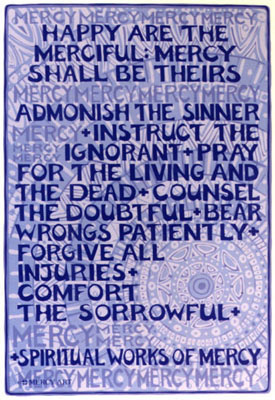
to recommit ourselves to the Spiritual Works of Mercy—
to meeting the deep needs of the soul:
by admonishing the sinner, by instructing the ignorant,
by counseling the doubtful, by comforting the afflicted,
by bearing wrongs patiently, by forgiving offences willingly,
and by praying for the living and the dead.


My friends,
in the way we worship, 
in the way we live each day,
in the way we reach out to needy neighbors,
we ought to be saying before the world, “We have seen the Lord!”
We must be the convincing evidence today
that Jesus is in fact risen from the dead;
that Jesus has entrusted to his Church and her priests the power to forgive sins;
that Jesus remains very much alive and present among us in the Sacrament of his Body and Blood;
that Divine Mercy is flowing freely and desires to fill every soul.

But if we aren’t willing to be those witnesses,
if we aren’t able to give that testimony,
then more than Christ’s tomb will remain empty.

So come—come to 40 Hours!
And then, go—go to announce the good news.
  

Sunday, March 31, 2013

Day 1

Happy Easter!  Happy Sunday!

   Easter Sunday of the Resurrection of the Lord   


An irate subscriber 
called the local newspaper at midday,
demanding to know why he had not received
his Sunday morning paper.
“Norman,” came the reply, “today is Saturday.
The Sunday Times 
will be delivered tomorrow as usual.”
There was a long pause on the other end,
and you could almost hear the wheels 
turning in Norman’s head
before at last he said,
“Well—that just might explain
why no one else showed up 
for Mass this morning…”


On the first day of the week,
Mary of Magdala came to the tomb early in the morning…

Timing is everything, right?
And it’s no different when the eternal
breaks into what is transitory,
when God bursts onto the human scene.
Do not the Scriptures say
that it was “in the fullness of time”—
only when the moment was exactly right—
that God sent his Son to ransom us from sin and death?  (Gal 4:4-15)
Timing matters,
and divine timing matters most of all.

We’re all familiar with the first chapters of Genesis—aren’t we?—
which give us the well-known story of the creation of the world.
Over the course of six days,
God makes the heavens, the earth, and all their array,
and on the seventh day God rests.
We shouldn’t be surprised, then,
that when the Creator takes flesh
to rescue his creation,
the progression of days is anything but accidental.
Set the seven days of creation side-by-side
with the seven days of the Holy Week we’ve just completed,
and the parallels between the two are rather astonishing.
On the first day, when light was created,
Christ enters Jerusalem in triumph—
the Light from Light appearing in his own city.
On a Thursday night, as the sixth day begins,
Jesus partakes of the Passover lamb
on the same day the cattle and wild animals were created.
On that day when man was created—
and, according to an ancient tradition,
on the very same spot where Adam was buried—
the God-man was crucified that all mankind might be saved.
On the day when God rested from all his creative labors,
Jesus lay asleep in death, resting in the tomb.
And then, on Easter morning, early on a Sunday,
on the first day of the week,
the very same day when creation first came into being,
the human race is given a fresh start
as the new creation begins.  (cf. M. Mosebach)

Yes—God’s timing matters.

Unlike some other feasts—such as Christmas—
which float about through the seven days of the week,
Easter is always on a Sunday.
And that’s immensely significant:
Easter is always a Sunday,
because Sunday is always Easter.
Now, that’s not to say every Sunday should be celebrated
with chocolate bunnies, jelly beans, and brightly colored bonnets.
But every Sunday—not just this particular one—
ought to be marked by a festive, holiday atmosphere.
This is the day when Christ broke the chains of death
and rose triumphant over the grave!
This is the day when sin was vanquished
and the gates of Paradise reopened!
This is the day that sets us free—
the day of liberation for which we long!
And because of what happened today,
nothing will ever be the same again.
Which is why, from the days of the Apostles,
those who believe in Jesus have gathered on Sunday—
and not just once a year, but once each week.
Here—in Word and Sacrament—
and now—on this, the day the Lord has made—
we come together to rejoice through, with, and in him
whose resurrection gives new life to the whole world.


God’s timing matters.
And our timing matters, too.
That’s why we need to take back our Sundays.
In many ways, they’ve become just like any of the other six days,
except for squeezing in a trip to church.
We need to re-learn at our core that every Sunday is Easter.
Now, two things are essential to a true sabbath—
to a day of real rest,
to a day kept by people who know they’ve been set free—
and they are praying and playing.
To call Sunday the Lord’s Day
and then omit one or the other is to miss the point.
But “half-sabbaths” have become a specialty of our culture:
either we’ve gone to church but haven’t played,
or we’ve gone to the stadium but haven’t prayed.  (cf. T. Ryan)
Making time both to pray and to play
is fundamental to what Sunday is all about:
the day of our re-creation.

The younger of my two nieces 
just turned three last month,
but she seems to already understand 
this concept fairly well.
All through the somber season of Lent,
about halfway through Sunday Mass
she’d turned to her parents and ask repeatedly,
“Why we no sing, ‘Alleluia’?”
She’s been loudly singing “Alleluia”
(or her own version of the word, at least)
since shortly after she began to talk.
It’s absolutely her favorite part of Mass! 
She noticed—and was troubled by—its absence.
And I know of other little ones 
who’ve done much the same—
in their own way, giving voice to the great joy
which ought always to be the hallmark 
of this sacred day.
Unlike us grown ups,
they still know how to pray and play 
in the same breath.

That’s the sense of Sunday we need to recover,
because timing is everything.

Your newspaper was probably delivered as usual this morning.
May nothing else be usual about this day!
It is Easter, so it must be Sunday.
And it is Sunday, so it must be Easter.
As we, in a few moments, renew the promises of our Baptism,
let us also recommit ourselves
to a genuine keeping of the Lord’s day:
this first day of the week;
this day of play and of prayer;
this day when a tomb once found empty
still fills hearts with wonder and delight.

This is the day the Lord has made;
let us rejoice and be glad!
  

Saturday, March 30, 2013

Tremble

   Holy Saturday   


The earth—our earthly nature—
         should tremble at the suffering of its Redeemer.  
The rocks—the hearts of unbelievers—
         should burst asunder.  
The dead, imprisoned in the tombs of their mortality, 
         should come forth, the massive stones now ripped apart. . . . 
What is to happen to our bodies 
         should now take place in our hearts.  

Saint Leo the Great
  

Friday, March 29, 2013

Catching Up

Photos from a couple of events that I just haven't had time to post yet...

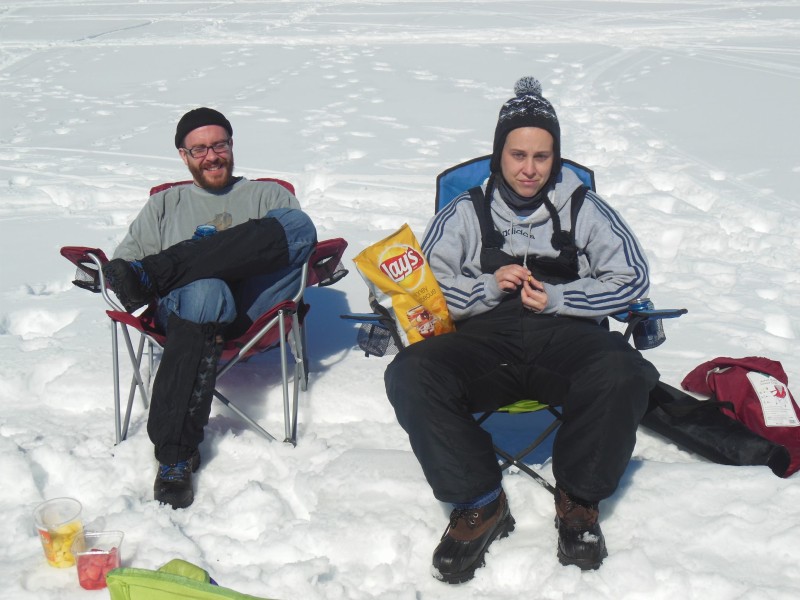
As I mentioned earlier, I went ice fishing with my sister and her family back on March 9.  It was not only a fun day...but I actually caught something!


Those who know me know I've never been much of a fish eater...so I gladly threw him back.

And then on March 17, I led a pilgrimage to St. Patrick's Church in Hogansburg.  This was the "mother church" for our region, established back in 1834.  Times have changed, and the church will close next July.  As you can see, a sizable number of grateful folks from the "daughter churches," along with their pastors, made the trip for the visit (which included a talk on the parish's history) and time of prayer.

Mortal

   Friday of the Passion of the Lord   


Listen to the Lord’s appeal: 
         Do not be afraid.  
This cross inflicts a mortal injury, 
         not on me, but on death.  
These nails no longer pain me, 
         but only deepen your love for me.  
I do not cry out because of these wounds, 
         but through them I draw you into my heart.  
My body was stretched on the cross as a symbol, 
         not of how much I suffered, but of my all-embracing love.  

Saint Peter Chrysologus

Thursday, March 28, 2013

Messing with the Menu

   Evening Mass of the Lord's Supper   

The Seder meal— 
the ritual supper which is at the very heart
of the Jewish celebration of Passover—
was already a fixed tradition more than a thousand
(maybe even twenty five hundred) years old
when Jesus reclined at table
to share his Last Supper with his disciples.
We heard the menu—still careful followed today—
prescribed by God to Moses in the Book of Exodus:
unleavened bread, because the Israelites left Egypt in such haste
there was no time for the dough to rise;
bitter herbs, recalling the harsh and bitter cruelty
of the slavery they had endured;
and roasted lamb, recalling the sacrifice
whose blood was applied to the doorframe of the house,
that the angel of death might pass over God’s chosen ones.

Customs that ancient and that venerable
are not ones you tinker with lightly.
So it should make us sit up and pay attention
when just this year a group of American rabbis
They’ve suggested adding…a tomato.

You see, Passover was never intended
to simply commemorate 
an event from long ago.
It’s about liberation—
about the freedom the Lord desires 
for his people,
both way back then and still even now.
The supper isn’t mean to just recall 
what happened in history;
it’s meant to set people free in each new generation.
And these American rabbis have looked around
and realized that not all slavery was left behind in Egypt.
They’ve looked at the migrant workers—
tomato-pickers, in particular—
whose hidden labor provides us with so much of our food,
and seen a people often underpaid and overworked,
sometimes even beaten.
“The truth is,” one of the rabbis said,
“there are people in our own country
who don’t have to imagine what it is like to be a slave.”

These socially-conscious rabbis, of course,
are not the first to tinker with the Passover supper.
Jesus did the same thing nearly twenty centuries ago.
And it would have surely been quite attention-grabbing to the Apostles
when their Master and Teacher began to deviate from the script
as they shared the Seder in that upper room.

First, Jesus knelt down to wash feet.
It was customary to have a household servant
make the rounds early in the proceedings,
ceremonially washing the hands of all the guests.
It was unheard of, however, that the head of the household
should take such a lowly task upon himself—
and bathing not hands already scrubbed clean,
but dusty, stinky, calloused feet.
Do for one another, he commands, as I have done for you.
When it comes to charity among those
who dare speak and act in his name,
there can be no task too humble.

And after returning to the table, Jesus shakes things up again.
Instead of blessing the God of all creation
for providing us with bread from the earth
and the sweet fruit of the vine,
he says, Take, eat, and drink. 
This is my Body.  This is my Blood.
Flesh and blood were repeatedly mentioned during the Seder meal,
but they were the flesh and blood of the Passover lamb,
not of the supper’s host.
And so Jesus reveals himself to be the Lamb of God,
instituting a Sacrament—the Holy Eucharist—
that he might remain present always
among those who believe in him—
food to sustain us on life’s pilgrimage
as we wait for the Lord to come.

But Jesus didn’t stop there, either.
This Body is to be given up,
and this Blood is to be poured out.
That is the language of sacrifice,
and sacrifice is uniquely the work of a priest.
Now, Jesus did not come from a priestly family—
his lineage from the tribe of Judah, not Levi.
And yet he speaks of making an offering to God—
offering not animals on an altar of stone,
but making a total gift of himself on the wood of the Cross.
Who better, really, to be our High Priest,
the mediator—the bridge—between heaven and earth,
than he who is both true God and true man?
And in his most daring move of all,
that his one, perfect sacrifice might be renewed in every age—
that God might continually touch the lives of his people
and that his people might continually
be able to reach out and touch their God—
Jesus shares his priesthood with those men he has chosen
and called to his side.
Do this in memory of me.


No, Jesus didn’t add any tomatoes to the Passover menu;
tomatoes, in fact, wouldn’t be introduced in the Middle East
for another eighteen hundred years.
But the startling changes he did make
were for much the same purpose:
he had come into this world to set slaves free.
When God created man and woman,
he placed them in Paradise—in a playground, a pleasure garden.
(And is it not walking again in a garden
that we’ll find our Lord at the end of this sacred Triduum?)
We were made, you see, for freedom,
not to ceaselessly toil and till the ground.
But sin and—with it—death
have made the human experience one tainted by suffering.
The Son of God has taken this suffering upon himself
and—like the Sedar ritual—turned it completely on its head.
What once bespoke destruction
has become in him the source of everlasting life.
To ransom us slaves, God gave away his Son.

As a French poet once insightfully put it,
“Christ did not come to do away with suffering;
he did not come to explain it;
he came to fill it with his presence.”  (Paul Claudel)
And so Jesus remains present with us
wherever charity and love prevail.
Jesus remains present with us
wherever we break the Bread of Life.
Jesus remains present with us
wherever his holy priesthood is exercised.
He remains present
because he radically altered and fulfilled the Passover.
He remains present that he might set us free forever
and renew the face of the earth.