Showing posts with label Saints. Show all posts

Saturday, March 25, 2017

All generations shall call me blessed...?

I got a most usual request last Sunday: to pose for an icon.  No, not an icon of me (don't be silly!), but  one of Blessed Marco d'Aviano--a Capuchin priest whose preaching rallied the Christian troops during the Siege of Vienna (1683-1689) and who was beatified in 2003.  You can read more about him here.

We didn't happen to have a Capuchin habit lying around, so we had to make due with an approximation.  But I did have the beard the iconographer was looking for.  She seemed pleased with my "modeling" debut...


Oh, to not only pose as a saint, but to be one...

Blessed Marco, pray for us!
   

Thursday, March 23, 2017

Holy Patron, Thee Saluting

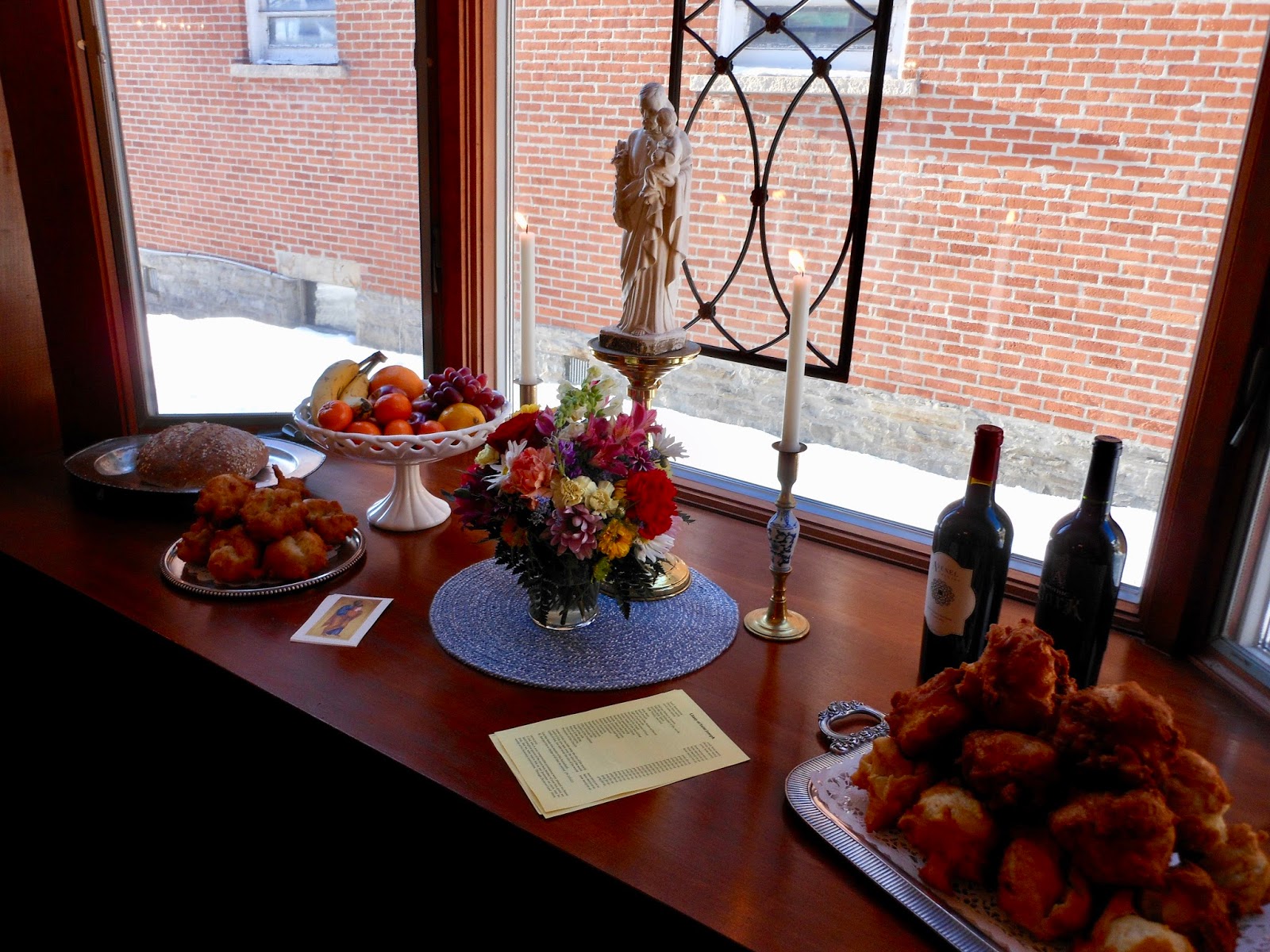
I'm a few days getting this things up on the blog...but...Monday was the feast of my holy patron, St. Joseph.  In honor of his solemnity, I have to things to post: one fun, one funny.

On Sunday evening, we had our new men's group, André's Brothers, over for Vespers and dinner.  It was a most enjoyable evening: good food and good fraternity.  Not to mention I put together my best looking St. Joseph's Table yet:


That was fun.  This is VERY funny:


Sorry the print's so small; you can see it full size here.  (Trust me: it's worth visiting the page!)
   

Sunday, November 1, 2015

What's in a Name

   Solemnity of All Saints    
We’re very happy to have Bishop LaValley
coming to Malone later today
to bless and dedicate Frassati House.
Ever since I started telling folks about this project,
there’s been a little confusion surrounding it’s name.
First, people have had some trouble pronouncing it.
A few have called it “Frascati” House…
…which is a delicious Italian white wine,
but was not the inspiration for this particular endeavor.
And even more have had trouble spelling it…
…including my computer,
which persists in “correcting” the name whenever I type it
by changing it from Frassati House to Frosty House.
Our five missionaries will soon enough
experience a North Country winter,
so there’s no need to rub it in like that!

Much more important than its pronunciation or spelling—
just who is the guy behind this tricky name?


Blessed Pier Giorgio Frassati was born in 1901
in the northern Italian city of Turin
into a family of great wealth and prestige.
His mother was a painter and a lukewarm Catholic;
his father was a newspaper editor and politician
who wasn’t sure he even believed in God.
Despite his parents’ lack of religiosity,
their son was quite pious;
when Pier Giorgio was sent to study at a Catholic school,
he asked for and was given permission
to receive Holy Communion on a daily basis—
something that was quite rare at the time.
In fact, he’d sneak out of the house to attend early morning Mass,
and then crawl back into bed so no one knew he’d been gone.
While at college, he joined and led several student organizations
that worked for social and political reform—
always from a Catholic perspective.
He enjoyed a good practical joke, appreciated the arts,
but loved to be in the mountains best of all,
often organizing trips with his friends
to climb some peaks or ski down a few.
Behind the scenes,
Pier Giorgio was greatly devoted to serving the poor.
He was always emptying his pockets—
even the money his parents gave him to pay his bus fare—
in order to give to the sick and the needy,
to orphans and the unemployed.
His concern for the disadvantaged
was only revealed at his funeral
when, alongside Turin’s elite and powerful,
the city’s poor lined the streets by the thousands
to pay their respects to the young man
who had cared for them so unselfishly.
His family didn’t know he’d been visiting the poor;
the poor didn’t know he came from such a prominent family.
Pier Giorgio died suddenly at the age of 24.
The cause?  Polio…which he probably contracted
from one of the many sick people he’d been helping.
He was declared “blessed” by Pope John Paul II in 1990—
and many of us are praying the Church will soon declare him a saint.

You can see that Blessed Pier Giorgio Frassati is the perfect patron
for our new missionary venture here at St. André’s.
He had an infectious joy that still draws others—
especially other young people—to the Catholic faith.
He’d sometimes make friendly wagers 
with his friends over little things;
while his friends demanded money when they won,
Pier Giorgio, if he won, would make them come to church with him.
He once wrote in a letter,
“I shall always be cheerful on the outside to show my companions…
that you can be a Catholic and still be young and happy….”


Blessed Pier Giorgio Frassati is also the perfect example
at the start of this Vocations Awareness week.
He held marriage in high esteem,
falling in love with a young lady at university,
and dreamed of spending the rest of his life with her…
…but she was from a lower social class
and his mother, sensing his intentions,
told Pier Giorgio he simply could never marry her—
so he never told the young lady of his feelings.
He also had great respect for the clergy.
Pier Giorgio depended on the ministry of priests
for his regular regimen of Holy Communion and confession.
Because of his affable character and active spiritual life,
he was encouraged many times to consider the seminary himself.
But Pier Giorgio recognized the work he could do
for his Church and his poor as a single layman,
living out the promises of his baptism to the full.
The story of his life reminds us that our vocations—
our individual places in God’s plan—
are all interconnected and interdependent,
and that each and every one of us has one.

Finally, Blessed Pier Giorgio Frassati
is the perfect example for us on this All Saints Day.
This solemnity is not merely a showcase for heroes from the past—
a parade of the white-robed multitude before the throne of God;
it is also an invitation—better yet, a challenge or even a demand—
that we be saints, too.
After all, “saint” is just another word
for somebody who’s made it to heaven,
or who is living in this world in such a way
as to assure that he or she is heading there. 
In other words, if you hope to live with God forever,
sainthood is what you’re after!
Pier Giorgio always aimed for the highest goals.
On the back of a photo from his very last mountain climb
where he’s scaling a rocky cliff,
he wrote, “Verso l’alto”—“To the top”—
which is how he lived every day.
But while he urges us toward greatness,
his example also shows us that holiness is in reach.
His sanctity wasn’t found apart from the ordinary stuff of life,
but right in the midst of it.
That’s why Pope John Paul II called Pier Giorgio
“a man of the eight beatitudes.”
Everything he did reflects those first memorable words
of Jesus’ Sermon on the Mount:
the Lord’s counter–cultural rule of life
that turns this world’s values on their head,
teaching us that true blessedness, true happiness,
is rarely found in the places we usually look—
in possessions or power or prestige;
instead, we discover it among the poor and the peacemakers,
the merciful and the meek,
those who hunger for what is right
and persevere in the face of persecution.
That is to say, if you want to be holy,
if you long to see God’s face, if you desire to be a saint,
then go where Jesus goes and do what Jesus does.


Spreading the faith, embracing a vocation, growing in holiness—
these were not the fruit of Pier Giorgio’s own efforts;
they are never something any of us can do on our own,
but are all things God alone can accomplish within us.
We can only be holy because our heavenly Father is holy.
It is the work of the Holy Spirit.
It’s the way grace flowers when we willingly cooperate with it.
It’s a living recognition of what we already are: God’s children now.

My friends, along with the holy men and women
of every time and place,
we are bound together in a great communion of saints—
in a chain of faith, hope, and love
that stretches between heaven and earth.
Let’s be sure to support and encourage one another
all along the way “verso l’alto”—“to the top”

Blessed Pier Giorgio Frassati, pray for us!
   

Thursday, March 19, 2015

Holy Patron


Holy Patron! Thee saluting,
here we meet with hearts sincere;
Blest St. Joseph, all uniting,
Call on thee to hear our prayer.
Happy Saint, in bliss adoring
Jesus, Savior of mankind,
Hear thy children thee imploring,
May we thy protection find.

Wednesday, September 17, 2014

Gladly Bearing

"Who would not be glad to bear a [pack] that does not press hard but caresses?              Who would not be glad for a burden that does not weigh heavy but refreshes?"  
                                                                                              St. Robert Bellarmine (slightly adapted)

Today has me thinking back fondly to one year ago:
to the first steps of a fine, long walk in the woods...


Monday, March 31, 2014

Saintly...& Cute

A brother priest just forwarded me the link to this wonderful video (18 minutes) on the life of Br. André.  It's entirely narrated and acted out by children--and so well done!  Watch it when you've got the time.  You'll love it!


Friday, November 1, 2013

Telling Stories

My NPT partner, Lawrence, put me onto this interesting article/study.  Go figure that in the midst of a 120 mile hike we'd be talking about what makes some people more resilient than others...

   Solemnity of All Saints    

It comes as no surprise to hear someone say that the family—the very building block of society—is in crisis.  So it should also come as no surprise to hear that many studies have been done on this troubling situation.  Most of these studies focus on what it is that’s tearing modern families apart.  But a number of years ago, a few psychologists decided that it would be much more helpful to study strong, successful families to see what was keeping them together.

Their research began by studying the children.  They gave the kids a “do you know?” test, and the focus was on their family stories.  The children were asked questions like: Do you know where your grandparents grew up?  Do you know how your parents met?  Do you know about a serious illness or other family tragedy?  Do you know the story of your birth?

The result?  They found that the more kids know about their family history, the higher their self-esteem and the stronger their sense of control over their lives.  Children are happier and far healthier emotionally when they know their family story.

As the researchers took their study deeper, they realized that there are essentially three different family stories.  The first is the upward climb: “When we came to this country, we had nothing.  But we worked hard, and your grandfather opened this store.  Your father graduated from high school.  Now you’re headed off to college…”  The second is the downward spiral: “Once upon a time, we had it all!  Then there was the fire, and we lost everything…”   But the happiest, healthiest kids heard a third story—one marked by both ups and downs: “Our family has come a long way.  Your grandfather built a strong business and was a pillar of the community.  And your mother served on the hospital board.   But we’ve also had our setbacks.  Your uncle went to jail.  And your father lost his job.  But no matter what has happened, we’ve always stuck together as a family.”  (cf. B. Feiler, NY Times, 3/15/13)

I think we’d find pretty much the same thing if we did a study of the children of God.


Today is a feast of family as we celebrate the Communion of Saints.  We—as St. John reminds us—are God’s children now.  Which means that all the holy ones who’ve gone before us are our elder brothers and sisters.  Today is a feast for retelling their story—for recalling our family history, the history of the Church.  It’s so very important for us to know where we’ve come from!  The saints need to be for us more than a collection of dusty statues.  Our origins have a huge impact on who we are now—living in the world—and who we long to be—living forever in heaven.

How would you do on a “do you know?” test when it comes to our saintly ancestors?  What so you know about the saints after whom our churches were named?  What do you know about the saint after whom you were named?  Believe it or not, the lives of the saints and the history of the Church make for some very fascinating reading!

But it makes a difference how we hear this family story.  There are some who speak of the saints in a constant upward climb; they make them so otherworldly that we could never hope to follow their example.  Then there are others who get caught in a downward spiral; they can see nothing but corruption in the Church’s past and crisis in her present.  But the Catholic family story that is most healthy and helpful—and which just also happens to be most accurate—is one marked by both ups and downs.  (Doesn’t that sound like the Beatitudes, where Jesus can declare the poor and the mourning, the thirsty and the persecuted, to be “blessed”?)  We must never forget: every saint has a past, and every sinner has a future.


If you want to have a stronger family, if you want your children to be able to bounce back better in the face of adversity, then keep retelling the family story—including both the good times and the bad.  What is needed in our homes is just as much needed in our Church.  Learn the Church’s history!  Get to know the saints!  Do so and, as God’s children, we’ll build a much happier, healthier, and holier family.
  

Monday, January 28, 2013

St. Thomas Aquinas


A little bit o' wisdom from our saint-of-the-day:


"Sorrow can be alleviated by good sleep, a bath, and a glass of wine."
St. Thomas Aquinas


Maybe not his most scholarly proverb...
...but I'm willing to give it a try!

Saturday, November 17, 2012

On the List


The following article (by yours truly) appears in today's edition of the Malone Telegram...

*  *  *

Our modern English word, “canonize,” comes from the ancient Greek word, kanon, meaning, “a measuring stick.”  Since the early days of Christianity, a “canon” has been a sort of sacred list—such as the canon of Scripture: the authoritative inventory of books in the Bible by which authentic Christian teaching can be measured.  Likewise, to “canonize” a person is to single him or her out for the official list of saints: the roll call of holy men and women against whom Christians can reliably measure themselves.

I consider myself blessed to have been in Rome just one month ago as the Catholic Church added seven more to its list.


None other than the New York Times (10/14/12) pointed out that this recent canonization brings to 12 the number of Catholic saints we can reasonably claim as American (although most were born elsewhere, and a few died long before the U.S. ever came to be).  And of that even dozen, we can champion seven of them as New Yorkers, including two of those newly added to the list: St. Kateri Tekakwitha and St. Marianne Cope.

Tekakwitha was born in the Iroquois village of Ossernenon (now Auriesville) in 1656.  (This was just a few years after three Jesuit missionaries from France—also on that list of U.S./N.Y. saints—were martyred nearby.)  Smallpox left her orphaned at the age of four, as well as severely scarred and almost blind.  (By many accounts, Tekakwitha translates, “she who bumps into things.”)  Having been adopted by a Mohawk uncle, she encountered Jesuit missionaries as a teenager and eagerly embraced Christianity.  Despite the objections of her uncle, she was baptized in 1676 and took the name Kateri (“Catherine”).  Harassed because of her newfound faith and her persistent desire to live as a virgin united only to Christ, Kateri moved north to a community of “praying Indians” outside of Montréal (now Kahnawake).   There she continued to grow in holiness before her 
                                                                                                               young death from fever in 1680.


Barbara Cope was born in Germany in 1838, but immigrated with her family to these shores as a very young child.  She grew up in Utica and joined the Franciscan Sisters of Syracuse in 1862, taking the name Marianne.  Having already successfully run two Catholic hospitals in central New York, when the call went out for sisters to care for the isolated leprosy patients on Molokai, Hawaii, she went simply to get the new mission started—but then decided to stay.  Remaining for more than 30 years, she proved herself a compassionate mother to both those suffering from leprosy and her fellow sisters.  Mother Marianne died in 1918 among the people she had so lovingly served.


Even in these very brief sketches of their lives, it’s fairly easy to see why these two women have been included in the Church’s canon of saints.  But why did I go all the way to Rome to see firsthand that they’d made the books?

Because these locals give me hope that I, too, might measure up and find myself on the list.

No—I have no pretensions of ever being formally canonized by the Pope in a solemn Vatican ceremony.  We New Yorkers, after all, are not generally celebrated for our outstanding holiness.  Yet with seven already in the official register, and knowing that these are but a select few out of the vast catalogue of those enjoying eternity in God’s presence, there is considerable hope that we—whether city slicker or country bumpkin, native-born or transplant, saintly now or still considering our options—might even eventually make the cut.

While saintliness may be officially recognized of those who’ve already made it to heaven, it’s a reality that’s first worked out right here on earth in responding to God’s call and cooperating with his grace.  For St. Kateri, that meant sticking with her faith when others were less than supportive—even outright hostile.  For St. Marianne, that meant going where she was most needed and standing up for those whom society would sooner abandon.  These two women may have lived in other times, when New York was a far different place, but the lessons we can draw from their lives are very much lessons for today.  That’s why they’re saints!  Whenever and wherever, their lives provide us with a dependable yardstick by which to measure our own.

May the example of these holy New Yorkers and their prayers from above inspire us each day to live as those the Lord can list as his own.

Saturday, October 6, 2012

St. Bruno

My little makeshift shrine here in the rectory on this gloomy fall feast day...


"In the solitude and silence of wilderness..., for their labors in the contest, God gives his athletes the reward they desire: a peace that the world does not know and joy in the Holy Spirit."
--St. Bruno (1030-1101)
   

Thursday, October 4, 2012

Hello, Kitty!

On this feast of the great St. Francis of Assisi, patron of animals and those who love and care for them, we received this cute little bundle of joy on our doorstep...

We thought for sure we knew the identity of our generous benefactor, but--alas--we were wrong and he or she remains a mystery.

I have a funny feeling you're going to see a whole lot more of FideliCat in the days ahead.
 

Thursday, July 26, 2012

St. Ann

As I mentioned last year, St. Ann has a pretty special place in my heart...so this afternoon, Fr. Tom and I make a quick pilgrimage to her shrine in Isle LaMotte, Vermont.  It wasn't the prettiest day to enjoy the view there on the eastern shore of Lake Champlain (the overcast skies were bringing us just a little bit of much needed rain), but it was well worth the drive, nonetheless...


Good Saint Ann,
pray for us!

Tuesday, May 1, 2012

St. Joseph the Worker


To constantly work with the Lord right at his side: that's Joseph's privilege...and ours as well.
   

Monday, March 19, 2012

St. Joseph


Today, of course, is the solemnity of my holy and glorious patron...who also just happens to be the Guardian of the Virgin Mary, Foster-Father of the Son of God, and Protector of the Church.

How could I not celebrate?

In a brief break from the rigors of Lent, last night found me preparing a fitting feast for a few folks, complete with a little altar to Good Saint Joseph.

We ate pretty well--the menu reflecting some of my Italian biases--and were not stingy with the portions, either.  (It's pretty safe to assume Joseph was a good provider.)

Now, the rest of the meal was really just a vehicle for dessert: the bignè di San Giuseppe (essentially deep fried cream puffs).  Very dear to my heart (even if very bad for it), they're a culinary souvenir of my Roman sojourn, and it's probably a good idea they're made but once a year!


True confession: I got so excited about cooking and eating them that I forgot to take any pictures...until I was about to down the very last bite!

I'm heading out momentarily to honor St. Joseph yet again, as is only right and just.  This evening I've been invited to be guest celebrant and preacher at a Mass (followed by a meal) in nearby Bombay, NY...at St. Joseph's Church...where else?!?
 

Tuesday, January 31, 2012

St. John Bosco


"How much God has done through us!" the ever humble St. John Bosco (1815-1888) used to say.  "But how much more he would have done if my faith had been stronger."


Setting a high bar for himself (and the rest of us), this tireless priest and friend of youth was also of the opinion: "Let us work now; in heaven, we shall have rest.  How can I be idle while the devil is working?  I did not become a priest in order to take care of my health. Anyone who dies from overwork will attract hundreds to fill his place."

Tuesday, January 24, 2012

St. Francis de Sales


Ever both practical and wise, 
the gentle bishop St. Francis de Sales (1567-1622)
once advised: 
"Each Christian needs 
half an hour of prayer each day, 
except when we are busy; 
then we need an hour."

Tuesday, January 17, 2012

St. Anthony of Egypt

The St. Anthony commemorated today isn't the one who helps us find our lost things.  That St. Anthony (of Padua) is most generally depicted holding a lily in one hand and the Child Jesus in the other; this St. Anthony...well...depictions of him tend to be a bit more colorful.  We generally either see him being "tempted" (attacked?) by a motley crew of rather fantastical demons...


...or with...a pig.


Yup: he's usually got a little piggy peeking out from under his robes or hot on his heels.  Whence his constant porcine companion?  Well, that's a little complicated...

Around the age of 20, Anthony (251-356) sold his property and gave away his inheritance, opting for the life of a hermit in the desert wilderness.  In this solitude he wrestled with the devil (hence the first picture), attracted numerous admirers and disciples (earning him the title "Father of Monks"), and gained a reputation for healing the sick...which leads us to porky.


It seems that Anthony--even from heaven--proved particularly adept at healing those with skin diseases.  And, once upon a time, certain skin diseases were treated with--are you ready?--applications of pork fat to reduce itching and inflammation.  (Maybe Lady Gag was onto something with that--yuck!--infamous meat dress.)


Anyway...this connection between cures and cured meat began to be depicted in art by means of a little porker snuggled up close to good St. Anthony.  Of course, they could have just shown him with a box of this very creative addition to your medicine cabinet...

Who knew?  Bacon has its very own patron saint.  And being a poor, (likely vegetarian) desert hermit, he probably never even touched the stuff.


Thursday, December 1, 2011

Blessed Charles de Foucauld

"As soon as I believed there was a God, I understood that I could not do anything other than live for him."  So wrote Charles de Foucauld.  Born a French aristocrat, he passed early adulthood as a fun-loving playboy and military officer.  But by way of a brief stint as a Trappist monk and then as a carpenter in Nazareth, he ended up a priest leading a solitary life among the Tuareg people in the Sahara desert of Algeria.  It was there that he was shot by Bedouin marauders on this date in 1916.  Despite his "hidden" life (not unlike the early years of another carpenter from Nazareth), his profound writings and humble example have had a wide influence.  His "prayer of abandonment" (composed in Nazareth in 1897) captures well the heart of his spirituality:


Father,
I abandon myself into your hands;
do with me what you will.
Whatever you may do, I thank you:
I am ready for all, I accept all.
Let only you will be done in me,
and in all your creatures.
I wish no more than this, O Lord.
Into your hands I commend my soul:
I offer it to you
with all the love of my heart,
for I love you, Lord,
and so need to give myself,
to surrender myself into your hands,
without reserve,
and with boundless confidence,
for you are my Father.

Friday, November 11, 2011

St. Martin (the Unflappable)

In the seminary, candidates for the priesthood undergo constant evaluation.  One of the rather positive things that kept coming up during my evaluations over the years was that I always seemed so calm--as I recall, "unflappable" was the precise adjective used by the rector on one occasion.  Praise God, despite crazy circumstances, I have--in general--experienced a whole lot of peace in my life.  So I was quite amused when I saw this on the funnies page during breakfast this morning:


(Prudently, Fr. Stitt advised that if I posted this strip without further comment it might be taken by some as a covert cry for help!  But there are days...)

And then, when I sat down with my breviary to pray, I came across the passage below in the Office of Readings (long an annual favorite) for today's memorial of St. Martin of Tours (316-397), the Hungarian-born soldier turned French monk and then bishop who was one of the very first (outside of Biblical figures and the early martyrs) to be widely recognized as a Christian saint:
Martin knew long in advance the time of his death and he told his brethren that it was near.…In their sorrow they cried to him with one voice: “Father, why are you deserting us? Who will care for us when you are gone?”…Turning to our Lord, he made this reply to their pleading: “Lord, if your people need me, I am ready for the task; your will be done.”

Here was a man words cannot describe. Death could not defeat him, nor toil dismay him. He was quite without a preference of his own; he neither feared to die nor refused to live. With eyes and hands always raised to heaven he never withdrew his unconquered spirit from prayer. 
--Sulpicius Severus, from a letter on the death of Saint Martin of Tours

An interesting juxtaposition, no?  (And not just because it's Peanuts next to the Divine Office!)  

There's something to be said for serenity in the face of life's many challenges--when it's one that penetrates beneath the surface, of course.  Oh, to have such an "unconquered spirit"!  To live with such detachment, and willingness to serve!


St. Martin, the "Unflappable," pray for us!

Saturday, October 22, 2011

5/12 + JP2 = Zzz

Have you ever wondered what a priest does all day?  Ask my father, and he'll tell you we only work on weekends...so he'd surely be pleased to see my Saturday line up:

6:30am     Get up, shower, do laundry, eat breakfast, pray
10:00am   Funeral Mass [St. Joseph's Church]
11:45am     Anointing in the ICU (emergency pager went off as I was leaving the cemetery)
12:05pm    Confessions start 5 minutes late [Notre Dame Church]
1:00pm      Wedding Ceremony [Notre Dame Church]
2:00pm     Lunch
3:00pm     Confessions [St. Joseph's Church]
4:00pm     Grocery shop
5:00pm     Baptism [St. Joseph's Church]
6:00pm     Supper (cook first, then eat)

Whew!  The sacramentally astute will note that that's five sacraments in the twelve hours or so listed there.  Grace was just a-flowin' around here!

Today--besides being busy--is the very first feast of Blessed John Paul II.  (October 22 was chosen since it was the day of his installation as Pope back in 1978.)  In the midst of my crazy schedule, I nearly forgot about today's commemoration...till I was standing at the altar and realized I was offering Mass with a chalice first used by him during the Jubilee Year 2000.  Then, since the second round of confessions were moving a little slow, I fished my rosary out of my pocket...only to realize that our late Holy Father had blessed those beads in 1992.  (The rosary was a gift from the bishop very shortly after I entered the seminary.)  And then, after I was into that rosary a bit, I realized that the Luminous Mysteries upon which I was meditating had been promoted by none other than--yup, you guessed it--JP2.  So when it came time to make supper and enjoy it, I knew it was time to pull out this candle which a parishioner kindly brought back for me from his beatification back in May.

Viva il Papa!  But now I want to go to bed...