Sunday, May 27, 2018

All in the Family

   The Solemnity of the Most Holy Trinity   B 

I was recently teaching a make-up class for one of our Confirmation candidates, to which she came with her grandmother.  The subject was the Creed.  Now, you can’t spend too much time with the Creed without having to confront our faith in the Holy Trinity.  “OK, we believe in one God…but we also believe in God the Father, and God the Son, and God the Holy Spirit.  So which is it?”

I had barely started in on the subject when the grandmother’s eyes glazed right over. “No need to try and explain the Trinity, Father.  I’m just as happy to accept it as a mystery!”

For nearly 2,000 years, the brightest Christian minds have been wrestling with this mystery—one too great, too extraordinary, for our mortal minds to fully grasp. Because it is such a central tenet of the faith, it’s important to get it right, which is why specific theological language has developed over time.  We find some of it in the familiar words of the Creed: we believe in the Son who is “begotten, not made, consubstantialwith the Father” and in the Holy Spirit “who proceedsfrom the Father and the Son.”  This makes it that much easier to fall into the trap of thinking of the Most Blessed Trinity as a complex concept, an academic abstraction, an intellectual puzzle…and something most of us, therefore, are just as happy to leave to the trained experts, thank you very much.

And yet, at the very same time, there can’t be anything more ordinary for us Catholics.   When you entered this church today, chances are you dipped your hand into the Holy Water and crossed yourself,  “In the name of the Father, and of the Son, and of the Holy Spirit.”  We did it again when Mass began.  We do it when saying grace before a meal or the beginning of any formal time of prayer.  It would be hard to think of anything more commonplace among the faithful.


Let’s consider for a moment the gods of the world’s other religions—both ancient and modern. I see them basically falling into two groups.  The first is made up of those gods that seem all-too-human.  Think of the gods of Greek and Roman mythology that you once studied in history class.  They have their love affairs, get insanely jealous, and quite a few seem to have some serious anger issues (which is a rather big deal when you’ve got unlimited access to thunder and lightening).  These gods are simply more powerful versions of ourselves; we’ve created them in our own image.

The second group is of gods who seem impersonal, distant, almost completely cut off from this world. I think of the gods of many religions of the Far East.  Remember the Force from the Star Wars movies?  These gods are like that: an all-pervading energy, a unifying principle, a harmonizing ideal.  You can’t really relate to such gods…which makes it much less likely for them to require much from us.

But then there’s the God of the Bible, the God of Jesus Christ, the Most Holy Trinity. Here’s the God who created us in his own image and likeness (not the other way around).  Here’s the God who is all-powerful, all-knowing, the very logic behind the whole universe, but who also desires to be intimately involved in our lives.

Let me use the example I used with my Confirmation class.  For a husband to be a husband, he needs a wife—and vice versa. What holds husband and wife together is love—love for each other pledged for life in marriage.  Love makes these two into one…and, in most cases, one then becomes three when a child is born.  Husband and wife thus become father and mother.  Now, you can’t be a father without a mother and a child. And you can’t be a mother without a father and a child.  And you can’t be a child without a father and a mother.  (Did I leave anyone out?)  


What you have are three distinct persons, defined by their interdependent relationships, and bound together as one family by love.  That’s nothing overly intellectual; actually, it’s something any of us ought to be able to understand from direct human experience, since nobody in this room came into being in any other way.

While it’s only an analogy, and by no means exactly the same thing, the basic structure of a human family can go a long way toward helping us understand the God who is love. Love, of course, requires both a lover and a beloved; it cannot exist in total isolation.  We begin with the Father, who in order to be a Father needs a Son.  Likewise, the Son, in order to be a Son, needs a Father.  And because the love of Father and Son is perfect, creative, and eternal, their love for each other is a third Person: the Holy Spirit.  

The God we believe in is so personal that he is three divine Persons, defined by their relationship with one another, yet only one God, in the unity of absolute love.  And since this triune God made us in his image, it should come as no surprise that we find hints and traces of God’s mysterious inner life reflected in our own human nature.  

The God of our Creed, the God we believe in, is not some nameless, faceless life-force simply running the machinery of the cosmos; he is the very personal God who not only created us, but then did whatever it would take to be part of the nitty-gritty of our lives.

And so we find Moses asking the Israelites, “Has anything so great every happened before?”  God had chosen this people as his very own—and proved it repeatedly with signs and wonders—not because they were extra special or any better than anybody else, but in order to give them a mission: to draw all the nations to God.  We can answer Moses’ question by saying, “No, the likes of this had never been seen before!”  Not until then, anyway.  But God would go on to top himself.  

Out from that same chosen people, God raised up a Savior, coming himself to dwell with us in our human flesh.  And in our flesh, God demonstrated the depths of his love, dying on the Cross.  Jesus himself had said, “No man has greater love than to lay down his life for his friends.”  No manhas greater love, but God’s love goes even farther: loving not only his friends, but also his enemies; loving us in our sin in order to save us from it.


By our Baptism in the name of the Holy Trinity, as Jesus commanded, our sins were washed away in the Blood of his Cross, and we were united with him in the one Body of Christ.  We were adopted, becoming heirs of the kingdom, heirs of heaven, children of God in his Only Begotten Son.  We were filled with the Spirit who allows us to call God ourAbba, our Father, just as really and truly as Jesus does.  And all of this makes it possible for us to go forth and do as Jesus did.  He has entrusted his mission to us, his Church: to gather all the nations; to bring all peoples to know and love the God who loves them.

When you make the Sign of the Cross over yourself, what’s at the center?  You are!  God has pulled you into himself—into the relationship of the Father and the Son and the Holy Spirit.

Is the Most Blessed Trinity a mystery?  Yes, of course!  But it’s not a mystery in the sense that trigonometry and organic chemistry are mysteries: subjects only the brightest minds can understand. No, the Holy Trinity is a mystery in the sense that love is a mystery: something you can’t figure out because it isn’t meant to be figured out; a mystery that doesn’t scare you away, but that draws you farther and farther into itself.

The next you make the Sign of the Cross, don’t do it so quickly or sloppily that you look like any other Adirondacker swatting at the mosquitoes and black flies. Instead, do it deliberately and with devotion, as someone who believes in one God in three Persons—the God who is life and love—who embraces you with his love now, and longs to share his life with you forever.

* * *
After Holy Communion:
Eternal Father, by the power of your Holy Spirit, in the Sacrament of his Body and Blood, your Son has come into our midst yet again—fulfilling his promise to remain with us always. May the loving, living presence of Jesus within us in Holy Communion draw us evermore deeply into you.
  

Sunday, May 20, 2018

Ain't No Shame

   Pentecost   B 


Some years ago, McDonald’s Corporation commissioned a study to understand why customers chose to order food through the drive-thru rather than go inside the restaurant. Most of us would guess it’s a matter of convenience.  But the main reason the researchers discovered was actually shame.  It seems that a lot of folks who use the drive-thru are ordering food between meals, so they’re afraid of who might see them getting that chocolate shake and large fry as a snack at three o’clock in the afternoon.


Wanting to keep their customers happy (and keep their money coming in), McDonald’s changed the drive-thru experience: ordering your meal by number through a speaker, then paying quickly at one window before picking up your order the next—minimizing the human contact you’ll have and so helping you to feel more anonymous.  Of course, that’s now the standard for any fast-food establishment.

In our gospel reading this Sunday, we find the Apostles on that first Easter night hoping to remain anonymous.  They’re locked together in the upper room.  They’re there because of fear: fear that what happened to Jesus just two days before, leaving him dead and buried, would also happen to them.  And they’re also there because of shame: shame that in their Master’s hour of trial and suffering, one of their own had betrayed him, another had denied him, and all but one had fled.

In our first reading, from the Acts of the Apostles, we find the same group gathered in one place 50 days later—presumably huddled together in the very same upper room.  But then the Holy Spirit descends upon them…and everything changes.  Now they’re out in the streets, speaking to strangers from foreign lands about Jesus Christ.  And we know they’re in the midst of a huge crowd, because later in the chapter we’re told that 3,000 people asked to be baptized that very day.


It’s too bad our passage doesn’t continue for just a couple of more verses, because we'd hear some in that crowd saying, “It’s only nine o’clock in the morning…but I think these guys are drunk!”  Which prompts Peter to declare, “No, our heads aren't swimming in new wine!  But our hearts are on fire with the Spirit of God, and we just can’t keep it to ourselves.”

What a difference the Holy Spirit makes!  All their fear and shame are gone.

Isn’t there just one Holy Spirit?  And isn’t the Holy Spirit that you and I received in Baptism and Confirmation the very same Holy Spirit that was given to the Apostles on Pentecost?  Then…where’s the striking change?  Where’s the dramatic difference?  Where’s the fire?

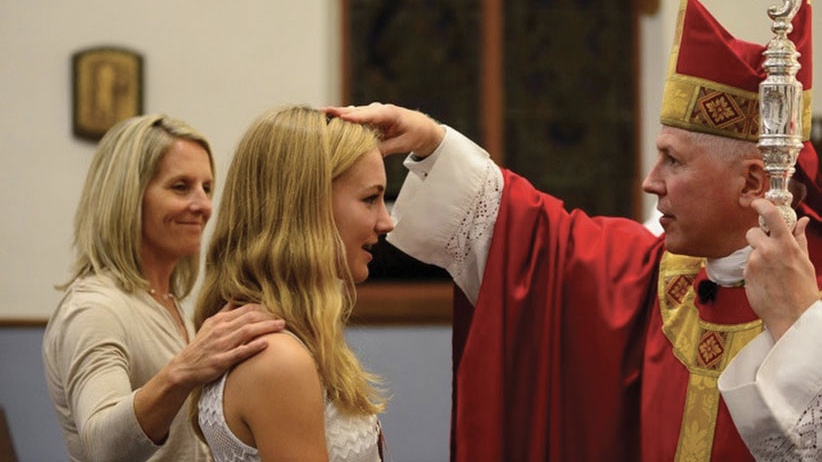
Let’s consider what happens in the Sacrament of Confirmation.  Confirmation is ordinarily conferred by a Bishop. And who’s a Bishop?  A successor to the Apostles—at our end of an unbroken chain that reaches back to that bunch gathered in the upper room. It’s takes an apostle to make an apostle—and that’s just what Confirmation aims to do.  

We’re given the gift of the Holy Spirit at our Baptism, when he serves as the glue that binds us together to Christ and his Body, the Church.  But the same Spirit who gathers us in as followers—as disciples—in Baptism, then sends us out as witnesses—as apostles—in Confirmation. The Spirit sends us out, not to leave the Church and never return (although that seems to happen far too often), but to go out so we can bring others in.  The Spirit is the wind in our sails, giving us power and direction as we go forth.

What does the Bishop do to confirm us?  He anoints us with holy oil—with the Sacred Chrism.  “Chrism” is only one letter different from “Christ,” and that’s no accident, for “Christ” literally means “the anointed one.” The Holy Spirit works through the sign of this holy oil to make you another Christ.  In Confirmation, we don’t confirm our own faith as a Catholic; rather, it’s God who confirms us as one of his own—sealing and perfecting what he began in Baptism.  Confirmation puts an invisible but permanent mark on your soul so that you will be able to leave a visible mark on the world.  


You are anointed on the forehead because this belonging to God, this likeness to Christ, this presence of the Holy Spirit within you, ought to be seen all over your face. Likewise, the Sacred Chrism is perfumed, usually with balsam (giving it a nice woodsy, Adirondack aroma). You know how, when someone wears too much perfume or cologne, you can always tell right where they’ve been? Well, we Christians ought to be so holy that you can smell it!  We ought to leave an unmistakable trail of sanctity everywhere we go.

After the Bishop anoints you on the forehead with Sacred Chrism, he says, “Peace be with you”—the very greeting the Risen Jesus spoke to his Apostles that first Easter. Nowadays, he usually does so with a modest, reserved handshake.  But back in the day, he’d slap the newly confirmed on the cheek (how hard it was done seems to have depended on the particular Bishop).  Why the slap when giving you a greeting of peace? To toughen you up. Christians need to be ready at all times to suffer for the Faith.  

We don't often speak this way any more, but the truth remains: Confirmation makes you a soldier of Christ.  That doesn’t mean we’re looking for a fight, becoming part of gang that’s ready to rumble.  No, the battle is already on.  It’s going on within us, as St. Paul points out to the Galatians: the flesh wars against the Spirit; we’re caught in the struggle between the things that drag us down to earth and those trying to lift us up to heaven.  And you don’t need me to give you examples of the battle that raging all around us and—sadly—sometimes even among us.

The very same gift given to the Apostles on that first Pentecost has already been given to you.  The Holy Spirit dwells within you!  But where’s that energy?  Where’s the spark?  Where’s the fire?  Unfortunately, far too many of us treat our Catholic life as if it were a drive-thru window: we pull up, get what we’re after, hoping to drive off as quickly as possible and without needing to deal with too many people in the process. And so, whether it’s because of fear, or shame, or doubt, or a lazy desire for convenience, we remain locked together in the upper room.

To make a glass of chocolate milk is simple enough, right?  You take a glass of milk and squeeze the chocolate syrup into it.  But you can’t stop there, or the chocolate just sits on the bottom and the milk remains unchanged.  It still needs to be stirred.  And so it is with the gift of the Spirit.  His presence is powerful, but it isn’t magic.  Get all stirred up—and don’t wait another day to do it.


We have our marching orders.  God has given us a mission and equipped us with everything we need to accomplish it.  Now it’s up to us to move—and no one else can do it for you.

The Lord has sent out his Spirit—has poured his Holy Spirit into our hearts.  It’s time to get up and go—to go out and renew the face of the earth.
    

Sunday, May 13, 2018

Looking Up


After one of the Masses, a parishioner came to me and said, "I never knew, Father, that you could bring coffee to church!"

Happy Mother's Day to all the moms out there.  Thank you for all the times you looked down into our eyes with love, so that we would learn how to look up to God.

  Seventh Sunday of Easter   B 
Twenty-five years ago, a mother wrote a book about raising a young daughter who’d been diagnosed with autism.  Early signs that something was out of the ordinary were when her parents realized that their daughter never imitated them, as little children do, or called out to them for help.  She had a hard time focusing.  She didn’t pick up clues from body language.  She preferred to be alone.  In fact, the mother tells of how her child never really seemed to look at her; instead, she seemed to look right through her.

In particular, this mother outlined the lengths to which she and her husband went to help their little girl recover.  What she describes is an intensive course of behavioral therapy—some of it involving therapists, but much of it dependant on mom and dad.  The cornerstone of this approach was nothing other than eye contact.  We don’t usually stop to consider the critical role something as simple as eye contact plays in the brain development, emotional stability, and social awareness of children.  Every deliberate drill, every casual interaction, began exactly the same way: “Look at me!”


This treatment plan—still in use today—doesn’t waste time trying to diagnose the causes of a child’s autism; instead, it works to correct whatever went wrong.  The constant repetition of, “Look at me!” and the associated techniques to help the child do exactly that, are a means for replicating a crucial experience in a child’s early development: the experience of his or her mother, while nursing, looking into her baby’s eyes—immature eyes that can only focus back on hers, because anything closer or farther away is just a blur.

After a little over a year of this behavioral therapy, the couple’s daughter acted no different than her peers.   They took her to her doctor for a reevaluation.  The doctor knew she’d made a full recovery as soon as this little girl walked into his office; he could see it in her eyes.

“Look at me!”

I suspect I’m not the only one who wants to repeat those same words to many people—adults and children alike.  I’ve been out to dinner and seen families seated around the table, or walked past mothers pushing strollers down the sidewalk, or waited in line with others at the grocery store—and everyone’s bent over their own little glowing screen. These devices claim to revolutionize communication, but quite often they pull people away from those who are right there in front of them.  This technology is having real effects—much of it frighteningly similar to autism.  It’s shortening our attention spans, impairing our ability to focus, and ruining our social skills.  It’s altering our patterns of thought, and studies are now revealing how it negatively affects a child's brain development.  


We’re becoming people who no longer know how to make eye contact.

There’s a spiritual impact to this, too: as we forget how to look into one another’s eyes, we can’t help but forget how to gaze upon God.

This Sunday’s gospel reading comes from St. John’s account of the Last Supper.  After Jesus has washed the feet of his Apostles and taught them at length—as we’ve heard the last two Sundays—we now come to what is known as his “priestly prayer.”  It’s the prayer of Jesus before he willingly dies on the altar of the Cross; it's the prayer of our great High Priest before he offers his perfect and living sacrifice.

Notice how the passage begins: “Lifting up his eyes to heaven, Jesus prayed…”

Jesus looks up to his Father when he speaks to him.  As a man like us, he’s more than his mind, and so his prayer involves both body and soul, the physical and the spiritual—his whole person.  Jesus is praying to his Father for us: praying that he will guard and keep us; praying that we will be consecrated as he was consecrated—set apart for God and holy.  But as we listen to the tender, intimate way in which Jesus speaks to the Father, it becomes perfectly clear: this is not the first time Father and Son have made eye contact.

What a lesson this holds for you and me!  In Jesus Christ, God is pleading with the human race: “Look at me!”

Our ancestors in the faith understood this well.  They enshrined this posture of Jesus at the Last Supper in the texts and rubrics of the Roman Canon—the most ancient of our Eucharistic Prayers—as it directs the priest himself to look upward as he recounts the way Jesus prayed “with eyes raised to heaven, to you O God, his almighty Father.”  And we see it in the way they built their churches, too: facing east, oriented toward the rising sun.  From the earliest days of Christianity until fairly recently, priest and people at prayer all looked in the same direction, awaiting the dawn of that great day when we will behold the face of God—when we will finally be able to look the Lord in the eye.

“Look at me!”

This Sunday, we’re going to tap into that great wisdom.  I will offer this Mass standing on the opposite side of the altar from what we’ve become used to.  Let me be clear: this is not—and never has been—about the priest turning his back on the people; it’s about all of us looking together at God.

Now, you and I both know that God isn’t literally up there in space just beyond the sun and moon, or hanging out somewhere along the east coast.  Looking up and facing east are both ways of indicating that God is far beyond the confines of this world he has created, surpassing the distant horizon and the highest heavens.

I recently offered daily Mass this way.  A parishioner who’d never encountered it before made sure to tell me that the Mass had been “special” for her: “It made me focus just a bit more than usual.”  I know it certainly does that for me.  Rather than concentrating on how best to “perform” the rituals, I can instead more easily pray the Mass—especially when I’m not distracted by folks in the pews reading the bulletin, sipping on coffee, clipping their finger nails, or texting on their cell phones.  

When I’d done this in another parish several years ago, someone there said, “Father, you feel so much closer to us when you stand on our side of the altar.”  She recognized that this really does help to restore proper eye contact.  Mass is not something that the priest does for the people, as it would appear when you and I spend the entire time looking at each other.  No, Mass is something that priest and people do together for the Lord.  It’s simply a matter of good manners, just like we teach our kids: Look at someone when you speak to them.


Rest assured: this is not a permanent change (I haven’t moved any furniture); I’m not attempting to turn back the clock or saying there’s anything wrong with the way we’ve been doing things the last 50-60 years (that’s the Mass I grew up with); and I’m not breaking any rules—this has been a legitimate option all along—so don’t call Bishop LaValley or write to Pope Francis (who, by the way, offers Mass this way himself every once in a while).  This is just a physical means—behavioral therapy, you might say—meant to assist us in recovering a spiritual skill we rapidly seem to be losing: how to gaze upon God.

Most of us (thank you moms!) had the vital developmental experience during our very first days outside the womb of looking into our mother’s loving eyes.  May the ancient wisdom of our Holy Mother, the Church, help us to fully recover our spiritual sight: raising our eyes to heaven with Jesus, together gazing into the eyes of our eternal Father, only to realize that God was already gazing upon us, his children—looking at us with the greatest love.


This homily depends heavily on the article, “Look at Me,” by Patricia Snow, in the May 2016 issue of First Things.
   

Sunday, May 6, 2018

Why Can't We Be Friends?

   Sixth Sunday of Easter   B 

About five years ago, we started noticing a “peeping tom” hanging around the rectory.  He was a resident of Vale Haven next door who began repeatedly standing outside our kitchen window: smoking his cigarette, drinking his coffee, and looking in.  He seemed harmless enough, so we didn’t worry about it too much.  And then one day, when this had been going on for awhile, as I stood at the kitchen sink looking out, I decided to wave.  The man waved back, and then scurried away. I thought, “There.  That’s the end of it.  He knows he’s been caught.”


But he came back. And he kept coming back. Because now, he wouldn’t leave until somebody waved at him.  In time, we got to know his name; I’ll call him, “Ralph.”  And we realized that Ralph wasn’t some sort of creep. Ralph was just lonely and looking for some human contact.

We knew that Ralph was innocent, but his presence did make life interesting at times.  Like whenever we had overnight guests staying on the first floor: “So don't be alarmed when you see a man standing outside your bedroom window…”  Or like the day one of us walked in and found him in church…sitting with his coffee in the presider’s chair.  Or like the night someone saw him out front and called the cops: “No, don’t worry, officer.  We know Ralph.  He peeks in our windows all the time!”

Understandably, we’re all rather uncomfortable with idea of someone watching us in our private moments.  But if you think about it, modern society thrives on this very thing.  It used to be that we’d pry into the lives of the rich and famous, curious about what celebrities do behind the scenes.  But now, with things like Facebook, Instagram, and Twitter, where people are constantly posting personal photos, videos, and messages, you can spy on anyone—family, friend, or stranger—from anywhere at any time.

But all this virtual people-watching comes with a danger—and not just to our privacy.  It gives us a false sense of intimacy.  We can exchange quick messages and get a steady stream of visual updates from long-lost cousins or old college roommates…but without making any truly human contact.  We call lots and lots of people “friends”…but without doing the hard, messy work of friendship.  We know very personal details about their lives…but without actually getting involved in them.  We can watch from a safe distance and never have to take the risks required of entering into a relationship.

Our gospel today picks up right where we left off last Sunday, as Jesus told us, “I am the vine, you are the branches.”  Jesus speaks these words on the night before he dies—at the Last Supper. They’re a pretty clear indication of the lasting bond—the deep communion—that he hopes to establish with those who come to eat and drink at his table.  And it is at this same meal that Jesus gets down on his knees and washes his Apostles' feet.  Based on many Holy Thursdays, I can tell you first hand: that’s a pretty up close and personal experience!  But now, just in case we didn’t understand him, Jesus comes right out and says: “You are my friends.”

Let that sink in for a moment: God himself, the Creator of heaven and earth, Almighty Ruler of the entire universe, has chosen you to be his friend.

You see, the Lord was not willing to be a celestial “peeping tom,” as if watching humanity through a window or on a little glowing screen.  He wouldn’t stay off at a safe distance.  That’s because the God we believe in—one God in three Persons: the Most Blessed Trinity—is defined within himself by relationship: the Father eternally loves the Son, and the Son eternally loves the Father, and the Holy Spirit is their eternal love for each other. Love isn’t just something that God does; God is love.

And God made us in his very own image and likeness.   When he was creating the world and everything in it, he looked upon the sun and the moon, the water and the land, the plants and the animals and man, and saw that it was all good.  There’s only one thing that God said wasn’t good: “It isn’t good for man to be alone” (Gen 2:18).  We were made for relationship; we were made for love.

In the fullness of time, God came to dwell among us—came in our own flesh and blood.  It’s hard to get much more intimate than that! And in the life, death, and resurrection of Jesus, God opened up his heart to us.  God made himself incredibly vulnerable—literally loving us to death.  God did that so that we might know and love him—up close and personal.  But even more, it was so that God could know and love us—from the inside out.

In Jesus Christ, God has extended to you the ultimate friend request, “It was not you who chose me, but I who chose you.”  God has chosen you, knowing everything about you—good and bad.

The question is, are you willing to take the risk of truly entering into this relationship?  Are you ready to say yes to being friends with God?


There are a few things you ought to know about this friendship before diving in.

First, you need to know that Jesus is not a friend like the others.  He tells us that he won’t be the sort of friend (unworthy of the name) who’s only looking out for what’s best for himself.  Such a person isn’t looking for a friend; he’s looking for a servant, a slave.  A true friend, we know, only wants what’s best for you.  It’s a great comfort when you have friends like that who’ve got your back.  But Jesus doesn’t only want what’s best for you; he knows what’s best for you.  That’s why he can say, “You are my friends if you do what I command you.”  Just imagine someone else saying, “We can only be friends if you let me tell you what to do!”  No, Jesus isn’t being pushy…but his friendship is demanding: it demands complete trust—trust that he always wants and knows what is best for us.

And you need to know that this friendship can never just be about “me and Jesus.”  “This I command you: love one another.”  Loving our fellow Christians is not an optional part of the deal.  Jesus doesn’t say, “I suggest that you all try to get along”; he says, “This is my commandment: love one another as I love you.”  In our “peeping tom” culture, we often settle for an easier substitute for love called “tolerance.”  It’s the supreme virtue of the modern age.  Tolerance isn't without merit, mind you, but it doesn’t go nearly far enough.  How would it make you feel to hear someone say, “Yeah, I think I can tolerate you”?  And we certainly won’t hear Jesus saying, “As the Father tolerates me, so I tolerate you.” We’re not called to put up with each otherto merely coexist; we’re called to love.  Love is hard work.  Love often hurts—sometimes a whole lot.  But love for each other is the only convincing evidence that we have true friendship with Jesus.  So if we aren’t willing to reach out in genuine love to the person in the next pew, it’s little wonder we aren’t attracting more folks to come in and fill our churches.

And you also need to know that Jesus is a jealous friend—actually, as jealous as they come.  He’ll settle for nothing less than total commitment.  Jesus doesn’t want to be part of your life—one interest among many.  Jesus wants to be the very center of your life: its heart and soul; the relationship that causes all the rest of your life to make sense. And so he’ll be expecting you to spend some quality time with him.  We call that prayer. All prayer is good for this friendship, but especially fruitful are the Mass and prayer before the Blessed Sacrament, where Jesus is present in a real and particular way.  And, as in any friendship, that quality time together is best spent listening to each other: finding out what makes the other one tick; getting to know the hidden, intricate workings of one another’s hearts.

Ralph moved away last year when the Vale Haven home closed down.  I’m sure our guests don’t miss the obligatory warning about a “peeping tom.”  But I do miss waving to Ralph through the kitchen window, chatting with him out front on the sidewalk, and running in to him here in church.  (He only had coffee in my chair once…as far as I know!)

Let us work hard to overcome the safe distance that so often separates us from one another these days. Above all, let us boldly take the risk of saying yes to Jesus’ invitation to close, intimate friendship with him.

Jesus, teach us to love!
* * *
After Holy Communion:
Risen Jesus, through the great Sacrament of your Body and Blood, you have come yet again to be the honored guest of our souls.  By your self-sacrifice, teach us how to truly love one another.  By your abiding presence, give us the courage we need to walk in your friendship always.
   

Sunday, April 29, 2018

Staying Connected

   Fifth Sunday of Easter   B 

As my family and friends will tell you: I’m not the person you want to ask about the latest technologies.  I’m not afraid of or opposed to all these new devices.  It’s just that I’ve seen too many people who buy them hoping to make their lives simpler and easier…only to end up with things getting a whole lot more complicated.

I bought my first laptop computer when I arrived here in Malone, replacing an old desktop model that was on its last leg.  With house and office at opposite ends of Main Street, I needed something I could pick up and go.  

Then a few years later, some of my priest friends bought me an iPod touch. I didn’t own a cell phone, and I think they wanted to nudge me in that direction…but they’re still waiting. I use it all the time to carry music and podcasts with me, and sometimes to take pictures.  I’ve even got my address book on there so that, when I’m away from home, I can look up a number and call…using someone else's phone.  

And just this last Christmas, my parents bought me a Fitbit.  It tracks everything: my footsteps, my heart rate, my sleep, the calories I’ve burned.  It even counts how many times I climb a flight of stairs—which is often, living up on the third floor of the rectory.


The thing is, to keep these three devices working as they should, I have to keep them all connected. They connect with each other to exchange data invisibly—over WiFi or Bluetooth.  But they need a visible, physical connection to stay charged.  They can be programmed with all the information in the world, but if they run out of juice, they’re good for nothing.  The result is that my desk is now covered with chargers and cables—looking like a high-tech bowl of spaghetti.

I bring all of this up on this Sunday when Jesus speaks to us of vine and branches because—well—there probably aren’t any vine growers in the room, but most of us are using these kinds of technology…and they can actually help us begin to understand what Jesus is getting at.

Just as our devices need both visible and invisible connections to work right, so too do we. The human person is made up of both a visible body and an invisible soul.  We require both to be truly human, and so both must also be engaged in our life of faith.  That is to say, it’s not enough to be spiritual (the invisible part); we need to also be religious (the visible part). 

Christianity isn’t a path to be studied; it’s a person to be loved: Jesus Christ.  Jesus left us his message—his gospel—which we are to pass on faithfully from generation to generation, like data downloaded from one device to the next.  But how are we supposed to stay in touch—in visible, physical contact—with Christ?  How do we remain plugged in?

This is where we leave high-tech and move to low-tech—or maybe I should say, "old-tech."

In Rome, there are beautiful churches everywhere you turn.  But one of the most fascinating is the Basilica of San Clemente—named in honor of St. Clement, the martyred third pope.  The church that you walk into from the street was built in the year 1108.  But if you go downstairs, you’re able to see what’s left of the “old” church, built in 384—one of Rome’s 25 original parishes.  And if you go down more stairs, you can walk through some ancient Roman buildings from the time of Christ and before; one of them is a home in which Christians gathered to worship before the year 200.  The faith—literally—runs deep there.

Let’s go back upstairs to the “new” church—the one from the middle ages.  The thing that captures your attention as soon as you walk in is the half dome over the sanctuary.  It’s covered in the most spectacular mosaic: millions and millions of small tiles of gold and stone and colored glass, all catching and reflecting the light.  In the center is Christ, hanging on the Cross.  But out of that Cross grows a luxurious, swirling, flowering vine that fills the whole space.  

Among its many branches are birds and fruits of countless kinds.  But also among them are a number of little people—men and women, rich and poor.  There are nobles in their finery.  There are monks writing books.   But there’s also a shepherd with his flock, a boy milking a goat, and a woman feeding her chickens.  And just who is this motley crew coming from all walks of life?  Why, it is the Church: the assembly of God’s holy people.  And all of this is purposely placed right above the altar.


So what does it mean? What’s the message?

On the night before he died—the very same night on which he said, “I am the vine, you are the branches”—Jesus did not hand his Apostles a book and say, “Take and read this; this is my mind.”  Instead, he broke bread and passed a chalice saying, “This is my Body; this is my Blood.”  So we have the Body of Christ which hangs upon the Cross—the same Body that was born of the Virgin Mary, was raised from the dead, and is now seated at the Father’s right hand.  And we have the Body of Christ which is the Eucharist, celebrated on the altar.  And we have the Body of Christ which we see amidst the branches and seated around us in the pews: the Church.

How many bodies does Jesus have?  Not three!  Jesus isn't a three-headed monster, nor does he have three bodies.  He has only one.  If we want to stay in touch with Jesus, risen Body and soul from the dead; if we want to remain in him and he in us, then it’s not enough for us to be spiritual, aware of his teaching; we must also be religious, staying in visible, physical contact with his Body in the ways he has provided: in the Holy Eucharist and the other sacraments, and in his Church.

This is where the comparison to our devices falls short in a couple of very crucial ways.

To be part of the Church isn’t to be a cog in a machine or a member of an organization; it’s to be part of an organism.  We don’t belong to a club, but are intimately united with Someone who is very much alive.  They used to say that, to be a “good Catholic,” you only needed to “pay, pray, and obey.” If it were only that simple! Being a member of the Body of Christ much run so much deeper than that.  It’s not about paying your dues; it’s about becoming a new person. Like sap from a vine moves out to the branches, we have—thanks to the Eucharist—Christ’s own Blood flowing through our veins.  And that is meant to change how we relate to God, and to the world, and to each other as brothers and sisters.  Each one of us is a living cell in a living Body. Which ought to make it clear how important it is to stay connected: it’s a matter of life or death.  As Jesus warns: if we fail to remain in him, we wither away and die.

All our many high-tech devices can be plugged in just about anywhere: at home, in the office, in your car.  They’re pretty much interchangeable.  But you can’t do that with branches on a vine.  There’s no switching them out.  That’s to say, there’s only one source for the life we seek, the life we need, and that’s Jesus Christ.  Without him—he tells us—we can’t do all things, or most things, or even a few things.  “Without me you can do nothing.”  Jesus cannot be exchanged or replaced.  And neither can you or I.

Just as you need to make sure your gadgets are connecting both invisibly and visibly to keep them working as they ought, make sure you’re engaging both your body and your soul in your life of faith.  Be both spiritual and religious.  Yes, study the gospel with your mind, but also stay in close contact with the one living Body of Christ: in touch with the Eucharist and in with touch the Church.  Draw all your power, your life—your new life—from Jesus, by loving him in your neighbor and pumping his Precious Blood through your heart.  Remain in Jesus, as a branch growing from the true vine, and you will surely bear much good fruit—now and forever.
    

Saturday, April 21, 2018

Counting Sheep

   Fourth Sunday of Easter   B 

No homily for you this Sunday...


"I am the good shepherd, 
and I know mine and mine know me."
John 10:14
  

Sunday, April 15, 2018

Ups & Downs

   Third Sunday of Easter   B 

How did you celebrate Easter?  (It’s only been a couple of weeks, so you can’t have forgotten already!)

Believe it or not, I celebrated Easter on a trampoline.  After the Masses, I headed to my sister’s house in Plattsburgh to have Easter dinner with my family.  After dinner, there was the Easter egg hunt.  And after the hunt, the grown ups went inside to visit and my nieces and nephew stayed outside to jump on the trampoline.  Having seen all the fun they were having, I headed out into the backyard.  Everyone else just assumed that I was going to watch…but I already had other plans. After determining that the thing could actually hold me, I climbed in and started jumping.  It wasn’t long before my youngest sister came out to tell me they’d already called 911 and put an ambulance on standby—and, of course, to take a few pictures.  I soon learned that jumping on a trampoline is harder than it looks—at least at my age, anyway.  I also learned that all that bouncing isn’t exactly the best thing to do with a tummy full of Easter dinner.


That’s how you celebrated Easter.  Now, why did you celebrate Easter?

So you believe that Jesus rose from the dead?  Why?  On what evidence?

Don’t worry: your pastor’s not having a crisis of faith!  But that’s a reasonable question, isn’t?  And the world has every right to ask it, because there seems to be plenty of evidence to the contrary…

We want to believe that Jesus, by his death and Resurrection, has triumphed over sin and death—once and for all.  But sin and death still hit us hard.  Easter comes along with the promise of springtime—full of hope and new life.  After the austerities of Lent, we can eat chocolate and dessert again!  But then the jelly beans get stale, the lilies wilt and die, and it starts to snow again…and again and again.  There’s political turmoil in our country and violent unrest in the wider world.  There are our individual or family struggles with illness or finances or conflict.  And there’s even heartbreaking diminishment in the Church—something we’re experiencing right here, right now.  If Jesus is risen, if he’s alive again and working among us still, then shouldn’t every day feel like Easter?  The world we live in doesn’t exactly look like everything’s been changed, and changed for the better.

Life—even for us Christians—can often feel an awful lot like jumping on a trampoline, with so many ups and downs.  But wasn’t the Easter grass supposed to be greener on the other side?  Weren’t the powers of hell defeated?  Where are the signs of victory?  

And so we end up being in much the same state as Jesus found the Eleven: startled, terrified, troubled, with hearts full of questions.

And the risen Jesus says to us precisely what he said to them: “Peace be with you.”


A little context here helps us better understand…

This Sunday’s gospel reading starts at the tail end of another story: that of the Easter walk to Emmaus.  With their Messiah (they think) dead and buried, two downcast disciples meet a stranger on the road: it’s Jesus, but they don’t recognize him.  He gradually sets their battered hearts on fire by the word he speaks, and then opens their eyes in the breaking of the bread.  They’ve run—breathless—the seven miles back to Jerusalem, and have burst into the upper room: “Listen up, everybody!  We need to tell you what Jesus just did for us!”  But before they can finish telling their remarkable tale…Jesus himself walks in.  (It’s what Jesus always does when you speak about him, isn’t it?)

And in our first reading, from the Acts of the Apostles, we hear one of the first sermons of the first Pope.  But what was the occasion for this homily?  Peter and John went to the temple to pray, and at the temple gate they met a crippled man, begging.  “We have no money,” they told him, “but what we do have, we give you.  In the name of Jesus Christ, stand up and walk.” And that’s just what the man did. The place goes wild!  This man was well known; he’d been crippled from birth and begging for years.  Now he’s leaping and dancing about!  The cured man is actually still clinging tightly to Peter when he starts to preach to the crowd: “You think that was amazing?  Let me tell you my story about the man who made this all possible…”

In both of these cases, we meet people who are living witnesses of the risen Jesus.  A witness, of course, is someone with personal knowledge of something.  They’re not teaching catechism from a book or making studied theological arguments—although those have their crucial place.  But it all has to start by speaking from their own, first-hand experience: “Let me tell you what Jesus has done for me…”  And through their witness, other people come to know Jesus personally and powerfully, too.

They don’t have evidence that Jesus is risen from the dead; they are the evidence.

People who witness to Jesus and his Resurrection testify to the wholeness, the healing, the fullness of life—in other words, to the true and abiding peace—that he brings them.  This is not a peace found apart from all the dizzying ups and downs life throws our way; it’s a peace found right in the midst of them. And this peace of Christ that they experience, they in turn can pass on to others

I learned on the trampoline—and rather quickly!—that you can’t always be going up-up-up. (Yes, we’re on our way to heaven—God willing—but you don’t need me to tell you that we’re not there yet.) You see, the question isn’t whether or not you will come back down; the question is how you will land.  And that makes all the difference.

While the Resurrection is the ultimate proof of his divinity, Jesus didn’t shed his humanity after rising from the dead.  He’s still flesh and bones—still very much human, like you and me.  Jesus still bears the wounds of the Cross in his hands and feet for all to see.  But those wounds have been transfigured.  They are no longer wounds of suffering and shame, wounds of injury inflicted by the cruelty of others or circumstance.  Rather, they have become wounds of love, holy and glorious wounds, wounds that reveal just how close God has come to man in order to restore man to closeness with God—to the communion with God for which we were made.


We all have wounds—from when we haven’t landed well; from when’ve come crashing down hard into reality on the trampoline of life.  Have you invited the risen Jesus into your wounds?  Have you allowed him to transfigure them?  To make them no longer a badge of your shame, but an emblem of his victory?  Are you willing to be a witness to the Lord’s Resurrection, sharing that personal, first-hand knowledge: “Let me tell you what Christ has done for me…”? Are you ready to pass on his peace?

Our world desperately needs such witnesses in the face of all the seeming evidence otherwise.

While it’s oh-so-tempting to try and look like you have it all together—as if that’s what it takes to be a “real” follower of Jesus—that won’t convince anyone for the simple reason that it would be a lie.  Instead, let the very fact that you’re wounded, yet still incredibly alive and well, be evidence of the all-important truth that Jesus of Nazareth, though himself wounded, too, is indeed risen from the grave.

Of this, my friends, we are all witnesses.

* * *
After Holy Communion:
Lord Jesus, in the gospels, after your Resurrection, time and time again you make yourself known to your disciples by joining them at table, doing what you did so often before your death: remaining in their company and breaking the bread. Open our eyes to recognize your presence here among and within us.  Heal our wounds.  Make us your courageous witnesses.  Fill us with your peace.