Sunday, May 28, 2017

Devoted

No homily for you this weekend: our deacon preached!

   Seventh Sunday of Easter   A 


All these devoted themselves with one accord to prayer,
together with...Mary the mother of Jesus...
Acts 1:14

Sunday, May 21, 2017

If You Love Me...

This homily was for First Holy Communion today...which will explain the question & answer/outline format...

   Sixth Sunday of Easter   A 

Do your parents love you?  Yes.
How do you know?  Food, clothing, shelter, teaching…  They care for me.

Do you love your parents?  Yes.
How do they know?   I obey them.
Is it always easy to obey?  No.

But it is easier to obey when we know we are loved—when we can trust the person who asks us to obey, isn’t it?


Does Jesus love you?  Yes.
How do you know?  He gives me everything I need.  He cares for me.

And the greatest way Jesus shows his love for us is right here in front of us: his Cross.  That’s the biggest, best love the world has ever known: that Jesus was willing to die for us.  That’s what we are celebrating during this Easter time: that Jesus died and rose again to take away our sins so that we can live with him forever.

Do you love Jesus?  Yes.
How does he know?  I obey him.

Jesus says to us in the gospel today, “If you love me, you will keep my commandments.”

Is it always easy to obey the commandments?  No.

But just like with mom and dad, it is easier to obey because we know that Jesus loves us.  We can trust him.  He knows what is best for us, and whatever he asks is meant to keep us safe and make us happy.

Jesus has given us many commandments to follow.  There are two I want us to think about today.

[1] After Jesus rose from the dead, on the day he’s returning to heaven, he tells his friends: “Go and teach all the nations, baptizing them in the name of the Father, and of the Son, and of the Holy Spirit” (Mt 28:19).  Jesus gives a commandment that those who believe in him be baptized.  You were baptized, right?  And your baptism comes with a mission: to tell other people about Jesus—to tell them about his love so that they can love him, too.  That job belongs to all of us.

[2] On the night before he died, when Jesus shared a Last Supper with his friends, he took bread and wine and said, “Do this in memory of me” (1Cor 11:23-25).  Jesus gives a commandment that those who believe in him should come together with others who love him.  And that’s what we do today, that’s what we do every Sunday, when we come together for Mass, when we celebrate the Eucharist, when we receive Holy Communion.

Telling others about Jesus and coming to church on Sunday are two very special, very important ways we keep the commandments of Jesus and show him that we love him.

But do you know what else?  These two Sacraments—Baptism and Eucharist—are also two ways that Jesus keeps showing his love for us.  They are two ways that Jesus has chosen to remain with us always.

[1] In Baptism, the Holy Spirit comes to be with us.  Jesus promised that he would send the Holy Spirit to teach us the truth and show us the right way.  We cannot see him, but the Holy Spirit is with us always as our Helper.  He leads us to Jesus.

[2] In Holy Communion—which you are about to receive for the first time—Jesus comes to live within us.  We do as Jesus did: we take the bread, and it becomes his Body; we take the wine, and it becomes his Blood.  Regular food and drink goes to our stomach, but through his Body and Blood Jesus goes to stay in our heart.  The Eucharist is Jesus living within us, his love now found in our hearts.


Boys and girls, I know that your parents love you very, very much.  I know that because they brought you to be baptized years ago.  I know that because they prepared you for your first Holy Communion.

But I also know that Jesus loves you even more.  Remember that every time you see his Cross.

And make sure that Jesus knows you love him, too.  He said, “If you love me, keep my commandments.”  Remember the commandment he gave to you at your Baptism: your special mission to tell the whole world about his love.  And remember the commandment he gives us about the Eucharist: to come together again and again with him and with one another around his Body and Blood, so that Jesus may live in us now, and we may live with him forever.
  

Sunday, May 14, 2017

Make Yourself Right at Home

   Fifth Sunday of Easter   A 
What’s the most important work in the world?  That, of course, depends on your criteria.  If we look at how much money people get paid, we’d have to say that movie stars, music makers, and professional athletes do the most important work in the world.  A better argument might be made for doctors, who cure and comfort the sick—who are among the very first and the very last people we see in life.  Having grown up on a farm, I could say that farmers do the most important work: if there were no farmers, there’d be no food, if there were no food, we wouldn’t be able to eat; if we couldn’t eat, we’d all be pretty cranky…and it would quickly go down hill from there.  One might also make the case that priests do the most important work, since without the priesthood we wouldn’t have the real presence of Jesus in the Eucharist or our sins forgiven in Confession.

Have you ever heard of C. S. Lewis?  He was an Irish-born writer—the author of the classic book, The Lion, the Witch, and the Wardrobe—who taught at Oxford University.  He was one of the keenest Christian minds of the 20th century.  One might have expected him to say that professors do the most important work in the world.  But when Mrs. Johnson sent him a letter in 1955 complaining that a housewife’s work was never-ending and felt like it was going absolutely nowhere, he gave a reply that was surprising then—and is even more surprising now, 60 years later: that the work of a housewife (or, as we’d say today, of a homemaker), “is surely in reality the most important work in the world.”


If Mr. Lewis were introduced to a woman and asked what she did for a living, and her reply was, “Oh, I’m just a stay-at-home-mom,” I have no doubt he’d be quite distressed.  He’d be distressed, not that her career options were limited, but that she didn’t recognize the great dignity and nobility of her lofty, God-given vocation.

In his letter, C. S. Lewis writes:
[Being a homemaker] is surely in reality the most important work in the world. What do ships, railways, miners, cars, government etc exist for except that people may be fed, warmed, and safe in their own homes? As Dr. Johnson said, “To be happy at home is the end of all human endeavour”. (1st to be happy, to prepare for being happy in our own real home hereafter: 2nd in the meantime to be happy in our houses.) We wage war in order to have peace, we work in order to have leisure, we produce food in order to eat it. So your job is the one for which all others exist.  (Letter to Mrs. Johnson, March 16, 1955)

That’s a different perspective than we’re used to, right?  Here’s another novel idea: that Jesus spoke of himself as a homemaker.  Did you catch it in this Sunday’s gospel?  Jesus says, “In my Father's house there are many dwelling places.  If there were not, would I have told you that I am going to prepare a place for you?  And if I go and prepare a place for you, I will come back again and take you to myself, so that where I am you also may be.”  Jesus makes a solemn promise—in the midst of his Last Supper—to make a home for us.

That gospel passage is one of those most commonly chosen to be read at Catholic Funerals—and for obvious reasons, given its very comforting message.  But when Jesus first spoke those words, his disciples wouldn’t have thought about death; they would have thought about a wedding.  In order to better understand what Jesus is saying, we need to know a little bit about the wedding customs of the day.

Nowadays—despite Church teaching and countless studies to the contrary—it’s most common for people to live together for a while before they get married.  In the time of Jesus, however, it was exactly the opposite: a couple would get married, and then it would be a while before they moved in together.  You see, a man and a woman would first be betrothed.  That was much more than a simple engagement: they exchanged vows, and were considered legally married.  (If the relationship broke up, they would have to get a divorce.)  Then the husband had up to a year to prepare a place for his new wife.  He’d return to his father’s house, and spend his time and resources to build or renovate a room for her—the very best he could provide.  And only when everything was ready would he come to take her home, to start their new life together and man and wife.  And only then would they have the wedding feast: their relatives and the whole community celebrating that a new family was making its home.

Knowing that, let’s listen again to the words of Jesus: “In my Father's house there are many dwelling places.  If there were not, would I have told you that I am going to prepare a place for you?  And if I go and prepare a place for you, I will come back again and take you to myself, so that where I am you also may be.”  Do you now hear what he’s saying?  Jesus wants to be one with us just as husband and wife become one—just as he is one with the Father.  He wants to share his whole life with us!  He’s proven that by laying it down for us. He has vowed to love us freely, fruitfully, faithfully, and forever—and we have done the same in our baptismal promises, which we renewed at Easter.  Each time we come into this church, he is bringing us deeper and deeper into his Father’s house.  Each time we celebrate the Mass, it’s Christ’s wedding reception: the celebration that he is taking us into his home to be with him always.


That’s pretty amazing, right?  But what’s the practical import of all this? 

We need to make sure we make room for the Lord in our homes.  By and large, that means setting aside space for Jesus in our schedules and priorities—and not just some hidden corner that’s left over after everything else is taken care of, but the very best, most valuable spot we can provide.  We must make our relationship with Christ—as individuals and families—our main concern.  One way to help us do this is to actually make some physical room for God in our houses: to set aside a little space where we can hang a crucifix or holy picture, where we can enthrone our Bible or light a candle, that becomes a sacred space for us to pray—alone or together, in good times or bad.  As St. Peter reminds us in the second reading, we are to be living stones that are built up into a spiritual house.  We need to be sure we make a real home for Jesus in our lives.

We also need to be sure we never lose sight of the home Jesus has made for us.  This is more than a matter of mansions in the sky, awaiting us down the line in a far distant heaven.  The new life Jesus wants to share with us is meant to begin right here, right now.   He paid for it dearly—with the price of his own blood—sparing no expense.  Let us not neglect his gift!  Let us return to this house of the Lord regularly to receive the sacraments—the great tokens of his love.  Let grow in our intimacy with Jesus by speaking with him daily in prayer.  Let us make ourselves right at home in Christ.

The work of the homemaker is surely the most important in the world.  All other work exists for it.  The Son of God himself has made it his own.  Let’s be sure to make a home for Jesus in our families, in our daily lives.  And let’s be sure to fully move into the home Jesus has made for us, that we might enjoy the new life he longs to share with us—now and for all eternity.
  

Sunday, May 7, 2017

A Fishy Spot

Between weather conditions and my schedule, I didn't get out in the woods much this past winter--in fact, I haven't been out for an overnight since October (the longest I've gone since my whole backpacking craze started back in the fall of 2013).

I'd hoped to get out camping two weeks ago (remember that day when it reached 80 degrees?), but I didn't get out for the office early enough in the afternoon to safely embark, so I settled for a nice hike the next day to the lean-to on St. Regis Pond--one of my favorite spots:


It's about 3.5 miles in (the last half mile is a bushwhack, since it's really a canoe access lean-to...although I've never been there by boat myself).  It was a great place to sit for a spell with a good book and my lunch.

This past week, I was a bit more guarded with my scheduling, and did make it out overnight Wednesday-Thursday.  When I left the rectory, I had plans to get a good bit farther afield, but as I drove from Malone and watched the clock, I decided it would be best to get into the woods, and to some overnight accommodation, a little sooner.  So I headed right back to the St. Regis Canoe Area ("behind" the NYS fish hatchery in Lake Clear) with my sights set on the lean-to I'd revisited just one week before.  Four things we different on my return: the trail was a bit wetter (but not too muddy), the woods were a bit greener (with some flowers now coming up, too), the temperature was a bit lower (the forecast was down in the 20's overnight), and most crucially...the lean-to was already occupied.

This left me, at 5:30pm, with another half-mile/half-hour of bushwhacking to get back to the trail, and a serious decision to make about my campout: should I return to the car and head home, or push on to the lean-tos on Fish Pond (another 2+ miles) and hope that at least one was still empty?  If they were full (and I'd never before found them empty, mind you), that would me a long hike back out, which would certainly end in the dark.

Up for adventure (and making a firm Act of Faith), I continued on.  And I found Fish Pond #2 empty!  I arrived in time to take in a great sunset view with my late dinner...


...and enjoyed a great (if chilly) night in the woods at a new-to-me lean-to.


As far as a good portion of my prep and packing went, it was pretty much winter camping in May (albeit without the ice and snow)...so I guess I didn't miss out on the entire season, after all.
  

Little Lambs

   Fourth Sunday of Easter   A 


I received the following email from a parishioner last week:

Hi Fr. Joe! You may not believe this…but I say the rosary every morning and on May 1st, I was thinking about how May is Mary's month and how I'd like to make a crown for the Blessed Mother statue at our house.  And actually, quite often, I visualize myself giving the Blessed Mother a hug for all she suffered seeing her son suffer.  So, imagine my surprise when I arrived at work on May 1st and a colleague called me to go and see her for a minute.  When I went to see her she showed me this picture in an old St. Joseph's Academy yearbook.  


It's curious because this statue of Our Lady has her holding a rosary…and the little girl is me.  I almost fell over.  I couldn't believe it.  I was hugging her then and I'm still hugging her now.

Doesn’t that just warm your heart?  It certainly did mine!  And receiving this message and the photo from about 40 year ago got me thinking, too:  What are the chances, 40 years from now, that the pastor of Malone will receive a message like this?  It’s certainly a point to ponder…

I think we can agree that, in the last 40 years, things have certainly changed.  The world has changed so much.  Our country has changed a lot.  There has even been some notable change in our Church.  And family life sure a changed quite a bit in the last 40, 50, 60 years.

But something that hasn’t changed much during that time is the way we’ve approached the religious education of our children.  We’re still using an essentially classroom-based model: teachers and students, lessons and books.  And since it hasn’t changed, while just about everything else connected to it has, it’s no longer working.  It’s sad to say, but for many of our youngsters, the parish “Sunday school” program is their only contact with the Church—with God and the things of God—and that means they associate the Catholic faith with sitting at a desk.  Kids are bored, parents are frustrated, and recruiting volunteers to serve as catechists gets more difficult every year.  Add to that the fact that Catherine Suprenant, our Director of Christian Formation, who’s done such a great job since she arrived last August, is leaving us on Tuesday, and it becomes pretty clear: it’s high time for us to make a change.

The traditional model of religious education still does a fairly good job of getting our kids to learn various Catholic doctrines.  There’s no question: that’s rather important.  If they stick with it a few years, most of them can tell you there are 7 sacraments and 10 commandments.  Borrowing the language of this Sunday’s gospel, they’ve learned a few things about the Shepherd.  But do they really know the Shepherd?  Can they recognize his voice?  Being able to repeat some of the Shepherd’s words is a matter of basic memorization, but knowing the Shepherd’s voice is a matter of a relationship.  Teaching our kids by rote puts religion in league with reading, writing, and ’rithmetic; but forming them is a matter of faith, hope, and love.  One touches the mind only; the other involves the heart.

This “Good Shepherd Sunday” is the World Day of Prayer for Vocations.  We’re all keenly aware of the notable decrease in recent years of young Catholics answering the call to give their lives in service to Christ and his Church.  But how can we expect them to even consider a life as a priest or deacon or consecrated religious—or, for that matter, as Christian husbands, wives, and parents—if we haven’t succeeded in making genuine Christians out of them in the first place?  No one gives their life for anything unless they’ve first fallen in love with it.

To keep getting emails like the one I shared with you today, we have to help our kids fall in love with Jesus, Mary, and the Church—in a away that begins in youth, but lasts for a lifetime.  It’s so important that we help the littlest lambs in the Lord’s flock to get close enough to him that they recognize their Shepherd’s voice!  There are the voices of so many strangers—all of them thieves and robbers—insistently calling out to our young people to lead them in other, dangerous directions.  But the voice of Jesus is the only one that leads to a new and more abundant life.


Considering the lengths to which we’ll go to get our young people on the team or into a good college, shouldn’t we devote even more effort and energy into getting them into heaven?

As I consider that cute photo, my thoughts turn not only to the little girl whose has now grown into a woman of faith, but to whoever it was that stood on the other side of the camera.  Her mother?  Her father?  Or maybe a grandparent?  It’s fairly possible that they posed the shot…but even if they didn’t, they surely planted the seeds of faith which inspired that child.  And that’s something which has not changed: the fostering of children’s relationship with our Lord, our Lady, and the Church happens best when it takes place within the context of their primary human relationship, which is their family.  Nothing that happens in a parish program can substitute for what can only happen at home! 

While no final decisions have yet been made, the new approach we’re seriously considering starting next fall is much more focused on teaching parents and grandparents and parishioners than it is on directly teaching our children (since we can’t pass on that which we do not have for ourselves).  More than ever, our focus needs to be on the entire family.  Watch for details as they become available in the weeks and months ahead, and start considering now what you personally can do to help pass on our precious Catholic faith to future generations. 

Here’s the rest of that email:

Which leads me to my question…out of sheer curiosity, do you have any idea where this statue may be?  This picture was taken behind St. Joseph's Academy about 40 years ago.  In this month of Mary, I'd just love to give her another hug, for old times' sake. 

I’m very happy to report that we know right where that statue is: it was moved to St. Joseph’s Cemetery on Fort Covington Street some years ago.  And I’m fairly confident our Blessed Mother will be receiving a crown of flowers there real soon—if she hasn’t already—and that she’ll being getting a hug.

Let us commit ourselves anew to doing all that we possibly can to foster such life-long faith and devotion in the young lambs of Jesus’ flock. 
   

Sunday, April 30, 2017

Correct Me If I'm Wrong

   Third Sunday of Easter   A 

Do any of you like to be corrected when they’re wrong?  No one?  I didn’t think so.  Me neither!  And have you ever noticed that correction can be harder to take from some people than others?  I have to say that I absolutely hate it when Fr. Stitt is right. For some reason, when we don’t agree and his side proves true, it really gets to me.  And it happens often enough, too, because he’s so smart!  (I’d ask you to keep this a secret between us…but he already knows it.)


Now just imagine what it’d be like to be corrected by Jesus.  That might even be a pleasant experience, right?  He’d certainly be kind and gentle.  He wouldn’t make you feel uncomfortable.  Maybe Jesus would just let your error slip by.  Right…?  The way some folks talk about Jesus, you could get that impression.  But let’s take a closer look at this Sunday’s gospel.

The story is from the first Easter Sunday.  Two of Jesus’ followers, in light of the last three very difficult days, are headed out of town: they’ve turned their backs on Jerusalem, turned their backs on the Cross, even turned their backs on the news of an empty tomb, and are trying to get as far away as their feet will take them before the sun goes down.  They’re discouraged.  The feel defeated.  They’re filled with questions.  They’ve lost hope.

It’s then that Jesus joins them on the road—but they do not recognize him.  Their first question to him is, “How could you possibly not know about all that has been going on?”  But after recounting their version of events—their tale of woe—the question seems to be: And just how is anybody supposed to make sense of that?

Did you catch how Jesus responded?  He didn’t say, “There, there—everything will be just fine.”  He didn’t say, “Well, you’re certainly entitled to your feelings.”  He said, “Oh, how foolish you are!”  As so often happens when we translate the Bible into English, the Lord’s words have gotten softened a bit.  More literally, Jesus says, “You’re not thinking!  Oh, how mindless you are!”  Or, as one translator puts it, “You’re being just plain stupid!”  (I’m glad Fr. Stitt doesn’t correct me that way!)

Despite this very blunt start to the conversation, they keep talking with this Stranger.  And obviously they’re captivated by his interpretation of all that has taken place, because they invite him stay with them: “Join us for dinner—we’ll even pick up the tab!”  And it’s there at the table, as he takes, blesses, and breaks the bread, that their eyes are finally opened.  “We’ve seen this before, in the way Jesus constantly shared a table with tax collectors, prostitutes, and sinners.  We’ve seen this before in the way he fed 5,000 with just five loaves.  We saw this last Thursday night when, during the Passover supper, Jesus broke bread and said, ‘This is my Body.’  This is Jesus!  Which means, he’s alive!  So, the grave is empty, but not because his Body was stolen.  He was crucified, but it wasn’t the end.  He is risen on the third day, just as he said he would be!  Which means everything else he said must be true.  Which means he truly is the Son of God.  Which means the way of life he taught us wasn’t just another nice suggestion from a swell guy; it’s the very word of God, which demands my complete obedience.”  Their hearts on fire, their faith and hope restored, they immediately return to Jerusalem to share the Good News with others.

You see, the people of Jesus’ day were truth-seekers.  They were in search of answers to the heart’s deepest questions—ones we’re still asking 2,000 years later:  “What’s the purpose and meaning of life?  Where do we come from, and where are we going?  How do we make sense of it all?  Is there a right way we ought to live?”  The two travelers found the answer in Jesus and, recognizing the truth, they went from being truth-seekers to being truth-speakers.


We see this in St. Peter.  His sermon, which we hear in our First Reading, was one he gave on Pentecost—just 50 days later.  No longer locked up in hiding, he’s now speaking out before the crowds.  He repeats the story that turned around the two disciples on the road to Emmaus.  It’s a message of great hope!  But did you notice what he says right in the middle of his message, as he speaks of Jesus’ crucifixion?  Taking a page from Jesus’ own playbook, he bluntly announces, “This man…you killed!”  True words—but such hard words to hear!

If we continue reading the next verses in the Acts of the Apostles, what do we find?  How did the crowd react?  Did they shout him down?  Did they pick up stones to hurl at him?  No.  Acts tells us they were cut to the heart and asked, “What are we to do?”  And Peter answered, “Repent and be baptized.”  And 3,000 of them were baptized that day (Acts 2:37-41).  3,000 truth-seekers become 3,000 truth-speakers!

In my years as a priest—especially in these last several months—there’s a trend I’ve started to notice, and it’s one that causes me great concern for our Church, for our country, for the whole human family.   I’m afraid that, these days, when people ask questions, they’re not actually looking for answers; they’re looking for affirmation.  What we want is somebody to tell us we’re right…even (especially!) when we’re wrong.  You see it the way we’re no longer governed by common sense and the common good, but by opinion polls.  I see it whenever I teach one of the Church’s harder truths—whether in a homily, or in the bulletin, or in responding to a particular question.  People don’t want to hear it! 

I’ve had four separate incidents like that just in this past week.  Someone asked me a question the other day, and I responded with the answer Jesus gives in the gospels.  I could tell from the look on her face that she wasn’t buying it, so I made it clear again that this wasn’t my own opinion, but the very word of the Lord.  To which she responded—at least with a smile on her face—“But that’s not the answer I was hoping for.”  There was another exchange where, after I’d affirmed some Church teaching, a parishioner wrote (I’m paraphrasing here), “I know what the Church teaches, and I even agree with what the Church teaches, but when you said it, it upset some people, and that upsets me.”

What’s a guy supposed to do?   I know what the temptations are.  One is simply not to say anything.  The other is to tell folks just what they want to hear.  But when we stop speaking the truth, before long we stop seeking the truth.  And then we’ve turned our backs to Jerusalem and are walking away from the Cross.

It’s good to ask ourselves: How do I take correction?  Am I more concerned with finding answers, or being affirmed?  When I find that a Church teaching is difficult, do I automatically assume that I'm right...and the Church isn't?  Am I willing to make changes when I see that I’m wrong?  Or do I expect the world, the Church—even God—to change to accommodate me?

I still hate it when Fr. Stitt is right…but I’m increasingly grateful when he corrects me.  And that’s the case because we’re good friends.  I know he only does it because he loves me.  He doesn’t want to see me get hurt.  How much more so is that the case with Jesus!  God did not come in human flesh to throw his authority around, to wag his divine finger in our faces.  He came out of love.  The way of life Jesus teaches—and I say “teaches” because he’s still teaching us through his Church—isn’t just one more opinion among so many others; nor is it meant as a way for an uncaring tyrant to keep us down with a long list of rules; it’s God himself saying, “You were made for so much more!  What I want for you is far better than this!  Let me lift you up—raise you with me, all the way to heaven!”  And to prove this love, he was willing to pay the highest price: not in sliver or gold, but with his own Most Precious Blood.

God has shown us the path to life: it is the way of truth, a road Jesus walks with us—he who is the Way, the Truth, and the Life.  As he opens the Scriptures and breaks the Bread for us in this Eucharist, may we be renewed and strengthened to always honestly seek the truth, and be given the courage to always speak it.
    

Sunday, April 23, 2017

What's in a (Nick)Name?

   Second Sunday of Easter - Divine Mercy   A 
My full name is Joseph W. Giroux, Junior—since I was named after my Dad.  So very early on, because we just couldn’t have two Joe Girouxs in the same house, I was given a nickname within my family: Jo-Jo.  It was cute enough when I was really little…but I still have one uncle who, to the great delight of my siblings, persists in calling me Jo-Jo even now when I’m in my 40’s.  My 1st Grade teacher, Sr. Stephanie, consistently called me Joseph—a name only otherwise used if I was in big trouble at home.  And at the dentist’s office, in order to keep my records separate from my father’s, they called me Joey (and to this day I’m not sure why, because no one else anywhere called me Joey).   I had a few other nicknames during my college days…but we won’t get into any of those right now.


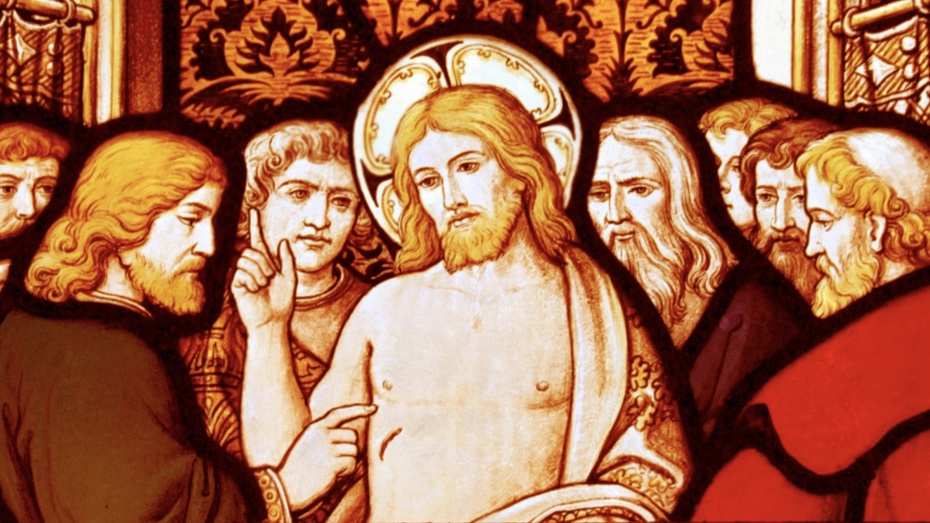
In the gospel reading this Divine Mercy Sunday, we hear the nickname of one of the Apostles: Thomas, called Didymus, one of the Twelve, was not with them when Jesus came.  “Didymus” is Greek for “twin”—apparently a nickname.  Whose twin was he?  Thomas probably wasn’t born a twin, since the name Thomas itself also means “twin” (which would be kind of like parents having a daughter and naming her Girl).  Some scholars speculate that Thomas was nicknamed The Twin because he bore such a strong resemblance to Jesus.  Maybe they cut their hair or trimmed their beards the same way.  Maybe they had the same eyes, or walked the same way, or talked the same way—we can only guess.

There’s more than a bit of irony, then, that Jesus’ double is the one who apparently has something more urgent to do on the most important day in the entire history of the world: that first Easter Sunday, when the risen Lord reveals himself to his Apostles.  It’s clear: a superficial, physical resemblance to Jesus isn’t sufficient.  It’s only a week later, when Thomas is now among the others, when Jesus appears again—wounds and all—and all of Thomas’ fears and doubts are dispelled, that The Twin begins to really look like Jesus. 

Thomas is brought to deep, deep faith as he realizes that everything Jesus has said is true.  He who was crucified for all to see has come back from the dead!  What complete trust Jesus has shown in his Father—throughout his preaching and ministry, and most especially in going to the Cross.  What complete trust Thomas can now put in Jesus: “My Lord and my God!”  In Jesus, Thomas has found Divine Mercy.  In Jesus he knows perfect peace.  With trust in the Lord, he can now truly be the Lord’s Twin: an instrument of mercy and peace for others.

Most of us can see a lot of ourselves in St. Thomas—in his questions and doubts.  Might we not also see ourselves in his nickname, The Twin?  We call ourselves Christians, and that—whether we realize it or not—is a nickname: we are “other Christs” or “little Christs.”  Which—if we’re going to be true to the name—means we ought to bear some notable resemblance to Jesus. 

We Catholics have a very visible religion: we do a lot of uniquely Catholic things and use a lot of uniquely Catholic stuff…which can give us the false assurance that, if we look Catholic and act Catholic, then we’re a pretty good disciple:  “Well, I wear a Cross around my neck and have a Rosary on my rearview mirror; I got my ashes on Ash Wednesday and palms on Palm Sunday and ate fish on the Fridays of Lent; I put out the manger at Christmas and colored eggs for Easter—so I must be doing OK as a Christian.”  But as Thomas the Twin makes clear, such exterior, physical things can never substitute for a relationship of faith and trust.  Resembling Jesus isn’t a matter of what’s on the outside; what’s on the outside must flow from within.


How can we do that—as individuals, and as a community?  In our first reading this Sunday, St. Luke gives us a snapshot of how St. Thomas and the other Apostles, along with the disciples who gathered around them, lived in those early days.  Since they were the ones closest to Jesus, their example is one we ought to examine and imitate.  The Acts of the Apostles says: They devoted themselves to the teaching of the apostles and to the communal life, to the breaking of bread and to the prayers.  There’s our recipe: four ingredients for being Twins of Jesus today.

[1] They devoted themselves to the teaching of the apostles.  The Apostles handed on to others what Jesus had handed on to them, and the first Christians knew that studying this was worth their time and attention.  Matthew Kelly, a popular Catholic speaker and writer, says that good Catholics ought to be lifelong learners.  But did learning about our faith stop for most of us when we received Confirmation?  Because we know there are 10 Commandments, 7 Sacraments, and 3 Persons in the Trinity, do we think we’ve got the Catholic faith all figured out?  When we stop studying the teachings of the Church, our faith grows either superstitious or vague—and, in neither case, can it really sustain us.  When was the last time you picked up your Bible?  Or read a good Catholic book or magazine?  Twins of Jesus never stop learning about the faith.

[2] They devoted themselves…to the communal life.  How many of you are at this Mass most every Sunday?  Now look around and ask yourself, of these folks whose hands are raised: How many of them do I know their name and something significant about their lives?  The first Christians didn’t just happen to all assemble in the same building at the same time every week or so.  They were intimately involved in one another’s lives.  When something good happened for one, everybody celebrated.  When somebody struggled, they all chipped in with support.  To say they were “brothers and sisters in Christ” wasn’t just a formal way of speaking.  Twins of Jesus care for each other as family.

[3] They devoted themselves…to the breaking of bread.  In the New Testament, “breaking bread” doesn’t mean sharing any ol’ meal; it means sharing the Lord’s Supper—celebrating the Holy Eucharist.  You might be thinking, “Whew!  At least we’ve got this one—we’re here for Mass!”  But do we have a clear sense of what it’s all about when we come together at the altar?  At a recent funeral Mass in the parish, something was said about the fact that we Catholics believe that the bread and wine really and truly become the Body and Blood of Christ and, therefore, that only Catholics who are properly disposed ought to come foreword to receive Holy Communion.  Not too long after, someone who was at that funeral posted something on Facebook saying, “I’ve been a Catholic all my life, though not an active one recently.  Am I the only one who’s never heard anything like this before?”  How we speak about the Blessed Sacrament, how we handle ourselves at Mass, how we handle the Sacred Host when we receive it—they all speak volumes about what we actually believe.  Twins of Jesus are clear: the Eucharist is the very heart, the very center of their lives.

[4] They devoted themselves…to the prayers.  The first Christians were people who prayed: alone and together, at home and in the Temple, every day and throughout the day.  They knew that prayer was absolutely essential for sustaining and strengthening their relationship with Christ and with his Church. They couldn’t even imagine living the Christian life without it.  Is it the same for us?  Or do we only pray on special occasions?  Or when we’re in desperate need?  Twins of Jesus stay in constant contact with him—and each other—in prayer.

They devoted themselves to the teaching of the apostles and to the communal life, to the breaking of bread and to the prayers.  And what was the result of this fourfold recipe for living as a Twin of Jesus?  Awe came upon everyone, and many wonders and signs were done through the apostles.… And every day the Lord added to their number those who were being saved.  Wow!  And the very same can happen today!

The older I get, the more and more I resemble my Dad, whose name I bear.  It’s not that we look that much alike; in fact, as far as physical features go, I’ve pretty much only got his hairline.  But I catch myself thinking like him, and speaking like him, and acting like him…and I’m proud when I recognize that I’m mirroring the very best I see in my father.

My friends, the world today as much as ever needs us to be Thomases—to be Twins of Christ, whose name we bear.  The people of our day cannot see the risen Lord, but they can see us.  As individual Christians, and as a Catholic parish community, let us live in such a way that others will see us, but believe in Jesus—putting all their faith and trust in him.
    

Sunday, April 16, 2017

On the Run

   Easter Sunday of the Resurrection of the Lord   
For a lot of teenagers, their favorite class is gym class.  Was that the case for anybody here?  Not for me!  I wouldn’t say that I hated gym class…but there was one part of it that I did, and that was running.  I’m not sure why, but I have never, ever liked to run—and that’s only become even more so in all these years when I didn’t have to do it anymore.

At the beginning of Lent, I began a little daily exercise program—one that will continue even after these last 40 days.  I’m not getting any younger…and I wasn’t getting any smaller around the middle, either: it was time.  So there have been pushups and sit-ups and jumping jacks, and some rather unusual stretches with funny names that I do not care to publically demonstrate or describe.  Sometimes it leaves me a little sore, but all in all, it has left me feeling rather good. 

Even before I got started on Ash Wednesday, I looked ahead through the pages of this exercise program, and there it was in black and white: running.  Another priest who’s doing the same program at the same time assured me, “We don’t have to run until Easter Monday, so don’t worry about it yet.”  Well, it’s a good thing he studied theology and wasn’t a math major, because he was wrong.  At the beginning of the week, I realized: my first run would be on Good Friday.  Seems rather appropriate, doesn’t it?  As you can see, I survived!


While I’ve been panting through my little exercise routine, do you know what Fr. Scott has been doing?  He’s been training for a half marathon next Saturday.  It’s hard for me to fathom, but he’s one of those weird people who actually likes to run—and I think he’s even good at it.  Which is why I was mortified when he said he’d looked out the rectory window at 7 o’clock Good Friday morning and saw me doing my 200-meter sprints up and down Arsenal Green.  He might have just been being nice to his pastor, but I took it as a huge compliment when he said I looked pretty good out there.

Today, we hear of how two of the Lord’s first priests—the Apostles Simon Peter and John—went for a little run on that first Easter morning.  (If Fr. Scott and I were to do a little reenactment for you, you should have no trouble guessing who would be Peter and who would be John!)  They run at first hearing the news that Jesus’ tomb has been found empty.  Having gone there to pay her respects, Mary Magdalene finds the heavy stone rolled away…and is afraid the Lord’s body has been stolen.  It’s John who’s not only fleet of foot, and therefore first to peek inside, but quick to put the pieces together: this is the third day since Jesus’ crucifixion.  Jesus had promised—as had the scriptures before him—that on this day he would rise.  And raised with Jesus were all the hopes that also died on the Cross among those who believed in him.

As much as I hate to say it: I think running is the most natural thing of all for us Christians to do on Easter—actually, I’ll take it even further: running is the most natural thing of all for us Christians to do, period.

St. Paul, in his first letter to the Corinthians, in a passage I’ve only just begun to appreciate, tell us:
Do you not know that all the runners in the stadium run in the race, but only one wins the prize? Run so as to win. Every athlete exercises discipline in every way. They do it to win a perishable crown, but we an imperishable one. Thus I do not run aimlessly…. No, I drive my body and train it, for fear that, after having preached to others, I myself should be disqualified (1 Cor 6:24-27).
The Easter jog taken by Peter and John tells us that we need to run to Jesus.  If we have been baptized with Christ, then we have died and been buried with him.  At the Good News that he is risen, we need to run after him—not just on Easter Sunday, but every single day.  We are not followers of a nice idea, or a righteous moral code, or of a respected teacher who’s long been dead and gone.  We are disciples of one who died and was raised, giving proof that he was no mere mortal, but God in human flesh.  If we’re disciples of a man who is very much alive, then we need to be constantly following after him.  If we want to share in his victory over sin and death, if we want to win the unfading crown that awaits us on high, then we need to seek what is above—and not waste a minute doing so.  Run so as to win—to win a place in heaven.


If you were paying close attention, then you caught the fact that Peter and John weren’t actually the first ones to get moving on their feet that Sunday morning.  It’s Mary Magdalene who first springs into action, running from the tomb to spread the word about what she’d seen.  The Resurrection of Jesus—even before she understood it clearly—was something she just couldn’t keep to herself.  It ought to be likewise for us.  In this world where the news is so often so very bad—of terrorism or natural disaster or unemployment or deadly disease—we really shouldn’t keep the truly Good News to ourselves.  As we find Peter doing in our first reading, and as he’ll do for the rest of his life, we need to get out there and share it—and at top speed.  Our weary world desperately needs to hear about the hope and new life that only Christ can give.  When others see the joy, the faith, the courage, that gets us up and moving, they, too, will want to meet the Risen One who has changed our lives.  Run so as to win—to win souls for Christ.

Now, just 10 days ago, running was so far off my radar that I didn’t even own a decent pair of sneakers in which to do it.  (I almost wore my fancy new ones this morning just to show them off!)  So this may seem like pretty strange advice coming from me of all people, but: Start running this Easter, and don’t ever stop.  First, run to Jesus.  Don’t let him get out of your sight!  Stay close to him, chase after him, no matter how far or fast you have to go.  Because you won’t find him in the tomb anymore, run to him in the Church, in the Mass and the other Sacraments, in the Scriptures, in prayer, in loving service to your neighbor—to all those points of encounter where we’re sure to meet the risen Lord.  And then run for Jesus.  Don’t keep the gift of salvation to yourself.  Take him out with you into the world, into your daily life, and do so with a spring in your step. 

So if you happen to see me dashing through the park these next several weeks, please don’t point and laugh (although I hope the sight does bring a smile to your face).  And please, don’t stop me to talk: I’m probably running against the stopwatch, and I really don’t want to have to start all over again!

But if you notice me—of any other of his followers—running to Jesus or running for Jesus, then by all means, run with me.  Run with Mary Magdalene.  Run slow like Simon Peter, or fast like the beloved disciple.  Run so as to win.  Keep running, and don’t every stop.
  

Friday, April 14, 2017

Passionate

   Friday of the Passion of the Lord   

If I say the word “passion” today, on Good Friday, it has a particular meaning: the suffering and death of Jesus Christ.  And that meaning is true to the word’s origins, for our English term comes from the Latin, passio, meaning, “to suffer,” or, “to endure.”

But if I say the word “passion” on almost any other day of the year, it means something quite different.  I can say, for example, that Fr. Scott has a burning passion for gardening.  (Has he told you yet that his garlic is up?  I think he walks past it about 10 time a day to see if it’s grown any more.)  In that sense, passion means enthusiasm, zeal, a strong feeling toward something.  Or, if I saw George and Anne Marie in each other’s arms out in the parking lot after this liturgy, I might say I found them in a passionate embrace.  That use of passion points to yet another sense: of intense, personal, intimate love—particularly of the romantic kind.


I cannot tell you historically how we got from suffering to enthusiasm to romance in the mutation of a single word over the years.  I’ve looked all week, and have found no convincing explanation.  But while I can’t make the historical connection, I hope to help you see this evening a deep spiritual one between these three meanings of “passion.”

Have you ever died for someone?  Of course not…or you wouldn’t be here to answer the question!  But if you were to do so, it’s safe to say you’d need to have a strong feeling about that person, or an enthusiasm for their cause, in order to give up your life on their behalf.  And so, indeed, was the case for Jesus.  We often have an image of Jesus being rather stoic in the face of his suffering and death…but it hardly seems that could have actually been the case.  He was anything but a passive victim—not of the angry crowds, nor of Judas’ betrayal, nor of the Jewish leaders, nor of the Roman authorities.   “Shall I not drink the cup that the Father gave me?” Jesus asks a sword-wielding Peter.  And to irritated Pilate he retorts, “You would have no power over me if it had not been given to you….”  Jesus’ suffering is a willful choice—one made with great zeal for his mission.  His is a deliberate, passionate decision to be obedient unto death.

It’s easy enough to see how the Passion of Jesus is connected to the passion of enthusiasm…but how can we connect the death of this virgin-born, single celibate man with the passion of romance?  But I tell you, when the Cross is held before us in a few moments, my friends, we will behold the most perfect image of a wedding that the world has ever seen.  Here we have the marriage of heaven and earth, of God and man.  This blessed union began at the moment of his conception, when the Son of God took human flesh in Mary’s womb.  But it’s on the Cross that we see this wedding most clearly displayed.  On the Cross, we behold God doing something that would have been absolutely impossible for God if he were not united as one with man: we see God die.  And on the Cross, we also see man accomplish something that would have been completely impossible for man if he were not united as one with God: we see man achieve salvation—saving you and me from sin, saving us from death.  And this blessed union is one of pure, passionate love.  (It’s no accident that in Latin, Jesus’ final words from the Cross—“It is finished”—are, Consummatum est, literally, “It is consummated.”) 


We’ve of course heard, time and again, that Jesus died out of love for us, and we assume that that means he loved us all generally, generically, as so many members of the whole human race.  But the love which led him to die was more personal, more intense, more intimate, more passionate, than any other romance the world has ever known.  When he was nailed to his Cross, he had you, Ralph, on his mind.  And when he breathed his last, he held you, Lindsay, in his heart.  If you, Becky, were the only other human being on the planet, he would have died for you, anyway.  And if he had to do it all over again just for you, Brent, he would.


Jesus went to his Passion with great passion and great passion.  And believing that really ought to change everything, shouldn’t it?

I doubt I’m the only one, when faced with a difficult challenge, with the prospect of suffering, with something I’d rather not endure, who hesitates and pulls back.  In fact, I’m sorry to say, I often enough will wait to see if the problem might somehow fix itself or just go away.  But when I’ve been able to face a challenge or some suffering head on, I’ve been amazed at what I’ve been able to achieve—far beyond what I thought was possible.  And that’s because, by not running from the suffering, I’ve been in the place where God wants me to be, and doing the thing that God wants me to do, and so God fills that moment with his grace.  I’m not suddenly some sort of superhero, but God is accomplishing his work in and with and through me.

Such hesitation, such resistance, such holding back, is the opposite of both passion and passion—and it’s not the way of life to which you or I, as followers of Christ crucified, are called.  As long as we’re in this world, suffering comes to us.  Are we prepared to face it with great zeal for our God-given mission?  Are we ready to endure it out of deep love for our Savior?

Having walked once more with Jesus on the way of his Cross this Good Friday, let us accept any small share we might have in the Lord’s Passion with both passion and passion.