Sunday, January 29, 2017

Hungry for Righteousness

No homily to send you this Sunday: I just pulled in this morning (at 12:10am), having spent the last few days as one of the chaplains for two busses of young people from our Diocese taking part in Friday's annual March for Life in Washington, DC. Accompanying these young people was quite exhausting...and also incredibly encouraging. To see these teens standing up for Christ and standing up for life fills a guy with great hope!


"Blessed are they who hunger and thirst for righteousness,
for they will be satisfied."

Matthew 5:6

Sunday, January 22, 2017

Change

 Third Sunday in Ordinary Time   A 

America magazine was first published by the Jesuits in New York back in 1909.  I haven’t been reading it all that time, but I have subscribed for about 15 years now.  I rarely agree with everything between its covers, but I do always find it well written and quite thought provoking. 

So I was happy when the latest issue appeared in my mailbox the other day, and brought it along to lunch to look through it.  I was just a few pages into it when I groaned: they had changed my magazine.  Right there on page 3, the editor explained that they’d spent the past year working on this redesign—their entire staff in consultation with experts in the field—and they were quite certain that the result was a far better publication.  I was not so sure. 

Before I’d finished lunch, I had concluded that I didn’t like the new layout (it’s hard to distinguish the articles from the advertisements), I didn’t like the new font (it’s more difficult to read, and my eyes aren’t getting any younger), and I didn’t like some changes they’d made to the contents (one of my favorite features of America has always been the letters to the editor, since they often print many of them and they’re usually a bit juicy…but in this issue at least, they seemed to have been cut by more than half).

While I was grimacing over the changes made to America the magazine this week, others were reacting to possible changes to America the nation as a new President was inaugurated.  Some, of course, are very hopeful and rejoicing at a victory…but others are quite unsettled, and even fearful about what changes may lay ahead.

Change is never easy.  The older I get, the less I like it.  And yet, with more experience under my belt, the more I’ve come to realize that the alternative to change is actually death.   When a living thing stops changing, it is because it has died.  Blessed John Henry Newman once put it so well: “To live is to change, and to be perfect is to have changed often.”  No, change isn’t ever easy, but it’s part of the very essence of life.


I realize that America magazine started to contemplate making a few changes right about the same time that we did the same here at St. André’s.  It was a year ago that the Pastoral Council and I began a lengthy, detailed process of long range, strategic planning for the parish.  We prayed a lot.  We talked a lot.  We gathered all kinds of information and studied it a lot.  We met twice as much as usual so that we could give enough time and attention to a project as important as this.  In November, we shared with you the first fruits of our labors, mailing out to all our parishioners our Proposed Pastoral Plan. 

And because our work was not done, we asked you to come to a listening session; between 125-150 parishioners came, and 21 of them spoke that evening—making comments, asking questions, and expressing concerns.  And in the two months since then, we’ve been gathering your written responses; we’ve received 20 of them to date.  (To be precise: we’ve received 18; one was sent to The Malone Telegram, and one was sent to Bishop LaValley…but those comments eventually found their way to us, too.)  The Pastoral Council and I are carefully considering all of this input as we continue to work on the Pastoral Plan.

It seems to me that now is a good time to share with you some observations, based on what’s been shared with us these past couple of months.  In reviewing the letters that have come in and the transcripts of the listening session, there are five themes, five common threads, that I want to highlight today.

(1) There seems to be a general impression that the Pastoral Plan is a done deal—and that we’re rushing into it irresponsibly.  I’m not sure how many more ways I can say it, or how to make it more convincing, but no final decisions have been made.  We wouldn’t be putting either you or ourselves through this process if everything were already figured out.  The Plan remains a work in progress.   And as far as rushing—one of our Pastoral Council members addressed this head on at our meeting last Monday.  He’s the longest serving member of the Council, and has a lot of not-for-profit and administrative experience.  His observation wasn’t that we’re moving too fast, but that we’ve gone too slow.  He pointed out that we’ve been at this for 15 years already (the first meetings to form Malone Catholic Parishes began all the way back in 2002).  It breaks his heart to think of the opportunities and resources that have been squandered because we’ve been overly cautious.

(2) There is also quite a lot of misinformation out there.  I suspect most of it is innocent.  People remember things partially, or misremember them.  Many are forming opinions based on a limited amount of information—what they’ve personally seen, heard, or experienced—which is only natural.  A plan for our entire parish, however, must take in the full breadth of the big picture.  Unfortunately, however, there also seem to be some folks who are quick to jump to false conclusions, or who prefer to rely on the word on the street rather than the facts on the ground.  Please don’t get swept up in what’s churching out from the rumor mill.  If you’re looking for information, ask me, or ask a member of our parish staff, or ask a member of the Pastoral Council, and we’ll get you the answers you’re looking for.  We have nothing to hide.

(3) If there’s any consensus out there about the Pastoral Plan, it seems to be this: “Fr. Joe, leave everything alone!  Don’t change a thing!”  No one, of course, has come out and said that in so many words…but several folks have said, “I really don’t want my church to close since I have so many memories there…and the folks at that church have said they feel the same way…and I’ve heard it from the other churches, too…”  I certainly appreciate this heartfelt sentiment.  It would actually be the easiest option for both you and me to change nothing at all.  But the status quo isn’t really an option.  We don’t have the people in the pews we once had.  And we don’t have the money in the collection basket that we once had, either.  And the community around us and its needs are changing, too.  Change is part of staying alive.

These last two are the core of what I want to speak to this Sunday.

(4) There is an awful lot of negativity and mistrust surrounding the Pastoral Plan.  Some pretty serious accusations have been leveled against me personally and against the Pastoral Council: that we have been intentionally deceiving parishioners; that this is all about stealing money from one church in order to pay for things at another; that the Proposed Plan is actually the end product of a long-term conspiracy of the sort that would make Vladimir Putin jealous.  (You folks give me far, far too much credit!)  To give you a sense of how far this goes: I was actually heckled while preaching this homily earlier today, when a man in the back called out, “Liar! Liar!”  I can’t be sure where this attitude of mistrust is coming from, but I know where it will lead—and that’s nowhere good.  We cannot move forward into the future if we cannot trust one another.

(5) This final theme has come up so often that there must be some truth behind it: we keep hearing that our parish just isn’t as warm and welcoming as it ought to be.  Mind you, I have never once heard this from a visitor to any of our churches; in fact, they often say quite the opposite.  But a notable number of parishioners have commented on St. André’s being inhospitable.  When folks attend a different Mass than usual, they get the impression that they’re an intruder in their own parish church.  That simply cannot be how we treat one another.  If this is true, then we’re all a part of the problem, and we all must be a part of the solution.

In our second reading this Sunday, we hear St. Paul writing to the Corinthians—writing to a church that’s divided within itself.  He really could be writing to Christians in any age, and so I’ve taken the liberty to make a few updates to his words:
            I urge you, brothers and sisters, in the name of our Lord Jesus Christ,
            that all of you agree in what you say,
            and that there be no divisions among you,
            but that you be united in the same mind and in the same purpose.
            For it has been reported to me about you, my brothers and sisters,
            that there are rivalries among you.
            I mean that each of you is saying,
            "I belong to St. John Bosco," or "I belong to St. Helen’s,"
            or "I belong to St. Joseph’s," or "I belong to Notre Dame."
            Is Our Lady divided?
            Were St. Joseph or St. John Bosco or St. André crucified for you?
            Or were you baptized in the name of St. Helen?
            No.  So carry on in such a way that the cross of Christ
            might not be emptied of its meaning.
Now, neither I nor St. Paul are saying that Christians must be in perfect agreement on absolutely everything.  Where there is more than one person, there are bound to be differences of opinion!  And I am well aware that there have been deep divisions among the Catholics of our community over the years: between the French and the Irish, between the rich and the poor, between the folks who lived in the village and those out in the country.  My friends, those divisions must now be a matter of our history, because our future is all tied up together.  Of course we will disagree about some things; such diversity—like change—is a sign of our life and vitality.  The question isn’t whether or not we disagree; it’s about how we disagree.   Our differences must never be marked by animosity or suspicion, which only serve to further our divisions.  Instead, our differences must always be marked by true Christian charity.   Christ didn’t die on the Cross that he might see his Body torn further apart; rather, he died to give us an example of the sort of love which should mark us as belonging to him even when we disagree.

The prophet Isaiah draws our attention to the fact that many people walk in darkness, that some are dwelling in gloom and the shadow of death.  He does so in order to point to the coming of the light: the arrival of a Savior who will banish the darkness forever.   This Sunday’s sad anniversary of the legalization of abortion in our country is just one of many such dark corners in our land as we recall the millions of innocent lives that have been lost.  As disciples of Jesus, it falls to us to reflect his light into this darkness…but if we are divided against one another, then we aren’t reflecting his light; we’re actually spreading the darkness.  If we treat one another with cold suspicion, then who would ever believe our witness to light and life?


Consider Jesus walking along the shores of the Sea of Galilee, as he calls first Peter and Andrew, and then James and John.  Do you think Jesus handed them a complete, detailed plan before he said, “Come, follow me”?  Of course not!  They had no idea what changes were in store for them—and for the whole world!  But these fishermen were able to trust that he had a plan, and that his plan would be what was best.  And it’s because they trusted Jesus, and others trusted them, that we are here in this church this morning.  Don’t get me wrong: I am not asking you to trust in me the way you ought to trust in Jesus Christ!  But we do have to trust one another, and together put our complete trust in him, in order to move ahead.  Even more than listening to each other, we need to be listening to Jesus and the plan he has for St. André’s Parish…without ever knowing everything he has in store for us.

America magazine has changed many times in the course of its 100+ years, making changes in order to stay vital and relevant in a changing world.  The fact that it’s still in print says that those changes have been, by and large, good ones.  When I took the time to sit down with a cup of tea the other evening and actually read through this new issue, I discovered something: it’s really pretty good.  No, not perfect, but much better than I expected.  I just needed to give it a chance.

There have been Catholics here in Malone for just shy of 200 years now, and over the course of these past two centuries they have witnessed many, many changes in the practice of their faith.  And we’re still here, the Church is still alive, only because it has continued to grow and change.

Let us grow in our trust for one another as we put our full trust in the Lord and his plans for our future.  Let us open our hearts and allow Christ to change us.
  

Friday, January 20, 2017

Upward, Ho!

I haven't been out in the woods much for quite a while (both the weather and my schedule have been wild), but yesterday I did manage to get out with three other guys for a little snowshoe up Mount Van Hoevenberg (2940 ft), about 9 miles outside of Lake Placid.  There was just enough snow for snowshoeing (and there was plenty of ice underneath it) as we trekked the 2.4 miles and gained 770 feet in elevation up to the summit, which gave us views toward the High Peaks.  From the pictures, you can see there was some snow in the air, too, giving hope for more winter adventures to come...


Sunday, January 15, 2017

The Lamb

 Second Sunday in Ordinary Time   A 

Have you ever played word association?  It’s a rather simple game.  Someone in the group says a word, and then the others say the first related word that comes to mind.  For example, if I said, “coat,” others might respond, “warm,” or, “heavy,” or “fur.”  Make sense?  Let’s play a few rounds…

Winter: “cold”…“snow”…“long.”  [At the first Mass, someone said, “miserable”; at the second, “lovely.”]

Green: “spring”…“grass”…“money.”

Lamb: “soft”…“cute”…“cuddly.”  [I was hoping someone might say, “chops,” or, “mint jelly”; at the second Mass, I did get, “tasty!”]

“Behold, the Lamb of God!”

In the time of John the Baptist, if he’d played word association with the word, “lamb,” he’d have likely gotten responses of, “blood,” or, “sin,” or, “death.”  You see, those who first heard John would have been familiar with the worship in the temple of Jerusalem.  They would have known—probably firsthand—that everyday, faithful Jews brought lambs to be offered in sacrifice.  To bring a lamb for sacrifice was to ritually say, “What’s about to happen to this innocent lamb is what, by rights, ought to happen to me.  I’m a sinner, and there’s a high price to be paid for sin: death.  As this lamb’s body is to be broken, so is my heart broken in sorrow for having disobeyed the law of God.  As this lamb’s blood is about to be spilt, so I’m pouring out my heart and crying, ‘Lord, have mercy!’”


That’s a slightly different word association than, “cute and cuddly,” isn’t it?  And it makes a huge difference when the title, “Lamb of God,” is applied to Jesus.  John the Baptist didn’t point to Jesus with a warm and fuzzy idea in his mind, in effect saying, “Would you take a look at this really nice guy!”  No—instead, John’s saying something that really couldn’t have made much sense to folks until after Jesus’ Passion and Death.  Only then they could have recalled his words and thought, “That’s why this man had to die!  Although innocent, he’s taken upon himself the full weight of my sins, and the sins of the whole world.  What we’d seen in the temple in symbol has now taken place in all actuality.   This Jesus has died in my place!”

I draw attention to this contrast in hopes that we can take away two basic but critical points this Sunday.

The first: What we think about Jesus’ true identity makes all the difference in the world.  Most everyone would agree that Jesus was a real historical figure.  Many non-Christians, even some atheists, would say he was a wise teacher, who imparted lessons from which we can all benefit.  But it’s altogether different to believe, as Christians do, that Jesus is true God and true man—the divine Word made human flesh, as we’ve been recalling and celebrating these last six weeks or so.  Only if God incarnate can Jesus truly bridge the gap between heaven and earth.  If he’s a really nice guy, then Jesus can inspire me; but if he is—as John the Baptist goes on to testify—the only begotten Son of God, then Jesus can save me from my sins.

The second: There are many times when we use the same words, but make very different associations.  For some, winter is “lovely,” but for others, it’s “miserable.”  The same happens when we speak of Jesus, or God, or the Church, or spirituality.  Lots of people use these words, yet meaning lots and lots of different things.  But because we want to be polite and accepting of others and their viewpoints, because we don’t want to rock the boat, or because we aren’t confident in our knowledge of the Catholic religion, we’re all too likely these days to say, “But it’s all good!  It’s all the same!”  If you handed me a $50 bill asking for change, and I handed you just four quarters in return, would you accept them without question?  Of course not!  But it’s all money, isn’t it?!?  If we wouldn’t accept this exchange as “the same,” we likewise ought not to settle for something lesser or even counterfeit in matters of faith.  It would be one thing if we were just playing word association…but it’s quite another when it’s a matter of salvation.  What we need to pursue isn’t the path the least challenging or controversial; we need to purse the way that’s true.  Certainly, we should respectfully enter into dialogue with those who believe differently than ourselves so that we might better understand each other.  But we don’t do anybody any favors to pretend that our differences aren’t real or don’t matter.  It’s so crucial that we have a good working knowledge of our faith and seek clear ways of explaining it to others.

“Lamb of God… Lamb of God…. Lamb of God, you take away the sins of the world.”  In every Mass, three times in a row, the entire congregation calls out to Jesus by this name.  And what is happening at the altar at that very moment?  The Sacred Host is being broken.  As those who first heard John the Baptist speak of the lamb and associated the word with offerings made in the temple, so for us this language and gesture should call to mind the offering Jesus made of himself on the Cross.  Blessed are those called to the Supper of the Lamb!  Blessed, indeed, are we who are saved by his sacrifice!
  

Sunday, January 8, 2017

Five from Three

   The Epiphany of the Lord   


We had a funeral a few days after Christmas, for which the family made an unusual musical request: they asked that we sing, We Three Kings, as the closing song of the Mass.  I thought this might simply have been because we clearly remained in the Christmas season, with manger scene and poinsettias still in place.  Or maybe it was a Christmas carol particularly dear to the deceased.  What I learned was that her children had picked this song because their mother always found the story of the magi both fascinating and inspiring.  What faith—she thought—it must have taken them to set out on their journey: their destination unknown, guided only by a star!

We know very little about these mysterious biblical figures—reflected in the fact that we variously call them magi, wise men, and kings.  We don’t know where they’ve come from, other than “the east,” which is rather vague.  And despite the words of the familiar carol, we don’t even know if there were actually three of them!  But the story we just heard again from St. Matthew’s gospel does bring to light five important spiritual lessons we can learn from these seekers of the Christ Child.


Have you ever seen a star?  Of course you have.  But have you ever seen a star and, because of it, set out on a harrowing adventure?  That’s not exactly normal behavior!  (We call them “wise” men, but in the eyes of the world, their behavior was actually pretty foolish.)  The magi saw a star, and recognized that it was more than a star: they recognized that it was a message from heaven.  Many, no doubt, saw the same star, but only those who were alert and looking deeper were able to take in its message.  God, of course, is constantly sending messages to you and to me.  Sometimes they’re in obvious places, like the words of Scripture or in the teachings of the Church.  But God also speaks through the wonders of nature and the people all around us.  Maybe it’s through that book your reading.  Or a song on the radio.  Or some billboard on the side of the road.  Such messages from heaven are strikingly personal, and constantly being sent…but so frequently go unnoticed because we aren’t paying attention.  The magi teach us the importance of staying alert, so that we might always recognize what God is up to.

Seeing the star, the magi then set out.  They not only received the message; they heeded it.  No matter the length of the journey or the danger along the way, they set out on the road.  How many times do we know what God expects of us, but then fail to act!  Sometimes it’s through fear, other times through laziness.  We get distracted by the surrounding world, or have fallen victim to bad habits.  Or maybe we’ve gotten really comfortable right where we are.  The magi teach us not to let the moment pass.  When God has made himself clear, our part is to get up and move.

Along their journey, the magi stop in Jerusalem, where they call upon King Herod.  He doesn’t exactly receive the message they bear as “good news.”  “A new king has been born?  But I’m the king!”  His frantic jealously—despite his pretensions to the contrary—has the potential to not only disrupt the journey of the magi, but to destroy the One who is the object of their quest.  When we’re on the path God sets before us, we ought to expect to run into obstacles and opposition.  This world is fallen and sinful, often set at cross-purposes with the ways of the Lord.   The magi teach us to rebuff such attempts to throw us off course, to refuse to cooperate with evil, and to continue undeterred of the road pointed out by God.

Having slipped past Herod, the magi arrive in Bethlehem, where they find the infant Jesus and his mother, Mary.  Falling at his tiny feet, they present him with their costly cargo: gold, frankincense, and myrrh.  These aren’t exactly practical gifts for a newborn!  (Try giving them as a present at a baby shower, and see what sort of reaction you get.  Although you might get a positive response to the gold…)  They’re not at all practical, but they are precious.  When we come to Christ, we mustn’t give him second best; he deserves the very best we’ve got to offer.  What’s just about the most precious thing we’ve got—which, when used, we can never get back?  Our time.  Jesus wants time with you—some of your most valuable time, time that comes with your undivided attention.  The magi teach us that, while it’s not very practical, giving Jesus the very best is just what he deserves.


The end of Matthew’s story about these traveling magi is a bit anticlimactic: they go home.  (Wherever “home” is…)  But they return there by a different route, of course!  The magi teach us that no one comes to Christ and goes back the same way that they came.

Three mysterious magi (maybe), five spiritual lessons to teach us.  Stay alert, for God is constantly at work.  When you received the Lord’s message, act upon it.  Expect opposition when following God’s way, but don’t be deterred by it.  Give Christ the very best of yourself, since it’s the only gift he really desires.  And set out with him on a whole new path, changed now and forevermore.

based on a reflection by B. Barron
  

Sunday, January 1, 2017

Blessed

   Solemnity of Mary, the Holy Mother of God   

Fr. McLane asked a married couple in his parish what they were making for New Years resolutions.  The man spoke up first: “I resolve, Father, to do everything I can this year to make my wife happy.”  The woman chimed in, “And my resolution, Father, is to do everything I can to help my husband keep his!”

Standing on the threshold between two years, many folks spend time looking ahead: making resolutions for the New Year, making plans for the New Year, making predictions about the New Year.  But from this same vantage point, we can also spend time looking back: considering the year that was and the things of significance which took place during these last twelve months.

For me and my family, one of the most significant milestones of 2016 was the death of my grandfather, Leo Giroux, last August.

The first reading we hear at Mass today—the instruction given to Aaron, the priest,  and to his sons on how to bless the Lord’s chosen people—was the first reading I selected for my grandfather’s funeral Mass.  It only seems like an odd choice until you know the story…


As a kid, my friends and their families had celebrations pretty similar to those of my family when it came to things like Thanksgiving and Christmas and birthdays.  But we Girouxs did things a bit differently at New Years.  On New Years Eve, our large extended family would gather.  The cousins would play with their new toys from Christmas while the adults played cards.  At midnight, there’d be hugs and kisses all around, and then a big feast.  Everyone would then sleep a few hours before getting up for chores on the farm.  If you hadn’t gone to the vigil Mass the night before, next you were off to church for the holy day.  And then the whole family would get together once again at my grandparents’ home—the old farmhouse where they’d raised their ten children—for yet another feast.  There were card tables set up all over the place to make sure everybody had a place to sit.  But before anyone took a bite, my grandfather would say the blessing.  This was not, mind you, simply “Grace Before Meals.”  Keeping an old French Canadian custom, my grandfather, as the patriarch, would give his paternal blessing, invoking God’s blessing on his family for the coming year.  Such a blessing by a father of his children is a tradition that goes back to Old Testament times—a tradition still older than the priestly blessing recorded in that first reading we hear each year on January 1st.


My grandfather’s blessing on New Years Day is one of my most treasured memories.  And one of the greatest honors of my life came on January 1, 2001.  Due to some unusual circumstances, I had spent my first Christmas as a priest at home with my family.   On New Years Day, I joined the rest of the gang at my grandparents’ house.  Not only did I get to sit at the “grown ups table” for the first time in my life, but after my grandfather had imparted his paternal blessing to us all, my grandmother insisted that I give my priestly blessing to the family, too!

Today, on the Eighth Day—the Octave—of Christmas, the Church gathers her children to celebrate the divine motherhood of the Virgin Mary.  Through Mary, we receive countless blessings, to be sure; but born from Mary is none other than he who is the very source of every blessing: the Word made Flesh, God become man, Jesus Christ our Lord.  His sacred Nativity, which we celebrated a week ago, could only take place with Mary’s willing cooperation.  And so we recall how, again and again, the almighty God freely chooses to use us, his mere creatures, to fulfill his great plan of salvation.  We see that most perfectly in Blessed Mary.  But we see it also in St. Joseph.  And in the shepherds.  And in Jesus' Apostles.  And, through the ages, in countless sinners striving to be saints.  I could see it, too, in my grandfather's New Years blessing.  And it should also be clear in your life and mine.

This feast of the Holy Mother of God is the perfect occasion to look back over the year just past.  Like Mary kneeling at the manger, reflecting in her heart on all that led up to the first Christmas, we need to take stock of the blessings we’ve received and how well we’ve cooperated with them.  But also seeking Mary’s prayers, we ought to look ahead: asking God’s renewed and abundant blessings on the year to come and all those we love.


I would particularly encourage fathers and grandfathers—whether you’re French Canadian or not—to bless your families today.  It’s a beautiful custom.  Don’t worry if you don’t know what to say; you can always make you own those powerful, God-given words we heard from Scripture:
            The Lord bless you and keep you!
            The Lord let his face shine upon, and be gracious to you!
            The Lord look upon you kindly and give you peace!

Through the hands of our Mother, Mary, let’s put this New Year in our Lord’s care.  May we each resolve to be an instrument of Christ’s blessing for all those we meet throughout the Year of our Lord Two-Thousand and Seventeen. 
  

Sunday, December 25, 2016

Delivered

   The Nativity of the Lord - Christmas   

It was Christmas Eve in Nashville, 1956.  Judy Charest was just 3 months old.  Her father had jumped into the shower, and by the time he stepped back out again his wife and baby girl were gone.  His wife suffered from depression, and she had driven their little daughter to the Shelby Street Bridge.  With Judy in her arms, she jumped 90 feet down into the icy river below.

Passersby soon noticed a woman floating in the cold water, and they heard her screaming, “My baby!  Somebody save my baby!”  In the crowd were two men—Jack and Harold—who immediately ran down to the water’s edge.  Jack dove in and swam first for the baby.  He brought Judy back to shore and handed her off to Harold before diving in the frigid water again to swim for her mother.  Harold grasped the little girl tight in his arms and immediately began to run up the riverbank.  He’d only gone two or three steps when—to his great delight—he heard the girl give a little grunt.  “It’s too good to be true,” he thought to himself.  “She’s still alive.  It’s a miracle!”


Incredibly, both Judy and her mother survived the ordeal.  Actually, because of it, Judy’s mom got the diagnosis and treatment she needed and went on to live a long, full, and otherwise wonderful life.

Judy knew nothing about the story of her first Christmas until she was 21 years old.  And when she heard the tale, she suddenly understood why her father held her so very, very tight every year on Christmas.  It was only last year, when Judy was 59, that she met Harold: the man whose strong arms had carried her up the riverbank that Christmas Eve.  When they met, they hugged—tightly, and for a long time.  Just a couple of weeks ago, when they met up again, Judy told Harold that being in his arms—the arms that once saved her—felt so very familiar.


No doubt you’re thinking, “That’s quite a story, Fr. Joe…but it’s not exactly your typical ‘Christmas story.’  There are no elves or reindeer.  Nobody exchanges any gifts.  While there are a mother and child involved, there’s no manger, no magi.”  And yet, when Ifirst heard Judy and Harold’s story a few days ago, I immediately thought, “That’s the truest Christmas story I’ve heard in a long time.”

Why?  Because what Harold and Jack did for Judy on her first Christmas is precisely what the Son of God did for you and me the very first Christmas: throwing all caution to the wind, thinking nothing of himself, concerned only with the dangers we faced, he jumped down to earth from heaven to rescue us.

To help us understand this, let’s consider Christmas music for a minute.  There is more Christmas music than any other kind.   It’s in every language, every style, coming out of every culture.  From Bach to Beyoncé, everybody writes and sings songs for Christmas.  As I heard on the radio the other day, there are a surprising number of our modern Christmas favorites that have been written by musicians who aren’t even Christian!

Listening to so much of this music the last few weeks, I’ve realized that pretty much all Christmas songs—with rare exceptions—speak about deliveries.


In contemporary Christmas songs, the deliveries are of the sort that come wrapped in shiny paper and bows: deliveries eagerly awaited this very night from a big man in a red suit (or maybe deliveries awaited the last few days from somebody driving a big brown truck).  Contemporary Christmas music sings a lot about presents.  But Christmas can’t be all about the presents, can it?  We give gifts on many other occasions, as well.  Why these deliveries?

If you turn back the clock a little to an earlier era, you’ll find that Christmas songs speak of a different delivery: the delivery of a little baby, who’s found lying in a manger.  They are sentimental songs that tug on the heartstrings as we hear the story of a child born into some rather difficult circumstances.  But babies are born every minute of every day—and far too many of them in less-than-ideal conditions.  We don’t celebrate the delivery of every newborn with all this fanfare.

Reach back even farther, and you’ll find some Christmas songs that today are by-and-large forgotten.  They, too, sing of deliveries.  They sing of how this baby born in Bethlehem grew to manhood, and how he delivered himself into the hands of the wicked, delivered himself to suffering and a Cross, and did so that you and I might be delivered from sin and death.  They sing of the God who dove headfirst into our humanity in order to save us.  And only here, my friends, do we learn of the delivery that makes any sense of all the others.

The good news the angels announced to the shepherds was the birth of a Savior.   But it means nothing for us to call Jesus our Savior, to celebrate our Savior’s birth, if there’s nothing from which we need to be saved.  We Christians innately know this.  At Baptism, we were literally pulled from the waters: raised up by one who jumped in after us.  And I think that’s why, at Christmas, so many Christians who don’t otherwise think themselves very religious, who don’t regularly practice their faith, still feel the pull to come to church.  Like when Harold hugged Judy 59 years later, we recognize a very familiar embrace.  Deep down, we know we’re most truly at home when held in the arms of our Deliverer.  It’s here where life is restored to us.  It’s here that we belong.


Two men saved a baby girl 60 years ago.  On the first Christmas, a baby boy was born to save all men.  Let us rejoice his Most Sacred Heart—at this holy time, and throughout the year—by living the kind of lives for which he risked everything to deliver us.

Merry Christmas!
  

Sunday, December 18, 2016

Betrothed

   Fourth Sunday of Advent   A 

I asked a guy at the last Mass if he did anything special when he proposed marriage to his wife.  He said, “No.”  She quickly chimed in, “He even had me pick out my own ring.”  (At least she got the one she wanted.)  So I asked another fellow the same question, and he said, “Yes.”  I asked, “Did you get her roses?”  He said, “No.”  But she jumped in, “Yes, you did!”  I quickly ended that line of questioning…  Not content, I asked another man after Mass.  “We got engaged in the McDonald’s parking lot,” he replied.  That’s not quite the kind of “special” I had in mind!  I dared to ask once more, and this time the wife answered: “The first time he asked, he said, ‘Would you marry me if we were old enough to get married?’”  I had forgotten they’d been high school sweethearts…

Matthew begins his account of the birth of Jesus by saying: When his mother Mary was betrothed to Joseph, but before they lived together, she was found with child through the Holy Spirit.  Given our own experience of contemporary wedding customs, we assume that “betrothed” means “engaged.”  But that’s not actually the case. 

You see, Jewish wedding customs 2,000 years ago were nearly opposite of what we see most often today.  Today, many couples cohabit and then commit: they live together for a while and, if things work out, then they’ll consider getting married.  But in the days of Mary and Joseph, when a man and woman were betrothed, they exchanged vows publically.  They didn’t live together yet—that could take up to a year more—but they were legally husband and wife.  What did they do during this year of betrothal?  The bride would begin packing her things, say good-bye to her family and friends, and learn from other women what she needed to know about being a good wife and (God willing) mother.  The groom would go to his father’s house, where he’d begin to remodel a few rooms (or build a few new ones) in order to prepare a proper home for his new family.  Meanwhile, he’d send gifts to his bride to woo her and show her his affection.  (He’d also receive gifts from his friends to help fund the renovations.)  When all was prepared, he’d send for his wife and welcome her into her new home.  That’s when they’d have the wedding feast and their married life would begin.


Note how, in the gospel, Matthew refers to Joseph as Mary’s “husband,” and the angel refers to Mary as Joseph’s “wife.”  When Joseph is discerning how best to respond to the news of Mary’s pregnancy, he doesn’t propose breaking off the engagement; he considers “divorce.”  It makes so much more sense of the story to know these customs, doesn’t it?  But there’s still more we can learn here…

You see, the pattern of betrothal and home-taking describes the whole history of salvation.  It’s the outline of the whole of the Old Testament: the age of patriarchs, prophets, and kings that we relive, in a certain sense, during these four weeks of Advent.  God sets his heart on a people of his choosing—his people, Israel—and sets about to draw his beloved ever to closer to himself.  He binds himself to Israel with a covenant: “I will be your God, and you will be my people.”  It’s no accident, of course, that this sounds a lot like wedding vows! 

And to seal this covenant, uniting God and man, heaven and earth, in an unbreakable bond, he sends his Son, Jesus.  In a familiar passage from the gospel of John, as Jesus prepares his disciples for his coming Passion, Death, and Resurrection, he tells them, Do not let your hearts be troubled.… In my Father’s house there are many dwelling places. If there were not, would I have told you that I am going to prepare a place for you?  And if I go and prepare a place for you, I will come back again and take you to myself, so that where I am you also may be (Jn 14:1-3).  We miss the connection, but those who first heard Jesus speak these words would have understood immediately: all is now ready, and the Groom has come to take his Bride home.

What is true of God’s relationship with his people is also true of God’s relationship with each and every one of us.  It is only out of God’s passionate love for you that you came into existence.  No one else can bring life into being.  God loved you before you were born, even before you were conceived.  God was in love with the mere thought of you!  And so God pursued you, and began a relationship with you.  At your Baptism, vows were made: the one true God—Father, Son, and Holy Spirit—became your God, and you became his own.  The rest of your life is now the time of betrothal.  The Bridegroom of your soul has prepared a place for you, and will return to take you to your eternal home to be with him forever.  In the meantime, he sends you gifts as tokens of his love: he speaks his love to you in the Scriptures, in the teachings of his Church, and in the lives of his saints; he touches your life with his love in the Sacraments; he looks on you with love in the faces of the poor and the wonders of nature.

But what are we to do during this time of betrothal?  How do we best prepare ourselves for the fullness of life and eternal communion God has in store for us?  We can take our cue here, too, from good St. Joseph.  The angel commands him to do two things: to take Mary, his wife, into his home, and to name her child Jesus.  These things Joseph promptly did.  Likewise, we need to take Mary into our homes.  The Mother of God is our mother, too.  She is the first and model disciple of Jesus.  We need to stay close to Mary, to take Mary into our hearts and homes, because without fail Mary takes us to her Son.  As well, we need to speak the name of Jesus.  Jesus’ name is said aloud by many people many times every day…but not in a reverent fashion.  We need to say his holy name often, for in it there is great power.  It’s not enough to speak about spirituality or religion or God in generic terms.  Not only in prayer, but also in conversation with others, we need to pronounce the sacred name of him who came to save us from our sins.  As we await the Lord’s return, let us keep Blessed Mary close and speak the Holy Name of Jesus.


This Sunday, we find St. Joseph at the very crux of his betrothal—and not only of his betrothal to the Virgin Mary, but of the saving betrothal of God and the human race.  It is due to his deep faith, his righteousness, his courage in obeying God’s will, that we can recognize Jesus as the fulfillment of the ancient promise: that Mary’s child is truly Emmanuel, God-with-us.  What a debt of gratitude we owe to that just man, Joseph, because of whom we can believe that God has made his home with us, that we might find our home in God!
   

Sunday, December 11, 2016

Flutter

"You ask me whether I am in good spirits. How could I not be so? As long as Faith gives me strength I will always be joyful. Sadness ought to be banished from Catholic souls... the purpose for which we have been created shows us the path; even if strewn with many thorns, it is not a sad path. It is joyful even in the face of sorrow."  Blessed Pier Giorgio Frassati

   Third Sunday of Advent   A 

If my nephew finds out that I’ve told you what I’m about to share, I’m going to be in trouble…

You see, when Nathan was little, we noticed a cute habit of his: when he gets excited—say, opening presents on Christmas or his birthday, especially if he’s getting something he’s long wanted—he flutters.  Let me demonstrate… [flapping lower arms really fast]  It was adorable in a toddler, and as we’d all laugh, I’m sure he could only assume that we were sharing in the joy he simply couldn’t contain.

But now Nathan is a 5th grader, and he’s all boy: playing football, racing snowmobiles, fishing, and hunting.  Last month, Nathan bagged his first buck—a six pointer.  When I saw my sister on Thanksgiving, I had to ask, “So, did he flutter?”  “Oh yes,” his mother said, “there was a whole lot of fluttering going on…”  Of course, we had this conversation out of earshot of Nathan, because fluttering isn’t exactly cool for a boy becoming a young man.

This Sunday, the Church flutters.  At the halfway point of Advent, she’s bursting at the seems with joy—not so much that Christmas is close, but that God has come so very close to us.  Unable to keep it in, the Church sheds the somber shades of purple and clothes herself in brighter, rosy hue. 

Such joyfulness should be the normal, natural disposition of Christians.  But it isn’t, is it?  No, we grow up…and we tend to forget to flutter.

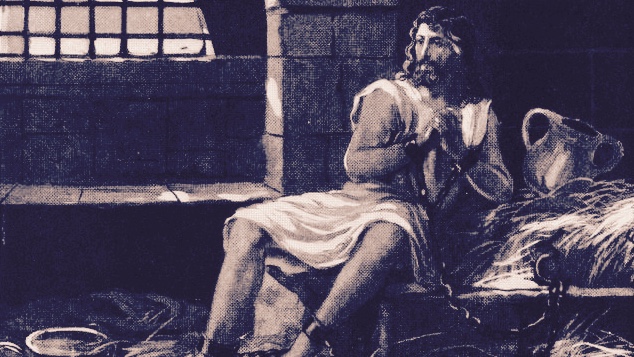
One reason is that we think joy is reserved for those times when everything is going right: when life is perfect, free from all challenge and struggle.  But if that’s the case, there will be no joy in the world.  Consider our first reading, when we hear the prophet Isaiah fluttering.  His joy is overflowing at the thought of when the Savior will come.  He says that the land itself will rejoice and bloom with abundant flowers.  But notice that Isaiah doesn’t foresee flowers in gardens, arising from earth that is fertile and well-watered.  No, it’s the desert that’s going to bud.   Likewise, we hear John the Baptist fluttering.   He hears reports of all that Jesus is doing—the deaf hear, the blind see, the lame walk—and he delights in the thought, “Is he the one?  Could he be the Messiah we’ve been waiting for?”  But where is John the Baptist that he must send others out to ask?  He’s being held in prison, sitting in the dark and damp beneath Herod’s palace.  Desert and dungeon!  A truly Christian joy isn’t experienced apart from all the hardships of life, but springs up right in the midst of the most adverse circumstances.


Another reason we grownups don’t flutter so much is that we’ve lost touch with our true desires.  Nathan doesn’t flutter for just anything, but only on attaining those things for which he’s waited most eagerly.  In the gospel, Jesus asks his own question of the crowds: “What did you go out to see?”  Were you disappointed by John the Baptist?  Is he something other than what you expected?  What exactly are you looking for?  The truth is, most of us don’t really know!  We’re too busy to ponder such a fundamental question.  We’ve lost touch with the deepest, most authentic longings of the human heart—the ones planted there by God himself: our desire to be in intimate, personal relationship with God; our longing to love and be loved.   But these holy yearnings have been thrown off track by sin.  And if we can’t see that we stand in need of saving, then we won’t be rejoicing too much to receive a Savior.

When was the last time you fluttered?  Oh, maybe you don’t flap your arms…but you might giggle, or grin from ear to ear, or your hearts skip a beat, or you get a spring in your step.  Most of us feel we’re too old for all that.  And I worry about that for Nathan.  I’m sure that he’s concerned that fluttering is childish and ought to be left behind.  Actually, I’d say that fluttering isn’t childish, but childlike (an crucial distinction), and did not our Lord himself say that unless we become like children, then we cannot enter the kingdom of God?  Heaven is joy in the fulfillment of our real desires, in being near to God.  Don’t we want to be in good practice?


Here are two things that ought to make you flutter. 

You should flutter tomorrow.  The “light will be on for you” all day, with confessions available from 6:00am until 10:00pm.  What more joyful preparation for Christmas could there be than one which brings to bear the very reason Jesus was born: God so love the world that he gave his only Son to pay our ransom and free us from our sins.

You should also flutter in just a few minutes, as we approach the altar to receive Holy Communion.  God did not only come close to us once in Bethlehem; he remains close to us, most especially in the Eucharist.  Jesus comes to us in the Sacrament of his Body and Blood—not only God-with-us, but God within us.  The thought of it ought to have us skipping down the aisle!  Sure, it’s a sacred, solemn moment, but we must never let it get so serious that it robs us of our joy.

I don’t know if I’ll see Nathan flutter this Christmas.  I also don’t know what he’ll have to say when he hears about this homily!  But I pray that your heart and mind will relearn how to flutter in these last days of Advent.  Rejoice!  The Lord is very near.