

Saturday, November 8, 2014
Retreat! Retreat!
I leave this morning to make my annual retreat (so no homily will be posted tomorrow). I'll be staying at Mount St. Francis Hermitage, which is attached to the friary of the Franciscans of the Immaculate in Maine, NY. Please pray for me, if you think of it. I'll be returning to Malone next Friday afternoon.


Tuesday, November 4, 2014

Sunday, November 2, 2014
What it's all about
Commemoration of All the Faithful Departed
Readings: Isaiah 25:6-9 / Psalm 23 / 1 Corinthians 15:51-57 / John 6:37-40
I love
the Peanuts holiday specials,
and
make it a point to watch them again each year.
On Thursday
night, we introduced Fr. Justin to,
It’s the Great Pumpkin,
Charlie Brown.
I
think he enjoyed it.

Now,
do you remember the scene in A Charlie Brown
Christmas
where
Linus gets up on the stage,
reads
the gospel account of the Nativity, and then says,
“That’s
what Christmas is all about, Charlie Brown”?
Well,
I really, really wish there was a scene like that one
in
the Great Pumpkin, too!
Why? Because, for weeks, I’ve been trying to
find a way
to
explain to Fr. Justin what Halloween is “all about.”
We’ve
guided him through the process
of
carving his first jack o’lantern (he did very, very well),
and
given him advice on where to find parts for his costume
(his
Duck Dynasty beard was quite
convincing).
But
it’s one thing to teach somebody the mechanics of the holiday,
quite
another to help him understand what it all means.
Cute
youngsters in disguise, begging for treats;
people
threatening tricks—some harmless, some hurtful;
homes
decorated with tombstones and skeletons
(or
even things far more frightful)—
why
in the world do we do all of this?
Having
had to think about this a bit more than usual,
I’d
say that Halloween, marked as it is by things both silly and scary,
is a
way that we’ve found to laugh in the face
of death.
Now,
to be clear,
that’s
not at all to make light of anyone’s grief.
Losing
a loved one is certainly no laughing matter.
Yet while death must be dealt with honestly,
for the Christian, death is nothing to fear.
Could
you hear St. Paul laughing during our second reading?
In
the face of human mortality he says:
Ha! Where, O death, is your victory?
Ha! Where, O death, is your sting?
You might as well admit your
defeat,
because you will not be the
end of me!
Even
as commercial and creepy as its gotten in recent years,
Halloween
is still the build up
to
two of the Church’s great observances:
to the
feast of All Saints on November 1st,
and
to the commemoration of All Souls on November 2nd.
First
we celebrate the heroes of our faith
who
inspire us and intercede for us—
those
who’ve gone before us in death
and
who can now assist us from heaven by their prayers.
But
then we pause to call to mind the faithful departed—
all
those others who’ve gone before us in death,
who
are still on their way to heaven,
and
who we have a duty to assist by our prayers.
As these
twin observances make plain,
it is
our faith that, at death, life is changed, not ended.
We believe
not only in the immortality of the soul,
but
in the resurrection of the body.
And
while soul and body may indeed be separated for a time—
as with
Jesus’ own three days in the grave—
 we
believe that we shall be raised up on the last day.
we
believe that we shall be raised up on the last day.
Christ’s
death on the Cross and Resurrection from the dead
are
the very heart of the Christian faith.
By Baptism
and in the Eucharist,
we are
caught up in Christ’s incredible victory.
The
Lord of hosts had long promised
to
wipe all tears away and destroy death forever.
It is
for this that the Son of God was sent:
by
dying and rising, to save us from our sins
and
to open for us the way to eternal life.
If
we don’t really believe this,
then
none of the rest of the Catholic faith
 makes
any sense whatsoever.
makes
any sense whatsoever.
But
if we do really believe this,
then
it changes absolutely everything.
So you see, Easter and Halloween have a connection far deeper
than just being occasions for eating much too much candy;
each in its own way gets to the core
of who we are as followers of Jesus Christ.
of who we are as followers of Jesus Christ.
One
gives us the solemn reason, the other a comic reminder,
of
why we Christians are able to laugh—
laugh in the face of death.
laugh in the face of death.
And
that is what it’s all about.
Friday, October 31, 2014


Walking the Line

Yesterday afternoon I took a walk in the woods at The Gulf, a most definitely "unique" area near Cannon Corners in northernmost Clinton County.
After parking off a back road off a back road (that's not a typo), there's a 2.6 mile meander through woods and wetlands dotted with some rather unusual rock formations--almost like the earth heaves just below the surface from time to time. In spots, the trail is over bare sandstone bedrock.


And then you get to The Gulf: a chasm formed when the last ice age melted off some 12,000 years ago. It's 3/4 of a mile wide, 2 miles long, with a maximum depth of 1,000 feet.


I didn't run into anybody else while hiking, but I still felt like someone certainly must be watching me standing there at the international border, so I walked back just a bit along the trail before stopping a moment to eat my lunch.
There's a waterfall which flows down the side of the The Gulf. Since I found myself at the top of it, and the chasm was so steep and deep, it was hard to get much perspective on it--or take a good picture. But then I noticed this:

And I couldn't resist. Using that rope to climb down may not be the smartest thing I've ever done...but it was a fun little challenge, and it got me halfway down the chasm so I could get a look at the falls (which are a whole lot higher than this photo would lead you to believe).

Not a bad way to spend part of a late fall day.
Monday, October 27, 2014

Sunday, October 26, 2014
Chilly?
I guess Our Lady has been wrapped up like this most of the day out in front of Notre Dame Church:

If she'd only told me she was cold...
If she'd only told me she was cold...
Attention, Please
Thirtieth Sunday in Ordinary Time A

Laurie
had been a good kid,
but
things changed when she grew into a teenager—
becoming
uncooperative, argumentative, even aggressive—
and
things were only getting worse.
All
her mother’s lectures and threats
weren’t
making any difference whatsoever,
and
she didn’t know what else to do.
“Life
is hard enough,” this single mom thought,
“holding
down two jobs so I can give her whatever she needs
and
even a few of the things she wants,
while
trying to manage the housework besides.
But
she won’t listen to me!
Doesn’t
she see how much I love her?
Doesn’t
she care at all?”
One
day, Laurie’s mother just gave up.
The
teen had disobeyed her again,
and
was leaving the house to visit friends
without
finishing her homework or chores.
Since
she didn’t have the strength to scream anymore,
the
tired mother simply asked sadly, “Why, Laurie? Why?”
And
in a calm voice, Laurie responded,
“Do
you really want to know?”
Her
mother nodded.
And
Laurie told her, “Because you never listen to me.
You’re
too busy with work all the time.
And
when you’re home, you’re always telling me what to do.
Whenever
I start to tell you my thoughts or my feelings,
you
interrupt me with more orders or take off for work again.”
And
that’s when the mother realized
that
she hadn’t been listening to her daughter.
She’d
been so busy trying to provide the best for her
that
she failed to give Laurie the things she needed most:
her
time and her attention. (adapted from a true story
told by D. Carnegie)
Most
of us have a pretty good sense
that
love—true love—is much more than just a feeling.
It’s
never enough for us to make loving promises;
we
must follow them up with loving deeds.
And
yet stories like those of Laurie and her mom
make
it crystal clear:
neither
does love consist solely in doing things—
even
extraordinarily generous things—for another person;
love,
rather, means being there for them.
Love
is often more a matter of our attention
than
it is of our actions.
Beyond gift-giving, love calls us to self-giving.
Beyond gift-giving, love calls us to self-giving.
We
21st century Americans are very busy people.
We’re
in constant motion,
running
from one project or event to the next.
Our
whole society is hyperactive!
A
parishioner—a retiree, mind you—
recently
said to me with a sigh,
“I
don’t have a life; I have a schedule!”
Even
in our spare time, we act like we do on the job—
as
if our worth is measured by our ability to do and produce.
Your
spouse and your kids, your
parents and friends—
are
they only interested in the things
you
can do for them or give to them?
Or
would they rather have some of your time and attention,
to
have you fully present and really listening?
The
finest compliment I’ve ever heard paid
by
one friend to another is,
“When
I’m with him/When I’m with her,
it’s
as if I’m the only other person in the entire world!”
(That experience is increasingly rare
(That experience is increasingly rare
with
folks forever glancing at the latest text on their cell phones…)
If
such genuine availability is prized among our dear ones,
might
it not also be appreciated
by
our coworkers or classmates or the clerk in the store,
by our
fellow parishioners or even a stranger?
You shall love your neighbor
as yourself.
You’ll
notice that Jesus commands us
to
love our “neighbor,” not “humanity”—
to
love real, live people, those with whom we cross paths,
and
not some nameless, faceless crowd
held
off at a safe distance.
It’s
one thing to anonymously give money to a soup kitchen;
it’s
quite another to sit at table
with
someone who’s down on their luck.
The
first gets stomachs fed—
don’t
get me wrong, a rather important thing to do;
but
the second keeps hearts alive—
 the
hearts of both who are involved.
the
hearts of both who are involved.
That second commandment of Christ
is
based upon one which is both first and greater:
You shall love the Lord,
your God,
with all your heart, with
all your soul, and with all your mind.
Love
of God involves giving our full attention, too, does it not?
Sr.
Marie of the Trinity was a Carmelite novice
under
the care of St. Thérèse, the “little flower.”
When
God was calling her deeper into prayer,
she
heard him say, “It’s easier to find laborers to work
than
children to play.”
With
God as with our neighbor,
we
need to spend quality time—to “waste” some time—freely,
purely
for the joy of being together.
We
are called not only to be the Lord’s servants, but his friends:
to
share his life, to be close to him,
over
and above any way we might be useful to his purpose.
God
doesn’t need us to get busy
as
much as he longs for us just to be with him.
Simple
and straightforward,
Jesus
has spelled out his two great commandments of love.
Let
us fulfill these greatest of the Lord’s commands
by
giving God and neighbor our very best:
our
precious time, our undivided attention, our very selves.
relying
heavily on a meditation by Fr. J. Philippe
Friday, October 24, 2014
Messy...but God's still in charge


The recently concluded "Synod on the Family" in Rome caused quite a dust up in both the secular and the Catholic press...making it kind of difficult to get a handle on what was really going on or what one should begin to think about it all.
Bishop Thomas Tobin of Providence, Rhode Island, has posted a few random reelections on the Synod that are both refreshingly succinct and sane. Check them out here.
Talking Again
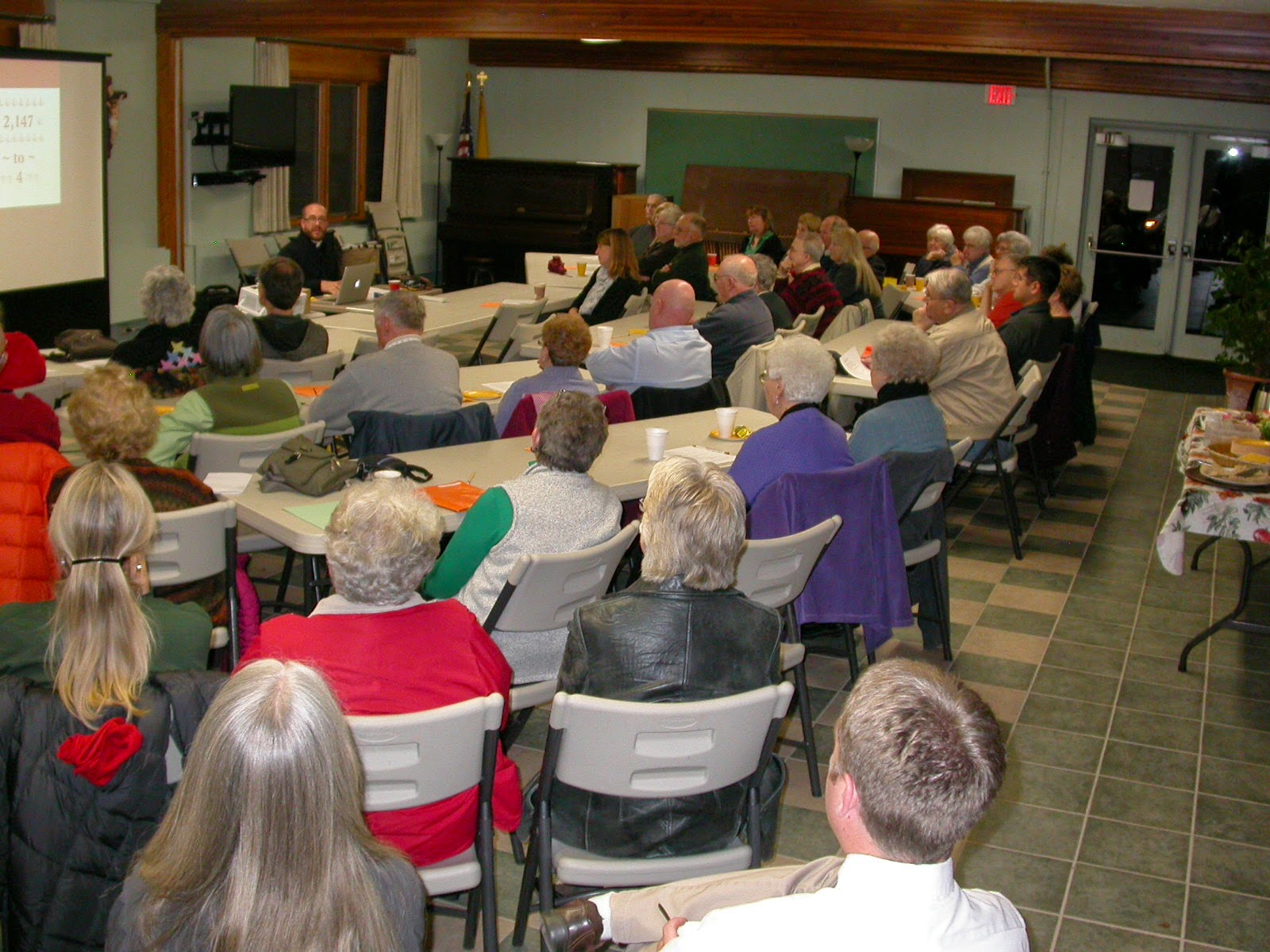
I spent last evening at St. Patrick's Church in Colton, where I was invited to give a talk on Vatican II's Constitution on the Sacred Liturgy as part of their adult faith formation series for the fall. This was essentially the same talk I gave at a diocesan workshop marking the 50th anniversary of the Second Vatican Council and the end of the Year of Faith (see here and/or here). You know it's quite a compliment to a cook to ask for a second helping of what's being served; likewise, it's quite a compliment to a speaker to ask him to give the very same presentation all over again! Deep thanks to my hosts for the kind invitation (along with a really wonderful meal beforehand), and to the fine group of folks from the parishes in Potsdam and Colton who came out on a "dark and stormy night" to listen, discuss, and ask questions.
A Time to Dance
Even though it doesn't look or feel anything like Indian Summer out there this morning, Snoopy's optimistic outlook had my toes tapping just a bit this morning...

And then I heard about this fancy footwork coming out from my alma mater:
Help these two priests go truly viral and watch the original YouTube video here. Then be sure to dance your way on through the day.
And then I heard about this fancy footwork coming out from my alma mater:
Help these two priests go truly viral and watch the original YouTube video here. Then be sure to dance your way on through the day.
Sunday, October 19, 2014
What it's Worth
Twenty-Ninth Sunday in Ordinary Time A
Two
well-worn bills arrived at the Federal Reserve to be retired:
a
twenty and a one dollar bill.
As
they traveled together down the conveyor belt,
they
struck up a conversation.
The
twenty reminisced about
what
an interesting and exciting life he’d had,
traveling
all over the country.
“I’ve
been to the finest restaurants, Broadway shows,
Hollywood
and Las Vegas,” he said.
“I
even went on a lovely Caribbean cruise.
Where
have you been?”
“Oh,”
said the dollar bill, “I’ve been to the Catholic church,
the
Methodist church, the Baptist church, the Episcopal church…”
Repay to Caesar what belongs
to Caesar,
and to God what belongs to
God.
Jesus
asks those trying to trap him
if
he might see a Roman coin—
cleverly
proving that he doesn’t carry any,
but
that the holier-than-thou Pharisees sure do.
(They
may not want to pay taxes to a pagan government,
but
its money isn’t so tainted
that
they won’t carry some of it around in their pockets.)
The
coinage bore the emperor’s likeness
 and his inscription—
much
like our American currency is marked
with
portraits of presidents and patriots
and
the signature of
the Secretary of the Treasury.
But
there’s an important difference
between
a U.S. dollar and a Roman denarius:
the
emperor, right there on the coin,
claimed to be divine.
What
we have here is not a conflict
between Church and state,
but
between the true God and a false one.
“Whose
image is this?” Jesus asks.
You
won’t find him asking for a Jewish coin
to
hold up alongside the Roman one—
a depiction
of the heavenly Lord of Hosts
to
contrast with the picture
of an earthly emperor.
No—on
their money as on anything else,
Jewish
law strictly forbade making any image of God.
Why?
Because
a sharper image of God could be found elsewhere:
not
carved into statues or painted on canvases
or minted
as spare change,
but
in human beings themselves.
As
God says on the sixth day in Genesis:
“Let us make man in our
image, after our likeness.”
God then looked at what he
had made,
and he found it very good (1:26, 31).
This
deeply embedded faith of the Jewish people
was
quite the opposite of the idolatry that surrounded them:
instead
of creating gods that resembled human beings,
they
believed in a Creator who made human beings
so
that they would resemble God.
That’s
a faith, of course, which would be perfectly fulfilled
when
the Word became flesh, when God became man.
From
the very beginning,
God
had been modeling the human race on Christ. (cf. J. Lienhard)
Jesus’
teaching here is thus not so much
about
taxation or the interplay of politics and religion;
it’s
about belonging.
These coins bear the image
of the emperor;
give him all the coins he wants;
they belong to the emperor.
they belong to the emperor.
But you have been created in
the likeness of God;
give him your heart and mind, your body and soul,
your energy and resources—your entire self;
you belong to God.
As
it is with money,
to
whom we belong determines what we’re worth.
A
woman who had suffered long and intensely
once
approached her pastor and said through her tears,
“I
have come to realize that I’m like an old twenty-dollar bill:
crumpled,
torn, and dirty, scarred and abused.
But
I’m still a twenty-dollar bill.
I
am worth something.
Even
though I may not look like much,
and
even though I’ve been battered and used,
I
am still worth the full twenty bucks.”

I’m
thoroughly convinced
that
all the hurtful things done in the world today
are
done because people don’t recognize
this
innate, God-given dignity:
their
own, or anybody else’s.
And
that’s why, on this World Mission Sunday,
we
must recognize the urgent need to spread this Good News.
We
are living in mission territory!
We desperately
need to help people—starting here and now—
to
see their true dignity:
that
they’re worth something;
that
they’re worth everything—genuinely priceless, in fact.
And
that this immense value of theirs doesn’t come
from
what they own, or who they know,
or
the things they might be able to accomplish.
They
are worth something
because
God has grasped them by the hand, called them by name,
given
them a title—even if they know it not.
They
have a Father who has chosen them because he loves them.
They
have been marked as God’s own
simply
by being formed in the likeness of his Son.
And
if they receive Baptism,
and
if they endure in faith, in hope, and in charity,
then
that image can be restored to its original glory.
But
if we’re ever going to help anybody else
to
believe this astoundingly good news,
we
must first believe it ourselves.
Do
I belong to God?
Have
I given my whole life to him, or only certain portions of it?
Do
I recognize God’s image in me?
When
I look in the mirror, do I see the likeness of Christ?
Do
I believe that God made me, made me out of love,
made
me for a specific purpose in his plan,
and
made me good—very good?
Can
I see my true dignity?
That
real value comes not
from
power or popularity or possessions?
That
every person I meet is a priceless treasure?
You
are worth so much more
than
any pile of coins or stack of bills.
Give to the Lord the glory
due his name!
Repay to God what belongs to
God.
Sunday, October 12, 2014
More Than Guests
A parishioner came up to me after the first Mass this morning and said, "Thanks for that homily, Father. My mother's not Catholic, but she's come with me to Mass many times. And she always says, 'I'll never understand you Catholics! When you come back from Communion, you just don't look happy. Some of you actually look miserable. I'll never figure you guys out!' Father, I can't wait to get home and tell her what you said..."
Twenty-Eighth Sunday in Ordinary Time A
I turned
40 on Wednesday,
and
on Friday night my family threw a party.
It
was a real feast, with lots and lots and lots of food.
But
what made the celebration
wasn’t
nearly as much the cuisine on the table
as
it was those who were gathered together to share it.
I
would have been a bit disappointed, of course,
if
any of the invited guests had failed to appear.
But
just imagine if all the balloons were hung,
the
table was set, the cake was baked…
…and
I hadn’t shown up.
I
sure would have had some explaining to do!

Now,
my birthday party was no royal wedding—
as
we hear about in Jesus’ parable this Sunday—
but
there is a parallel in imagining a grand banquet
to
which the guest of honor never comes,
or
arrives not properly disposed.
When
Jesus tells a story,
we
know it isn’t just a story…and this one is no exception.
The
king is God, and the king’s son is Jesus.
The
wedding banquet is an image of heaven—
but
it’s also the new life God offers us here on earth,
one
that we taste most unmistakably in the Eucharist.
The
king’s servants are prophets and apostles.
The
first guest list is made up
of
those who fail to heed their message;
the
second, of those on the margins.
So
much for what’s in the story.
How
about what’s missing?
All
this talk of a wedding,
and
there’s not a single mention of the bride.
Where
is she?
Better
yet, who is she?
Well,
if the king’s son is Christ,
then
we know that the bride is his Church.
The
bride is you and me.
No
matter the outward appearance of the building—
however
humble or opulent—
whenever
we come to church for Mass,
the
Lord is taking us into his house
and
spreading a table before us
with
juicy, rich food and pure, choice wine.
But
the King gathers us in not just as so many guests:
we
are to enter into an intimate union—a holy communion—
with
his Son.
This
is where heaven and earth, God and man,
come
together to be joined as one.
That’s
how we can make sense
of
some of the stranger twists in this Sunday’s parable.
The
king reacts so strongly to news of his deadbeat guests
because
it’s actually the bride
who’s
failed to show up for his son’s wedding.
And
the king’s feelings are so intense
about
a missing wedding garment
because,
in fact, the bride now shows up…
…but
without putting on her dress.
A
priest friend recently shared with me
an
insight that he’d read or heard
on
our sense of being “invited” by the Lord
to
come here to Mass.
Someone
who receives an invitation to a dinner party
is
free to take it or leave it,
depending
on how interested they are or if they get a better offer.
But
the Eucharist is less like a dinner party
and
more like a family supper.
You
aren’t invited to a regular family supper;
you’re
expected.
Your
absence is noted
because
your presence has been anticipated.
And
if you show up to the table in body
but
your attention is obviously elsewhere,
that
will certainly be noticed, too.
You’ll be missed when you’re missing
You’ll be missed when you’re missing
only
because you’re so deeply loved.
You
are so much more than an invited guest!
Although born a commoner,
you have been chosen to become a member of the royal family.
you have been chosen to become a member of the royal family.
Your
place at the king’s supper table is reserved,
and
this is a standing appointment not to be neglected.
When
I look out into the pews on most Sundays,
 I
must say I don’t see folks who look like they’re at a wedding;
I
must say I don’t see folks who look like they’re at a wedding;
to
tell the truth, I see folks who look a lot more
like
they’re at a funeral—quite possibly their own!
What
ought to be seen—on my face as much as yours—
is
the look I see on a bride’s face
as
she takes her walk down the aisle:
smiling,
beaming, unable to hide her happiness and excitement
at
the wonderful thing about to take place.
In
light of Jesus’ challenging parable,
we
all need to stop and ask ourselves:
Why
am I here?
Do
I come to church because of some sense of duty,
to
fulfill a stern obligation, out of fear of hell?
Or
do I come to Mass
because I’m filled with love, joy, and devotion
at
the thought of the one who awaits me here?
If
you’re happy to be here,
then
make sure your heart gets the message to your face!
Your
disposition in coming to Mass
will
affect what you’re able to take from it.
It
will also affect who else decides to join us here.
We
certainly don’t want to leave Jesus jilted at the altar.
But
neither is it enough for us to simply show up.
A
little preparation is required of each one of us.
It
matters how and why we’ve come.
When
Jesus tells a story, it isn’t just a story.
And
when Jesus serves a meal, it isn’t just a meal.
The
Eucharist is a royal marriage banquet—
it
is the wedding supper of the Lamb of God.
Don’t
get caught having to explain your absence!
Come
clothed in joy to be joined again
with
the Bridegroom of your soul.
You've not only been invited—
you've been chosen.
You've not only been invited—
you've been chosen.
Subscribe to:
Posts (Atom)