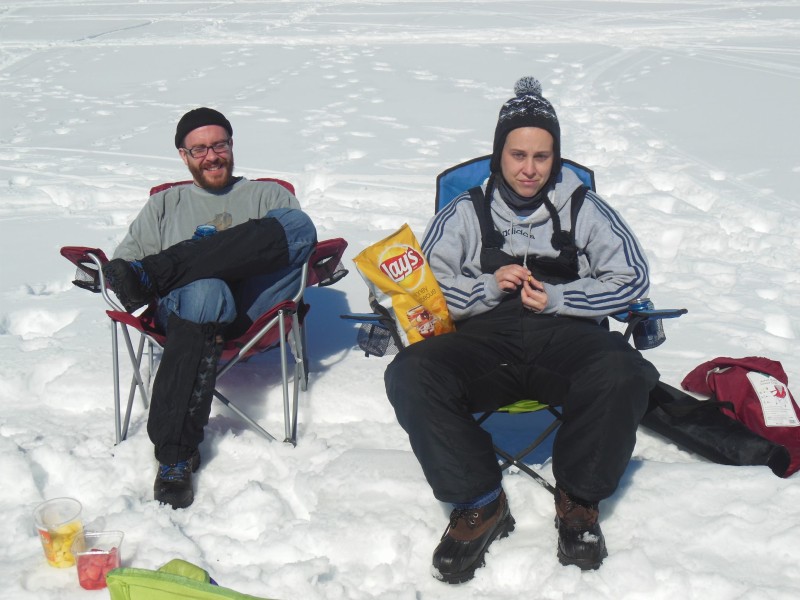
Photos from a couple of events that I just haven't had time to post yet...
As I mentioned earlier, I went ice fishing with my sister and her family back on March 9. It was not only a fun day...but I actually caught something!
Those who know me know I've never been much of a fish eater...so I gladly threw him back.
And then on March 17, I led a pilgrimage to St. Patrick's Church in Hogansburg. This was the "mother church" for our region, established back in 1834. Times have changed, and the church will close next July. As you can see, a sizable number of grateful folks from the "daughter churches," along with their pastors, made the trip for the visit (which included a talk on the parish's history) and time of prayer.
"Oh miracle—thus to be able to give what we ourselves do not possess, sweet miracle of our empty hands!" (Georges Bernanos, Diary of a Country Priest)
Friday, March 29, 2013
Mortal
Friday of the Passion of the Lord
Listen to the Lord’s appeal:
Do
not be afraid.
This cross inflicts
a mortal injury,
not on me, but on death.
These nails no longer pain me,
but only deepen your love for me.
I do not cry out because of these
wounds,
but through them I draw you into my heart.
My body was stretched on the cross as a symbol,
not of how
much I suffered, but of my all-embracing love.
Saint Peter
Chrysologus
Thursday, March 28, 2013
Messing with the Menu
Evening Mass of the Lord's Supper
The
Seder meal—
the ritual supper which is at the very heart
of
the Jewish celebration of Passover—
was
already a fixed tradition more than a thousand
(maybe
even twenty five hundred) years old
when
Jesus reclined at table
to
share his Last Supper with his disciples.
We
heard the menu—still careful followed today—
prescribed
by God to Moses in the Book of Exodus:
unleavened bread, because the Israelites
left Egypt in such haste
there
was no time for the dough to rise;
bitter herbs, recalling the harsh and bitter
cruelty
of
the slavery they had endured;
and
roasted lamb, recalling the sacrifice
whose
blood was applied to the doorframe of the house,
that
the angel of death might pass over God’s chosen ones.
are
not ones you tinker with lightly.
So
it should make us sit up and pay attention
when
just this year a group of American rabbis
They’ve
suggested adding…a tomato.
You
see, Passover was never intended
to
simply commemorate
an event from long ago.
It’s
about liberation—
about
the freedom the Lord desires
for his people,
both
way back then and still even now.
The
supper isn’t mean to just recall
what happened in history;
it’s
meant to set people free in each new generation.
And
these American rabbis have looked around
and
realized that not all slavery was left behind in Egypt.
They’ve
looked at the migrant workers—
tomato-pickers,
in particular—
whose
hidden labor provides us with so much of our food,
and
seen a people often underpaid and overworked,
sometimes
even beaten.
“The
truth is,” one of the rabbis said,
“there
are people in our own country
who
don’t have to imagine what it is like to be a slave.”
These
socially-conscious rabbis, of course,
are
not the first to tinker with the Passover supper.
Jesus
did the same thing nearly twenty centuries ago.
And
it would have surely been quite attention-grabbing to the Apostles
when
their Master and Teacher began to deviate from the script
as
they shared the Seder in that upper room.
First,
Jesus knelt down to wash feet.
It
was customary to have a household servant
make
the rounds early in the proceedings,
ceremonially
washing the hands of all the guests.
It
was unheard of, however, that the head of the household
should
take such a lowly task upon himself—
and
bathing not hands already scrubbed clean,
but
dusty, stinky, calloused feet.
Do for one another, he commands, as I have done for you.
When
it comes to charity among those
who
dare speak and act in his name,
there
can be no task too humble.
And
after returning to the table, Jesus shakes things up again.
Instead
of blessing the God of all creation
for
providing us with bread from the earth
and
the sweet fruit of the vine,
he
says, Take, eat, and drink.
This is my Body. This is my Blood.
Flesh
and blood were repeatedly mentioned during the Seder meal,
but
they were the flesh and blood of the Passover lamb,
not
of the supper’s host.
And
so Jesus reveals himself to be the Lamb of God,
instituting
a Sacrament—the Holy Eucharist—
that
he might remain present always
among
those who believe in him—
food
to sustain us on life’s pilgrimage
as we
wait for the Lord to come.
But
Jesus didn’t stop there, either.
This
Body is to be given up,
and
this Blood is to be poured out.
That
is the language of sacrifice,
and
sacrifice is uniquely the work of a priest.
Now,
Jesus did not come from a priestly family—
his
lineage from the tribe of Judah, not Levi.
And
yet he speaks of making an offering to God—
offering
not animals on an altar of stone,
but
making a total gift of himself on the wood of the Cross.
Who
better, really, to be our High Priest,
the
mediator—the bridge—between heaven and earth,
than
he who is both true God and true man?
And
in his most daring move of all,
that
his one, perfect sacrifice might be renewed in every age—
that
God might continually touch the lives of his people
and
that his people might continually
be able
to reach out and touch their God—
Jesus
shares his priesthood with those men he has chosen
and
called to his side.
Do this in memory of me.
No,
Jesus didn’t add any tomatoes to the Passover menu;
tomatoes,
in fact, wouldn’t be introduced in the Middle East
for
another eighteen hundred years.
But
the startling changes he did make
were
for much the same purpose:
he
had come into this world to set slaves free.
When
God created man and woman,
he
placed them in Paradise—in a playground, a pleasure garden.
(And
is it not walking again in a garden
that
we’ll find our Lord at the end of this sacred Triduum?)
We
were made, you see, for freedom,
not
to ceaselessly toil and till the ground.
But
sin and—with it—death
have
made the human experience one tainted by suffering.
The
Son of God has taken this suffering upon himself
and—like
the Sedar ritual—turned it completely on its head.
What
once bespoke destruction
has
become in him the source of everlasting life.
To
ransom us slaves, God gave away his Son.
As a
French poet once insightfully put it,
“Christ did not come to do away with suffering;
he did not come to explain it;
he came to fill it with his
presence.” (Paul
Claudel)
And
so Jesus remains present with us
wherever
charity and love prevail.
Jesus
remains present with us
wherever
we break the Bread of Life.
Jesus
remains present with us
wherever
his holy priesthood is exercised.
He
remains present
because
he radically altered and fulfilled the Passover.
He
remains present that he might set us free forever
and
renew the face of the earth.
Sunday, March 24, 2013
Criminal
"For I tell you that this scripture must be fulfilled in me, namely,
'He was counted among the wicked'..." (Luke 22:37)
Palm Sunday of the Passion of the Lord C
On
February 12, 1913—
just
over 100 years ago—
Frederick
Poulin was the last man
to
be executed in the electric chair
at
the state prison in Dannemora.
The
Schenectady bartender
had
been caught in a love triangle
a year and a half before,
leaving
Charles Leonard shot dead;
the
details of both
the relationship and the killing
are,
of course, disputed.
Accounts
from the time state
that,
on his way to the death chamber,
Mr.
Poulin carried in his right hand a little crucifix.
That
same crucifix had previously been carried
in
the hands of 19 other condemned men at Dannemora
who
had preceded him
in
taking the fatal walk to the chair.
(cf.
Press Republican, 2/11/13)
Now two others, both
criminals,
were led away with Jesus to
be executed.
Those
two convicted criminals mentioned in our Lord’s Passion—
they
stand for us all, do they not?
The
Son of God took flesh and dwelt among us
because
the human race was on death row.
Because
of sin, we have been condemned justly,
for the sentence we received
corresponds to our crimes.
But
this man, Jesus:
he
has done nothing criminal.
And
yet he dies—
neither
rebelling nor turning back,
nor
loudly protesting his innocence.
Rather,
Jesus humbled himself,
becoming obedient to the
point of death, even death on a Cross.
As
we’ll pray in a few moments—
praying
as his saving Passion is renewed for us in the Eucharist—
“though
innocent, he suffered willingly for sinners
and
accepted unjust condemnation
to
save the guilty.” (cf. Preface, Palm Sunday
of the Passion of the Lord)
A
small crucifix in Dannemora was passed down
through
the hands of twenty condemned men…
…but
it points to the Cross which has now been grasped in faith
by
countless sinners across twenty centuries:
the
same Cross we are called upon
to
contemplate during this Holy Week;
the
same Cross whose sweet wood
we
will kiss again with tenderness on Good Friday;
the
same Cross which has remained
the
paradoxical sign of hope for the hopeless,
who
recognize their real and urgent need for a Savior.
Joy-filled
crowds, who only know half the story,
can
wave their palm branches
in
a frenzied welcome fit for a King.
But
we who dare to stand by Christ to the end,
knowing
that he will likewise always stand by us,
raise
instead the instrument of his death
which
signals not man’s final defeat,
but
God’s ultimate victory.
With
us and for us, Jesus willingly chose to be condemned,
nailing
our sentence to his Cross.
Behind
the thick, high walls
of Dannemora’s prison,
there
is a Catholic chapel—
a small church, really—
built,
stone by stone,
by the inmates there.
It
is dedicated to the Good Thief.
With
that dying criminal
who steals his way into Paradise,
with
all who cling
to Christ and his Cross, we pray:
Jesus, remember me
when you come into your
kingdom.
Sunday, March 17, 2013
Takin' it to the streets
Happy St. Patrick's Day, everybody!
Fifth Sunday of Lent C
Pope Francis.
It’s going to take some getting used to, isn’t it?
We
don’t know too much about our new Holy Father just yet,
so
the whole world is eagerly watching his every move.
You’ve
already heard—of course—
that
as Cardinal Archbishop in Buenos Aires
he
led a rather simple life:
staying
in a small apartment; cooking his own meals;
riding
on buses and subways rather than in limousines.
He
was a “priest of the streets”:
a down-to-earth
shepherd living right amongst his poor flock.
In
fact, on his very first day as Supreme Pontiff,
he
stopped by the hotel in which he stayed before the Conclave
to pick
up his luggage and pay his own bill.
We
shouldn’t be too surprised, then,
at
the news out of Rome this morning:
it
seems that, for breakfast today,
Pope
Francis decided to stroll out of the Vatican
to
a neighborhood café and order an espresso.
When
he was done, the Pope asked the barista, “How much will it be?”
“That’ll
be 5 euro,” came the answer.
As
the Pope reached into his pocket for the money,
the
barista joked, “You know, we don’t get many Popes in here.”
Which
is when Pope Francis replied,
“And
at these prices, you won’t get many more, either!”
(OK…so
I made that story up…
…but
it sounds like it could happen, right?)
We
welcome the election of our new Pope
…and
it sure seems he’s the right man at the right time.
In
his native Argentina,
Pope
Francis showed a strong commitment
to the new evangelization—
to
revitalizing the Catholic faith among his people.
In
an interview published just about a year ago,
then-Cardinal
Bergoglio said
that
faith “is not a possession, but a mission.”
The
future Pope continued:
We
need to come out of ourselves
and
head for the [margins]*.
We
need to avoid the spiritual sickness
of
a Church that is wrapped up in its own world:
when
a Church becomes like this,
it
grows sick.
It
is true that going out onto the street
implies
the risk of accidents happening,
as
they would to any ordinary man or woman.
But
if the Church stays wrapped up in itself,
it
will age.
And
if I had to choose between
a
wounded Church that goes out onto the streets
and
a sick withdrawn Church,
I
would definitely choose the first one.
(Vatican Insider, 2/24/12)
Out
in the streets.
That’s
where our new Pope seems most comfortable.
And
that’s where Jesus seems right at home, too.
In
this Sunday’s familiar and dramatic gospel story,
we
find Jesus not sitting within the temple,
but
outside of it—in the surrounding area.
It
is there among the common people that he’s teaching,
first
by his words, and later—so powerfully—by his actions.
It
is there in the streets that Jesus
encounters
the adulterous woman and the murderous crowd—
both desperately in need of
healing and mercy.
Jesus
didn’t wait for the lost to find him;
he
went out to seek and find them.
So
far during this Year of Faith,
we’ve
undertaken a number of initiatives here in our parishes
and—praise
God—I believe we’re seeing them bear fruit.
We
distributed a thousand Year of Faith booklets
in November,
half
of them going to fallen away Catholics.
We’ve
strongly promoted the Sacrament of Penance;
not
only have we increased the availability of confession,
but
we’ve also seen more people taking advantage of it—
some
of them, after many, many years.
We’ve
got better than 50 people—some weeks, as many as 75—
participating
in the ten-part Catholicism series.
Fr.
Stitt’s virtual tour of the Vatican
brought
in about 150 folks 10 days ago,
and
I hope many will be taking part in today’s actual pilgrimage
to
St. Patrick’s Church in Hogansburg.
And—as
some of you have noted—
Mass
attendance appears to be up;
we even
seem to have more young people
in our
churches on Sundays.
But
the most encouraging thing I’ve noticed
is
not something I can mark on a calendar or a tally sheet;
it’s
a shift in attitude I’ve observed in so many of you.
More
and more often I hear you telling me stories
about
how you’ve reached out to someone
to
invite them back to the practice of the faith,
or
even to check out the Catholic Church for the first time.
I’m
seeing a new confidence, born of renewed conviction.
You’re
rediscovering the supreme good
of
knowing Christ Jesus as Lord,
and
you just can’t keep it to yourselves.
Our
Catholic faith—as our new Pope says—
“is
not a possession, but a mission”;
it
necessarily takes us out into the streets.
And
so this Sunday we’re announcing
our
next “big thing” for the Year of Faith:
on
Divine Mercy Sunday—the Sunday after Easter—
we
will be beginning the 40 Hours Eucharistic Devotion.
40
Hours was once very common
here
in Malone and across the North Country,
but
now—as far as we know—hasn’t taken place
anywhere
in the Diocese of Ogdensburg for several decades.
We
think it’s high time to dust off this venerable tradition.
Basically,
from early morning until midnight,
the
Blessed Sacrament will be exposed for adoration
and
various liturgies and devotions will be scheduled
for
a total duration of—you guessed it—40 hours.
(More
specific details can be found in this weekend’s bulletin insert.)
This
is about coming together to spend time with Jesus:
not
before a pretty statue or painting of him,
nor
contemplating noble ideas about him
in
our minds and hearts,
but
sitting attentively before his real presence in the Eucharist—
just
like those crowds did, gathered around Jesus in Jerusalem.
In
the weeks ahead we’ll be asking for volunteers
to
sign up and commit to an hour or two of adoration
during
the course of these two and a half days.
But
we’d miss the whole point if we stopped there.
And—to
be honest—it’s the “grand finale”
to which
I’m most looking forward.
On
Tuesday, April 9, after an evening Mass,
we’ll
be taking Jesus out into the streets:
we’ll
have a Eucharistic procession,
carrying
the Blessed Sacrament into and through our community.
With
candles and incense, prayers and songs,
we’ll
be making it clear that the Savior we worship
didn’t
come to stay locked up inside our pretty churches,
but
still desires to go out and touch a hurting world.
Can
you imagine the impression it’ll make
on
the people of this village—
not
to mention the truckers driving down Main Street—
to
see hundreds of Catholics
making
such a visible, public statement about their faith?
And
can you imagine the momentum it will generate
as
we continue through this Year of Faith—and beyond—
to
keep introducing our friends and neighbors to Christ,
to
keep helping the lost find their way back home?
Do
start making plans now—as much as you are able—
to
take part in the upcoming 40 Hours.
We
recall that, in ages past, God led his people
through
the mighty waters of the sea
and
then through the desert wasteland,
accompanying
them all along their long journey to freedom.
And
we know that Jesus, likewise, stayed very close
to
the sick, the sinner, and the poor,
announcing
to them the Good News of salvation.
It
is the very same Lord who walks with us today
and
stays near us still.
Let
us, then with our Holy Father, Pope Francis,
strain
forward to what lies ahead:
the
pursuit of life’s true goal,
our
upward calling in Christ.
Let’s
not hesitate to take this faith
out
into the streets.
*Original: "periphery"
Subscribe to:
Posts (Atom)