"Oh miracle—thus to be able to give what we ourselves do not possess, sweet miracle of our empty hands!" (Georges Bernanos, Diary of a Country Priest)
Wednesday, August 8, 2012
Fair Day
A visit from my sister, niece, and nephew yesterday had Fr. Tom and I taking in the joys of a gorgeous afternoon at the Franklin County Fair. A few highlights...
Sunday, August 5, 2012
Hungry?
Eighteenth Sunday in Ordinary Time B
A
rich man came across a poor, hungry beggar.
The
rich man asked, “Do you smoke?
I could
give you some cigarettes.”
But
the beggar replied, “No, I don't smoke.
I’m
just want food.”
Then
the rich man asked, “Well, do you drink?
I could give you.”
But
the beggar responded, “No, I don't drink.
I’m
just looking for something to eat.”
Finally
the rich man asked, “Do you gamble?
I
could give you some good tips
on the races this weekend.”
The
beggar again replied, “No.
I’m
just hungry and need some food.”
So
the rich man said,
“In
that case, I’d better take you to my home.”
He
loaded the beggar into his fancy car,
drove
him to his swanky house,
and
there introduced him to his wife.
She
immediately asked,
“What
are you planning to do with this man?
Are
you going to invite him to live with us,
to
eat our food and wear our clothes?”
“Heavens,
no!” the rich man replied.
“I
just wanted to show you what becomes of a man
who
doesn’t smoke, drink, or gamble.”
Rich
or poor,
on
the seashore or in the desert,
we
all get hungry.
We
have physical appetites for food and drink, for sure.
But
we also have longings and desires
for
affection and intimacy, for security and belonging,
to understand
and to possess.
We all
know what happens
when
you don’t respond to bodily hungers
with
a regular, balanced diet:
you
settle for the junk food most quickly and easily available.
Your
health suffers for it…
…and—no
matter how much of it you eat—
you
still can’t seem to shake the hunger.
So,
too, with the appetites of mind and soul.
How
often we settle for junk!
And
we all know, my friends,
that
smoking, drinking, and gambling
are
just the tip of the iceberg.
St.
John Vianney—whose feast was celebrated yesterday—
once
put it this way:
Without the Holy Eucharist
there would be no happiness
in this world;
life would be
insupportable.
When we receive Holy
Communion,
we receive our joy and our
happiness.
The good God,
wishing to give himself to
us in the sacrament of his love,
gave us a vast and great
desire,
which he alone can satisfy.
Where
do you go when you’re hungry—really
hungry?
Is
there junk food you’ve settled for?
Do you
truly recognize the one and only place
where
your deepest appetites can be fed?
Are
you ready and willing—if necessary—to change your diet?
As
Jesus instructed the crowds
miraculously
filled by five loaves and two fish,
“Do
not work for food that perishes,
but
for the food that endures to eternal life.”
May
our partaking in the true Bread from heaven
only
serve to deepen our hunger
for
him alone who can satisfy it.
Sunday, July 29, 2012
Winning Isn't Everything
Seventeenth Sunday in Ordinary Time B
The
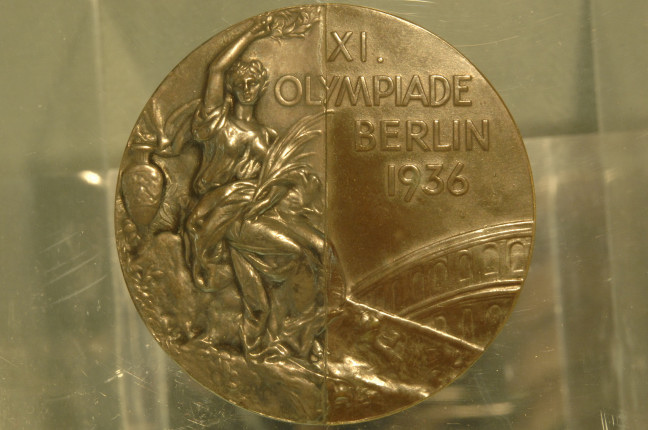
1936 Summer Olympics in Berlin
are
generally remembered for their controversy.
Hosted by Hitler’s Nazi party,
the original intention was that no Jews or blacks
be allowed to participate in the Games;
at the threat of international boycott,
the organizers relented.
Hosted by Hitler’s Nazi party,
the original intention was that no Jews or blacks
be allowed to participate in the Games;
at the threat of international boycott,
the organizers relented.
But
there’s a little known piece of 1936 Olympic trivia
which
has recently caught my attention.
It
seems that two Japanese athletes—
Shuhei
Nishida and Sueo Oe—
tied
for second place in the men’s pole vault.
Rather
than continue
to compete against each other in a jump-off,
the
two drew lots for the silver medal.
Nishida
won, and Oe took the bronze.
But
when the pair got back to Japan,
they
had their medals cut in two and then joined together
so
that each had a medal which was half silver and half bronze.
For
the next few weeks,
the
eyes of the world will be fixed on London
and the Olympic Games now underway there.
The
Olympics would not be the Olympics, of course,
without
competition…but—as stories like that
of
the Japanese pole-vaulters remind us—
competition
is not their ultimate purpose.
The
purpose of the Olympics is not the awarding of medals—
though
it is right for us to celebrate excellence and achievement;
no,
the purpose of the Olympics
is
to bring the world closer together:
first
by uniting athletes across competitive borders,
and
then by better uniting their nations
in
mutual understanding and respect.
If
strict competition isn’t the ruling principle
even
of the Olympic Games,
then
maybe there are some of the other areas of life and society
where
we need to reexamine our purpose and priorities.
I
think of global economics,
where
the gap keeps growing between rich and poor;
where
nearly a billion people go to bed hungry each night
while
there’s more than sufficient food to feed the world.
I
think of national politics,
where
the focus has shifted from what’s best for the country
to
who wins and who loses—no matter the cost.
I
even think of the Church,
where
conflicts escalate on so many issues
ranging
from liturgy to lifestyles.
But
for all the struggle to come out on top,
why
does it seem we’re not getting ahead—
in
fact, that we’re loosing ground?
Is
this what it means to take first place?
Consider
how that little boy
brought
forward by Andrew on the mountainside
That’s mine! I earned it. I brought it. Get your own!
But
instead, he placed his few loaves and fish in Jesus’ hands
and
watched a miracle unfold:
not
only that there was more than enough food to go around,
but
that, by sharing this simple meal,
a
ragtag crowd come from all over
had
been changed into a community
reclining
on the grass to picnic together in this out of the way place.
“I
urge you,” Saint Paul writes to the Ephesians,
“to
live in a manner worthy of the call you have received.”
He’s
encouraging us to be the very best!
But
Paul here doesn’t advocate a fiercely competitive spirit
where
triumph comes at great expense to others;
rather,
he’s summoning us to a humble striving
that
preserves unity and strengthens the bonds of peace.
Just
imagine how different our times would be
if
we each did our very best every day—
not
for our own glory, but for God’s!
In
1936, a world on the brink of war
desperately
needed the example of two Japanese pole-vaulters,
telling
it that there’s something much more important than winning.
In
2012, when so many things still divide us,
the
world very much stands in need of the same message.
May
this message come not only from the Olympic Games,
but
even more from those of us who are disciples of Jesus Christ:
who
have in common one Lord, one faith, one baptism.
Continually
brought closer together in one body by the Eucharist,
may
our increasing unity give living witness
to
the one God and Father of all.
Yes,
we may need to lay aside some of our competitiveness…
…but
let’s not neglect to go for the gold!
Thursday, July 26, 2012
St. Ann
As I mentioned last year, St. Ann has a pretty special place in my heart...so this afternoon, Fr. Tom and I make a quick pilgrimage to her shrine in Isle LaMotte, Vermont. It wasn't the prettiest day to enjoy the view there on the eastern shore of Lake Champlain (the overcast skies were bringing us just a little bit of much needed rain), but it was well worth the drive, nonetheless...

Good Saint Ann,

pray for us!
Sunday, July 22, 2012
Relax
Hope you can enjoy a day of rest...
Sixteenth Sunday in Ordinary Time B
Sherlock
Holmes and Dr. Watson
went on a camping trip.
As
they lay down for the night, Holmes said:
“Watson,
look up into the sky
and tell me what you see.”
Watson
replied, “I see millions and millions of stars.”
"And
what does that tell you, Watson?"
“Astronomically,
it tells me that there are millions of galaxies
and
potentially billions of planets.
Theologically,
it tells me that God is great
and
that we are small and insignificant.
Meteorologically,
it tells me that
we will have
a beautiful day tomorrow.
What
does it tell you, Holmes?”
“It
tells me, my dear Watson,
that somebody has stolen our tent.”
I
spent this past week
“camping,” after a fashion,
and
the staff at Camp Guggenheim.
It
wasn’t exactly vacation:
I
offered daily Mass, heard confessions,
led
prayer, helped with workshops,
and
took part in all the many
summer camp activities
which
kept me up well past my usual bedtime.
But it was a refreshing change of pace, nonetheless,
that
gave me the opportunity
to
climb a mountain, get out in my kayak,
eat
a few more ice cream cones
than I probably should,
and
even stop to look up
and marvel at the stars.
Coming
back from these days—paradoxically—
both
a little more sleepy and a little more relaxed than usual,
I smiled widely to come across the following reflection yesterday morning:
Modern life is lived at high tension;
its pace is intense and nerves get frayed.
Whatever it costs,
we must learn how to stop, when we need to,
and draw a quiet breath.…
[W]e must still learn how to relax…
In order to acquire this art,
we must learn particularly how to take advantage
of the little opportunities life has to offer
and become children at heart again.
We must not live at such an intensive, hustling pace
that we no longer have time to…have time.
To be relaxed makes one accessible to others.…
We must learn, or re-learn, to have time.
Our Lord himself did not want his apostles
to live in a state of perpetual tension.
He urged them to “come away into a quiet place”:
“rest a little”, he said to them
on days after they had finished their apostolic
missions.
In the wilderness and in solitude,
he revealed to them the best of himself and his
message.…
We stand in need of rest;
rest in the ordinary sense of the word,
and also rest in God.
We must find a place for him in the bustle of the
day;
a place for private prayer, for slow and meditative
reading.
We need this “oxygen.”
No luxury this; it is one of our vital necessities.…
In the midst of work,
we must keep our hearts open to God.
It helps so much to keep things in their proper
proportion
if we keep a window open to heaven.…
We need to get our breath back.
That is why the Church is so insistent
on Sunday being kept as a holy day;
a day for public worship, certainly,
but also a day of rest.…
We must stop,
like the [mountain] climber who has reached a high
peak,
to take breath for a moment, admire the view,
fill our lungs with fresh air and go on to the next
peak.…
Do not let us neglect to fix our gaze on the sky
until we can see the stars there.
We make much better headway here on earth
when we have a sense of direction
and move forward with a firm step on solid ground.
Looking at the heavens is the form of relaxation
we can least dispense with
if we want to keep things in their perspective
and make the world a better place to live. (Christian Life Day by Day)*
Those
words are so apropos today!
Incredibly,
they were written by
Leon Joseph Cardinal Suenens of Belgium
all the way back in 1961—
a
time to which we very well
might look back now
as a far simpler one…
During
these last several days,
our
hearts—like Christ’s—have been moved with pity
at
news of fatal car accidents and damaging storms
here
in the North Country,
and
the senseless shooting in Colorado that tore apart
what
should have been an enjoyable evening at the movies.
Things
can seem completely run amok—
people
running about like sheep without a shepherd.
How
crucial for us to remember
that
Christ Jesus came preaching peace—
peace
to those both far and near!
We
need to stay in touch with that peace.
We
need to re-learn how to relax—
not
just because we want to be rested when we get back to work,
but
because “to be relaxed makes one accessible to others,”
and
accessible to God above all else.
On
these clear summer nights,
let’s
all take some time to step out and look up at the stars,
catching
our breath and—even for just a moment—
resting
in the God who made them.
*The entire book is available online here;
these passages are excerpted from chapter 27, "Learning to Relax," which begins on page 95.
Sunday, July 15, 2012
Nothing
On his way out of church this morning, a visitor stopped to say, "Thanks for nothing, Father!"
I had several ideas for a homily
when it hit me:
since it’s so blasted hot around here this weekend,
I ought to preach about nothing.
Now, before you get too excited,
I don’t mean no homily at all;
I mean a brief one on nothing.
St. John Vianney—
the patron saint of parish priests
whose image is right here beside the pulpit—
once said:
I have been privileged to give great gifts
from my empty hands.
Stay cool...
Fifteenth Sunday in Ordinary Time B
floating around in my head
since it’s so blasted hot around here this weekend,
I ought to preach about nothing.
Now, before you get too excited,
I don’t mean no homily at all;
I mean a brief one on nothing.
St. John Vianney—
the patron saint of parish priests
whose image is right here beside the pulpit—
once said:
I have been privileged to give great gifts
from my empty hands.
You’ll
notice in the gospel
that
Jesus sends out his twelve Apostles—
his first priests—empty handed:
no food, no money, no
change of clothes.
(Jesus
did, however, say they were to wear sandals…
…so
I’m carefully following
his instructions this morning!)
Given the crucial nature of this mission,
why
are they sent—apparently—with nothing?
![]() |
| Fr. Tom (right, with modern "sandals") and I in the sacristy before Mass yesterday evening at 90° F |
Well,
because they are sent to preach…
…but
theirs is to be
Jesus’ own message of repentance,
and
not some new teaching
which
they themselves have devised.
And
because they are sent to drive out demons…
…but
they can only do so in Christ’s name,
rather
than their own.
And
because they are sent out to heal…
…but
they are to use an intermediary—
oil for anointing—
since
they, too, are but instruments
of
Another’s power to cure both body and soul.
You
see, the Twelve go out with nothing—
nothing
of their own, at least—
to
make it perfectly clear
that what they have to give
does
not in any way come from them.
And
just what is it they have to give?
Every spiritual blessing in
the heavens,
lavished
upon us
out of the riches of God’s grace.
Like
the Apostles, all of us—
yes,
we priests in a particular way,
but
every single follower of Jesus, as well—
are
summoned and sent out to proclaim his gospel,
to drive
out the spirit of evil from this world,
and
to restore the sick to health.
So if
you’re feeling inadequate
or
ill-equipped for the job at hand,
have
no fear;
you’re
probably right where you should be,
since
what’s most needed to accomplish this mission is nothing:
not
our talents or skills or abilities,
not
popularity or power or pedigree,
but
our nothingness.
What
a privilege to be chosen to
give such great gifts
from
these, our empty hands!
Sunday, July 8, 2012
His & Hers
In honor of this blog's anniversary, I've got a little present to share with all of you. You may recall that my friend Dan had been serving a tour of duty over in Afghanistan and sent me a most fascinating gift. Well, Dan has safely (thank God!) returned home to his family...and sent me another care package about a month ago--this time, with a piece of headgear that I could be photographed wearing without causing either cross-cultural or cross-dressing scandal. The hat is called a "pakul" (or "mujahideen cap") and, together with the accompanying "man scarf," is as popular in Afghanistan as a baseball cap is here in the States. Dan was kind enough to include directions on how to properly roll the cap and wear the scarf. I could not, however, find instructions on how to take a picture of me in them that didn't look either rather frightening or mostly ridiculous...

Thanks again, Dan! I miss your blog...but we're so glad to have you back safe and sound!
A Prophet?
It was a year ago this past week that I started blogging. One can clearly see from the counter below that there've been nearly 18,000 visits to the blog since then. What you can't see is that nearly 2,000 of those visits have been from people searching for Bart Simpson. Whodda thunk mentioning him would open such doors for evangelization?
However you got here, thanks for visiting!
Fourteenth Sunday in Ordinary Time B
A
bishop was interviewing a seminarian,
asking where he might someday like to be assigned as a priest.
The seminarian said, rather boldly,
“Oh bishop, anywhere but Smallville.”
“Well, why not there?” the bishop inquired.
“You see,” the seminarian answered, “that’s my hometown—
and we all know that ‘a prophet is never honored in his native place.’”
“Don’t worry, my friend,” the bishop replied.
“Nobody is ever going to mistake you for a prophet.”
asking where he might someday like to be assigned as a priest.
The seminarian said, rather boldly,
“Oh bishop, anywhere but Smallville.”
“Well, why not there?” the bishop inquired.
“You see,” the seminarian answered, “that’s my hometown—
and we all know that ‘a prophet is never honored in his native place.’”
“Don’t worry, my friend,” the bishop replied.
“Nobody is ever going to mistake you for a prophet.”
I
quite clearly remember
during
my days as a student at Wadhams Hall Seminary
going
on a mountain climb in the Adirondacks
with
several other students and members of the faculty.
When
we’d reached the summit
and
were resting there on the warm rocks,
the
conversation somehow turned to particular challenges in ministry.
One
of the priests shared—
I
can still hear it like it was yesterday:
“One
of the hardest things to do as a priest
is
to be priest for your family.”
And
in my experience, anyway, time has proved him right.
Some
of it’s just plain practical.
I
have a whole bunch of cousins,
and
every time I turn around another one of them is getting married,
another
one of them has had a baby.
Very
early in my priesthood,
I
had to make it clear that I simply could not be present
for
every wedding and every baptism,
since
I have weddings and baptisms aplenty in the parish.
Now,
they’ve never complained to my face…
…but
I’ve heard it through the grapevine
how
this one or that has been less than understanding of my absence.
Of
course, there are deeper issues, too.
My
heart breaks as I see family members and close friends
who
have stopped going to Mass;
or
who have moved in with a partner—or even started a family—
without
the benefit of the sacrament of Marriage;
or
who have adopted a way of life
openly
at odds with the faith in which they were raised—
the
faith to which I’ve devoted my entire life.
Without
a doubt, my love and affection for them endures…
…but
what should I say? What shouldn’t
I say?
How
can I lovingly be their son, brother, nephew, cousin, friend…
…and
also faithfully be a priest of Jesus Christ?
It’s
a challenge, indeed!
And
it’s one I’m not sure I always get right.
A
recent exchange with a friend was a good reminder
that
this isn’t only a struggle for us
who
are “professionally religious.”
I’ll
call him “Adam.”
I
met him when he was getting ready for his wedding.
Adam
wasn’t raised in a very religious household—
and
hadn’t been going to Mass for many years—
but
his finacée was a rather devout Catholic.
And
to his credit, Adam realized
that
if he was going to ask the Church to give its blessing to his marriage,
then
he’d ought to become a better member of it.
To
see him reconnect with his faith
was
a truly wonderful thing to behold!
Now—a
number of years later—Adam’s father is dying.
He
wants for his dad the same thing he found for himself:
to
rekindle a relationship with God,
especially
in this crucial hour.
Adam
freely admits: he’s not as good a Catholic as he could be.
He
doesn’t always make it to Sunday Mass with his wife and daughter.
So
he’s not coming at this from some position of great self-righteousness.
He
just knows—firsthand—what a difference faith in Christ makes.
Adam
has tried to talk his dad into a visit from a priest…
…but
without any success just yet.
Needless
to say, he’s pretty disappointed.
But
at my urging, Adam’s praying…and hasn’t given up hope.
We
might all marvel at the way missionaries travel to far distant lands
and
proclaim the gospel to nonbelievers.
But
it’s an even trickier thing, I think,
to
share our faith with those who are closest to us.
We
can see in the gospel how Jesus’ own relatives and neighbors
were
at first astonished by his teaching…
…but
their astonishment quickly turned to taking offense.
They
thought they knew everything about him.
Maybe
they also thought Jesus owed them some special favor,
since
they shared a hometown and a history.
He was amazed at their lack
of faith—
not
mad, I don’t think, but sad:
disappointed,
like me and like Adam,
because
he loves them so very deeply,
and
wants only what’s best for them,
and
knows full well what they’re missing.
The
challenge that faces the Church today
here
in the western world
is
of reacquainting people with faith in Christ—
not
people who have never known him at all,
but
people who have never really known him well
and
who have to come to take him for granted.
Our
society has become a lot like Jesus’ native place.
We
think we’ve got him all figured out…
…when,
in fact, Jesus is little more than a “familiar stranger” to most.
Not
because we’re any better than anybody else,
but
because we love those who are near and dear to us
and
because we love our faith,
let
us recommit ourselves—each and every one of us—
to
this critical work of the new evangelization.
With
all gentleness, and with great compassion,
let
us speak and act out of the courage of our convictions.
Then
maybe—just maybe—we’ll be mistaken for a prophet.
Subscribe to:
Posts (Atom)