Sunday, March 25, 2018

Real Characters

   Palm Sunday of the Passion of the Lord   B 

The drama of Christ’s Passion is populated with many characters, some of whom play obviously pivotal roles and whose names are familiar: Judas and Pilate and Barabbas; Simon the Cyrenian, Mary Magdalene, and Joseph of Arimathea.  Today, I’d like to focus our attention on two seemingly minor characters who might appear to play little more than a supporting role.

The first is the nameless woman who anoints Jesus in Bethany.  All four gospels record some version of this scene, but only Mark makes it an integral part of his Passion narrative. 


Bethany is what you might call one of the “suburbs” of Jerusalem, and a place very familiar to Jesus as the home of his dear friends Martha, Mary, and Lazarus lived there.  Jesus is at a dinner party in another house when this woman breaks open her jar of rare perfume, and then a heated dispute breaks out.  It seems that the rabbis of the time debated which was the greater act of mercy: to give alms to the poor or to bury the dead.  It’s worth noting that rabbis who favored burying the dead were ones who believed in a coming resurrection.

Mark tells us that this fragrant ointment—spikenard important from far distant India—was worth about 300 denarius: 300 of the silver coins which were a common laborer’s daily wage.  Assuming that a person did not work on the Sabbath, we’re talking about a full year’s salary here—say, $25,000 to $30,000 in today’s terms.  That’s some mighty expensive cologne!  And suddenly we’re tempted to side with those who decry the waste.  Couldn’t all that money have been better spent?

A question remains: how would a woman in that time and culture have had that sort of money at her disposal?  We can’t, of course, know for sure, but here’s an educated guess: that it was her dowry—the money that her parents had been setting aside since the day she was born to accompany her into marriage as she started a new family.  And if that were indeed true, this nameless woman poured out more than aromatic oil that day.  She poured out her future.  She poured out her hopes and dreams.  She completely wed herself to Jesus and his mission.  She was all in.

We encounter this woman at the beginning of the Passion; the second character is one we meet near the end: the Roman centurion.  What was a centurion?  He was an official in the Roman army appointed to lead about 100 other men.  He had generally proven himself in battle and risen up through the ranks, hardened by many campaigns.  How had this centurion been “rewarded” for his dutiful service?  By being assigned—likely far from home—to a backwater province in constant rebellion, and there to preside over the execution of criminals.

How many crucifixions had he supervised in order to verify that the condemned were actually dead?  We know that Jesus wasn’t the only one who received a capital sentence that Friday.  How many messiahs had this centurion already seen die on a cross?  There were many promising to lead their people to freedom in this occupied territory.  They sought liberation through violent revolt against their oppressors; here was one who had instead preached, “Love your enemies and pray for those who persecute you.”


After so many crucifixions, with so many reasons to be cynical, what could there possibly have been about this man that, when he breathed his last, would cause a pagan centurion to profess, “Truly this man was the Son of God”?

The woman at Bethany provides us with a powerful lesson about how we ought to approach the beginning of this Holy Week: that our walk with Jesus during his final days and hours ought not be done begrudgingly, but with great generosity; that our motivation, to be true, can only be the deepest love—and love, of course, seeks not to do just the minimum required, but instead aims to give as much as possible to one’s beloved, to give one’s whole self.

And the Roman centurion helps us to recognize the one we will face at the end of this long Way of the Cross.  What did he see that was so different about Jesus at his death?  That his last breath wasn’t taken from him by force; it was something freely given.  Jesus was not so much executed by the authorities, as offering himself willingly in sacrifice.  This man was no helpless victim of brutality; in fact, this man was in perfect control…of everything!

What the centurion saw was the fulfillment of words Isaiah had put on the promised Messiah’s lips more than 500 years before: I gave my back to those who beat me.  I yielded by cheeks to those who spit and plucked my beard.  I did not rebel, did not turn back, from the difficult mission entrusted to me, knowing that—in the end—I would not be put to shame.  He could sing right along with St. Paul: Jesus did not cling to any divine prerogatives, but took on our full human likeness, took the form of a slave, humbled himself, emptied himself—poured out completely like that jar of ointment—even to the point dying on a cross.
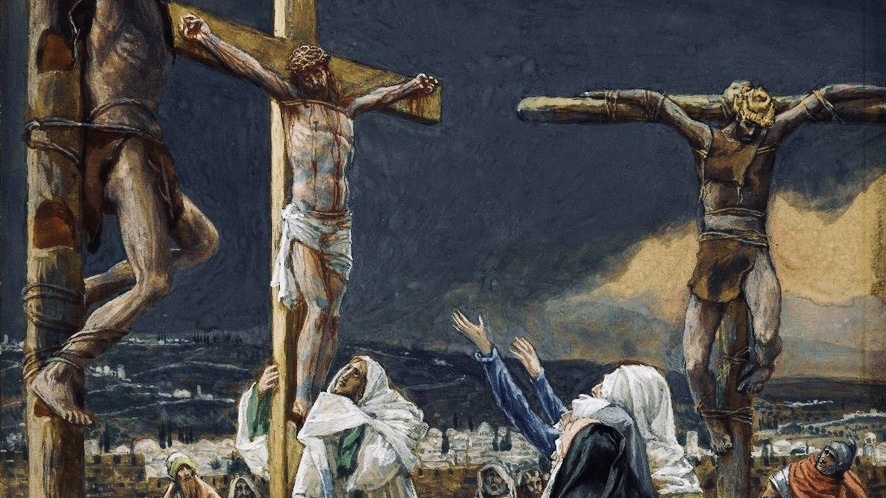
During his Passion, a crown of thorns rested on our Savior’s head…but we were what was on his mind—not some generic mass of humanity, mind you, but you and I as the unique individuals his Father created.  Jesus endured all this suffering out of pure love for you.  Which means there’s no avoiding it: you, too, are a character in this drama.  What role will you play?  The Lord doesn’t need any more to swell the noisy crowd that waves palm branches and exclaims, “Hosanna!” today, but waves fists and shouts, “Crucify him!” only a few days afterward.  Jesus has already had plenty of disciples deny him or desert him or simply watch him from off at a safe distance.  As Jesus goes from the upper room to Gethsemane then to Golgotha then into the tomb—and three days later, back out again—what role will you play?

My friends, may God give us the grace this Holy Week to respond to the One who freely gives all for us by willingly being all in for him.

* * *
After Holy Communion:
Lord Jesus Christ, Crucified Savior, we believe that you are present here with us, present here within us, in the Blessed Sacrament of your Passion, Death, and Resurrection.  Strengthen us by it to walk with you—this week and always—on the way of your Cross.
     

Sunday, March 18, 2018

Get Real

   Fifth Sunday of Lent   B 
I have to be honest: sometimes I struggle to follow exactly what’s going on in St. John's Gospel.  Today’s passage is a perfect example.

We’re told that some Greeks want to see Jesus.  They approach Philip, who goes to Andrew—two disciples from Galilee: a region where most folks were bilingual.  They serve as translators and bring this simple request to Jesus.  And how does Jesus respond?  “Unless a grain of wheat falls to the ground and dies, it remains just a grain of wheat; but if it dies, it will yield much fruit.”


That leaves me wanting to say, “Gee, thanks for the folksy lesson in agriculture, Jesus, but do you or don’t you have a minute to visit with these Greek guys?!?”

So what’s actually going on here?

So often, we want to see Jesus.  We’re struggling, hurting, questioning, grieving.  We’re looking for answers, for purpose, for meaning in life.  “I need you, Jesus!  Where are you, Jesus?”

And our desire to see Jesus usually comes with a pretty clear expectation of just how we want to see him.  Because I have a definite picture of how I think life should go, I also have a definite picture of who Jesus ought to be and what he ought to do.  When things are bad, I want him to come and fix ’em—quick!  When things are good…well, just leave well enough alone, won’t you, Jesus?  Which means that when I want to see Jesus, it’s generally not the real Jesus I’m after, but my own image of who Jesus should be.

And that’s why Jesus’ response isn’t really so far out in left field.

For us, Palm Sunday is still a week away.  But in the Gospel of John, the scene we hear about today comes right after Jesus’ not-so-subtle entry into Jerusalem.  Passover is coming, so a whole lot of pilgrims are in the holy city.  And in light of Jesus’ rather splashy entrance, the packed town is abuzz.  In fact, in the verse immediately previous to our passage, the Pharisees are saying to one another, “Look, the whole world has gone after him!”

Which brings us back to those Greeks.

It’s important to note that they’re Greeks—that is, they’re Gentiles; they’re not Jews.  Jesus’ circle of influence is now expanding beyond his own people.  And Jesus is concerned that the Greeks, like the Jews, will get the wrong idea about him.  You see, many Jews were looking for a Messiah who would save them from oppression by overthrowing the Romans—restoring their nation’s former glory.  The Greeks?  Perhaps they got swept up in the frenzy of the crowd and wanted to get close to this “rock star” preacher so they can ride on his coattails when he really takes off.

But Jesus knows that the only way to truly understand him and his mission has yet to be revealed—although that hour is coming very soon.  What will be the sign of Jesus’ great triumph, that he’s fulfilled the purpose for which he’s come?  How will we see the Son of Man glorified?  It won’t be when we see him carried along by adoring throngs waving green palms of victory.  We won’t see riding high on a white stallion at the head of a mighty army or ascending to a golden throne.  No—it will be when he’s lifted up—bruised and bloody—on the Cross.

That’s not exactly the Jesus they were looking for…but that’s the real Jesus.


The real Jesus is one who acts in perfect obedience to the Father.  He doesn’t ask to be saved from his ordained place in God’s plan, however mysterious or painful it might be.  Of course he sends up tears and loud cries, yet he trusts the Father—and trusts him completely.  Obedience is what the Father desires—from Jesus and from all of his children—which is why obedience glorifies the Father’s name.  And when Jesus glorifies his Father by willingly being lifted up on the Cross, the Father in turn glorifies his Son by lifting him up from his grave in the earth to take his place in heaven at God’s right hand.  The grain of wheat has fallen and died, and therefore produces its abundant fruit.

Can you and I do likewise? Can we accept our place in God’s plan, rather than mope about because God won’t enact our plans?  Are we willing to meet the Lord in our suffering, rather than just hold out for him to swoop in and rescue us from it?  Can we trust that God really does love us and care for us, and really does know what’s best for us, even when the road is long and winding, or isn’t leading exactly where we wished to go?

Which is all to say: are we ready to see and follow the real Jesus?

It is at the altar, in the Most Holy Eucharist, that we meet the real Jesus again and again: the one who accepted that the new and eternal covenant could only be sealed by the shedding of his Blood. 


The Eucharistic Prayer—the heart of every Mass—ends with the priest chanting a doxology: “Through him, and with him, and in him, O God, almighty Father, in the unity of the Holy Spirit, all glory and honor is yours, for ever and ever.”  And all respond, “Amen!”  As those words are sung, priest and deacon lift up the Body and Blood of Christ under the humble yet fitting appearance of wheat and grape.  Notice that the two are separate from each other…and we all know what happens when your blood gets separated from your body.  When we are kneeling before the altar, we are kneeling at Calvary.  But it’s in this willingness to obey, this willingness to utterly trust the Father, even unto death, that Jesus gives him highest glory and honor.

We, my friends, are called to do the same.

Let Jesus draw you to himself, draw you to the real Jesus, draw you to the Cross—so that he may then lift you up in his Resurrection.  To this invitation of the Lord, may our entire lives be a resounding and continual: Amen!

* * *
After Holy Communion:
Lord Jesus, in the Sacrament of your Body and Blood, you have planted yourself like a grain of wheat in the soil of our hearts.  In these privileged moments after Holy Communion, when you are so very close to us, help us to see you—to see the real you—so that we may serve you and follow you and bear much good fruit.
   

Saturday, March 17, 2018

Family on the Farm

Most folks have some notion that farming is a tough way of life, but all too few have a clear idea about just how tough dairy farming is right now.  If you like cheese, drink milk, or occasionally enjoy some ice cream (although you might not be enjoying that until after Easter), then you really ought to take the hour to watch this important program (broadcast just last night)--and not just because my brother is on the panel and my father takes the mic, too.  Even if dairy isn't part of your diet, it is a major part of our North Country way of life and at the heart of the story of so many of our families.

Watch the forum.  Spread the word.  Join the conversation.


Sunday, March 11, 2018

A Chronicle of Love

I made the following announcement at the beginning of all the Masses this Sunday:

I have some news to share with you this morning.

As you are well aware, for more than 2 years we have been engaged in a planning process—one that’s taking place all across our Diocese.  It has been a difficult task.

I come today to tell you that Bishop LaValley has approved the plan we proposed to him.  Most significantly, that means that St. John Bosco Church will become an oratory—remaining a place of prayer, but where Sunday Mass is no longer celebrated—and St. Joseph’s Church will close permanently.

This is not easy news to have to share.  This is a very sad loss—not only for those of you who are attached to these two particular church buildings, but for all the Catholics of Malone—your priests included.  We were not ordained in hopes of spending our priesthood realigning parishes and closing churches.

Bishop LaValley will be coming to Malone on Sunday, April 22, to celebrate the last Sunday Mass at St. John Bosco.  He will be returning the evening of Tuesday, May 1—the feast of St. Joseph the Worker—to celebrate the last Mass at St. Joseph’s.

All of our registered parishioners will receive a mailing in the next several days, including a letter from our Bishop and details about his visits.  Copies of these will also be made available in our churches.

The Church wears rose-colored vestments this Fourth Sunday of Lent as a sign of her joy on reaching the midway point to Easter.  The first words of the Mass, as we just sang in our Entrance Antiphon, boldly proclaim: Rejoice, Jerusalem, and all you who love her.  Be joyful, all you who were in mourning…

In light of this announcement, those words can seem a cruel irony.  But I think that they actually hold an important message for us at this crossroads.

It can be awfully tempting at a time like this to focus only on what’s being lost.  That, of course, would be to miss the bigger picture.  The whole point of having a plan is to set our sights on the future.  Committing ourselves to working toward a brighter tomorrow, as did those who built our churches years agothat is the very best way to honor the rich legacy of our past.

As we especially remember at this time of year: with the Lord, there is no death without the joyful promise of resurrection.

In recent days, the comforting words of a familiar hymn have kept ringing in my ears: O God our help in ages past, our hope for years to come, our shelter from the stormy blast, and our eternal home.

The Lord remains ever faithful—no matter what.  May he increase our faith that he is very near to us, now and always.

   Fourth Sunday of Lent   B 

John 3:16.  Anyone who’s watched an NFL game knows that scripture citation.  Now, you may not know what it says, but you know the chapter and verse.  It’s likely the most commonly quoted line in the entire Bible, and it’s at the heart of the passage we’ve just heard: For God so loved the world that he gave his only Son, so that everyone who believes in him might not perish but might have eternal life.  John 3:16 has rightly been called “the gospel in a nutshell.”

But have you ever seen anyone holding up a sign that says 2 Chronicles 36?  Of course not!  We rarely hear from that book; in fact, it only shows up twice among the many readings in our Lectionary: on one weekday every two years, and one Sunday every three years.

Chronicles is the very last book in the Jewish Bible.  What we read today are its very last verses.  And I’m going to guess that the anonymous author of Chronicles must have failed creative writing class, because the original ending of his book is absolutely horrible!

We’re told that God’s people—from the nobles and priests on down—had “added infidelity to infidelity,” picking up all the wicked ways of the peoples who lived around them.  Now, God had chosen them to be a light in the world: to be different from all the rest; to lead other nations to him.  Instead, they kept showing how much they preferred what they could do with their neighbors in the darkness—how much they wanted to be just like everybody else.

So how does God respond?  Out of his deep compassion he patiently kept sending his people messengers—the prophets.  “Early and often,” we’re told, did the Lord reach out, giving them plenty of time to change their hearts and to change their ways.  But they mocked his messengers, despised his warnings, and scoffed at his prophets.

Having exhausted all other options, God allows the people’s faithlessness to reach its logical conclusion.  The nations that Israel should have been converting now turn on it.  The Babylonians brutally attack Jerusalem.  They burn down the temple, tear down the city walls, kill many, and carry off those who remain as captives into exile.

The result will be more than a brief “time out.”  Interestingly, we’re told that the land must retrieve “its lost sabbaths.”  One of the people’s most grievous sins was failing to keep holy the Lord’s Day.  Because they didn’t heed the Lord’s command concerning the seventh day, now the Promised Land would enjoy a sabbath rest in their absence for seventy long years.

God’s people must have been asking themselves: Where is the Lord?  How could he let this happen?  It’s the Lord’s own temple that’s been destroyed!  It’s the Lord’s own land that’s been left in ruins!  It’s the Lord’s own people that have been killed and captured!

This Sunday’s psalm is their lament in captivity: By the rivers of Babylon, there we sat and wept.  We hung our harps up in the trees for we were unable to sing.  What they’re expressing here, it seems to me, is more than understandable grief.   It’s a stubborn refusal to experience joy.  They have been so focused on the glories of their past that they can’t see how God is working among them right now, or where he might be leading them in the future.

That, my friends, is the original ending of Chronicles—and thus the ending of the entire Jewish Bible.  The end of the book appears to be the end of the whole story.  It’s certainly not, “And they all lived happily ever after.”

But with the Lord there’s always more to the story.  As the Hebrew Bible slowly took shape, editors added two more verses to the end of Chronicles—the very same two verses we find at the beginning of the Book of Ezra.  They tell us that Cyrus, king of Persia, issues a decree: all the people of Israel are now free to return home.  Even more, Cyrus commissions them to rebuild the temple, and he will (we’re told elsewhere) go so far as to provide the resources to do it.

It would be easy enough when considering this story—along with its parallels both throughout history and in our very own lives—and think that it’s evidence that God can and does fall in and out of love with his us…just as we do with one another, and just as we do with him.  How else do you explain their destruction and exile?  How else do you explain our own suffering and loss?

But that would be to miss the point entirely!

God does not abandon his people—never has, never will—despite how things sometimes feel.  The Lord remains faithful, even when we do not.  That’s because love isn’t something God does; love is who God is.  God is love—eternal love, unchanging love.

As Jesus reminds Nicodemus, God’s purpose is not to condemn the world, but to save it.  When God’s anger is inflamed, it’s not out of thirst for vengeance, nor is it aimed at destruction.  Rather, it’s God’s passion to set things right again.  Believe it or not, it’s just another expression of God’s merciful love.  Sometimes, things reach a point when only drastic measures will work—when only radical surgery will bring about true healing; when something old must be torn down in order for something new to be built up; when something must first die before it can rise again.  As the old proverb says, “The darkest hour is just before the dawn.”  Divine purification is most generally a painful process, but it’s an absolutely essential one.

Israel’s restoration after exile comes about in a way no one ever saw coming.  They’re returned to their homeland by a foreign—pagan—king: a worshipper of other gods; the conqueror of their conquerors.  Cyrus’ motives were likely mixed, at best—but God can make use even of these.  The Lord’s will will be done.

Jesus calls to mind another unexpected turn in his people’s history.  (You might say that such twists are one of God’s specialties.)  The Israelites are wandering forty years in the desert, and all along the way they grumble against God and against Moses.  They doubt the Lord’s good intentions toward them.  In light of this breach of confidence, this breaking of faith, poisonous snakes are sent among the people and, as a result, many of them die.

The people recognize their sin, and the Lord hears their cries.  He directs Moses to make a serpent out of bronze and mount it on a pole.  The Lord promises that any of those who have been bitten have only to look upon the bronze serpent to be healed.  You can imagine their reaction:  Really?  Another snake?  You want me to look what’s killing me in the eye?

But as God so often does, the thing that seems to us a harsh chastisement turns out to be the very thing that saves us.  And it’s precisely thus that you and I must face the Cross.  God constantly keeps before our eyes a vivid reminder of what sin really does.  Jesus will endure what our sins deserve—and, in so doing, save us from them.  In Jesus, God descends into our human suffering—as low as he could go—in order to lift us up from it.

Our parish finds itself in a moment of real sadness and loss.  In times like these, it’s easy enough to ask, “Where is God?”  However suffering comes to us—and come to us it does—we must trust that the same God who has brought us to it will also, always, see us through it.  For God did not send his Son into the world to condemn the world, but that the world might be saved through him.  No—God doesn’t condemn us.  But we do condemn ourselves if we won’t allow God’s love—in its most mysterious disguise—to work in our hurt and in our sorrow.

If The Malone Telegram’s “Today in History” column is to be believed, we have a most remarkable coincidence this weekend.  For it was precisely on March 10, 515 years before Christ, that the new temple in Jerusalem was completed after Israel’s exile.

You see, the sad end of Chronicles was not the end of the story, because God is always faithful.  The Lord’s love knows no end.
   

Thursday, March 8, 2018

Well Known

So, I haven't posted a song on here in a VERY long time...but I just came across this one (through a rather long, strange chain of connections), and it is SO beautiful (both the music and the video) that I can't stop listing to it and just need to share...


"Know Me Well," by Roo Panes (2012)

Well you know me with that ancient gaze 
Stripping down with yesterday's eyes 
You know me as I was you see me as I will be 
And I still had a lot of growing 
When you took me and you shaped me with those hands 
You know me better than myself 
Make me better than I am 

Oh, you know me well 
Know me well 
Know me well 

When I think about my past 
I see our love too many years before you came 
In my hopes and my dreams 
With the wax and the moon wanes 
And you saw what I could be 
Please teach me how to be what I was meant to be 
See without you I was nothing 
But with you can be anything 

Oh, you know me well 
Know me well 
Know me well 

What can I fear 
When I know that I walk by your side 
You're the fortress 
Within which I got nothing to hide 
None can take me 
I'm the tower the world cannot fell 
'Cos I'm stronger 
When I know that you know me well 
Know me well 
Know me well 

Oh, you know me well 
Know me well 
Know me well
  

Sunday, March 4, 2018

I'm looking for an address...

   Third Sunday of Lent   B 

Where does God live?

That’s a legitimate question to ask, is it not?  Where does God live?  It’s the sort of question you might actually be asked by a young child, or by a coworker who doesn’t have a background in the faith…but knows that you do.  Where does God live?


Of course, one can answer, “Everywhere!”  And that is perfectly true.  God is not only omnipotent (all-powerful) and omniscient (all-knowing), but also omnipresent (present everywhere).  And yet, believers in the one true God—from Old Testament times on—have identified certain places as ones where the Lord seems to like to hang out.  They built altars and shrines in locales where they’d encountered the divine, and expected that they might do so again.

For the Jewish people, this was especially true of the temple in Jerusalem.

When the Israelites wandered for 40 years in the desert, God instructed them to erect a tent—called the “tabernacle”—where the Lord and his people might meet as he accompanied them all along their journey.  When in time the Chosen People arrived in the Promised Land and Jerusalem became their capitol, the tent was abandoned for a grand temple built of stone—the symbolic heart and center of the entire nation.

It would be hard to overstate the importance of the temple to God’s People.  We might be tempted to think of it as their “Vatican”:  a grand house of prayer where many important ceremonies were held, but only really a larger version of the synagogues found in many Jewish towns.  But that was not at all the case!  Synagogues were schools where one could be instructed in the scriptures, but the Temple was the only place for true worship—the only place to offer sacrifice.  (In connection to last Sunday’s readings: the temple was built on the very same mountain up which Abraham had led Isaac to offer him to the Lord.)

This is the place to which, more than anywhere else, the Jewish people could point and say, “That is where God lives.”

And that’s why it’s such a big deal when Jesus goes through the temple and trashes the place!

What Jesus is doing in cleansing the temple is more than a mere act of civil disobedience.  This isn’t “Occupy Wall Street” or carrying a picket sign out in front of the Supreme Court to make some political statement.  St. John tells us that, when Jesus speaks about destroying a temple and raising it up again in three days, “he was speaking about the temple of his body.” 

Jesus is saying that the day has arrived when people should expect to begin meeting God elsewhere.

When Jesus’ disciples saw the livestock running helter-skelter in the sanctuary and tables heaped with coins dumped onto the floor, we’re told that they recalled a line from Psalm 69: “Zeal for your house will consume me.”  Zeal is devotion and enthusiasm.  It is eagerness, energy, and dedication.  Zeal is fervor and passion.  It is being on fire for something you believe it.

Jesus clearly had zeal for the place where God lived.  But do we?


Let’s consider four specific “addresses” where we would say God lives…

(1) God lives in heaven.  It’s to the Father’s right hand that Jesus ascended in his risen body after his resurrection.

How many of you want to go to heaven?  (And, no, I don’t mean today!)  Now, how many of you want to be saints?  Because here’s the thing: the only people living with God in heaven are saints.  Which means getting through the pearly gates must not be taken for granted.  We have all been called to lead lives of holiness.  And because we can’t do it on our own, God gives us every grace we need to live—now and forever—as the men and women he created us to be.  But that requires our cooperation.  Do we have the dedication, do we have the eagerness, do we have the zeal it takes to get to heaven?

(2) God lives in the tabernacle.  Jesus left us his body and blood, soul and divinity, in the Most Blessed Sacrament.  God is really right there!

What sort of zeal do we show for the Holy Eucharist?  Is Sunday Mass just one more part of our usual routine, or the very highpoint of the whole week?  Do we long to come here, or are we quick to find excuses?  Do we prepare ourselves beforehand—by prayer and observing an hour-long fast?  Do we take time afterward to thank the Lord for this most amazing gift?  How do we behave in the presence of the Blessed Sacrament?  Do we genuflect and otherwise show due reverence?  Do we have devotion, do we have fervor, do we have real zeal for the Eucharist?

(3) God lives in his Church. 

Have you ever noticed that sometimes we spell the word “church” with a capital “C,” and sometimes with a lowercase one?  When we’re talking about a building, it’s the lowercase church, but it’s the community of those who believe in Jesus that is the capital “C” Church.  (In fact, the church building is only called such because that’s where the Church’s people gather together.)  The Church is more than a service organization, more than a social club.  The Church is the body of Christ—and that’s more than a metaphor.  Christ is the head of this body, we are members, and the Holy Spirit is its soul.

What sort of zeal do we have for the Church?  Are we proud to be known as Catholics?  Do we participate in the life of the parish?  Do we treat one another with love as true brothers and sisters?  When the Church speaks in an authoritative way, do we receive it as the voice of Christ or do we view it as just one more opinion among many?  Are we ready to defend the Church?  Are we on fire, do we have enthusiasm, do we have zeal for the Church?

(4) And God lives in you.  By Baptism, you have become a temple of the Holy Spirit.  God dwells in you—and not just in your soul, but in your body, too, since to be human involves both.

What sort of zeal do we have for the God who dwells within us?  Do we allow God to be present and active in all of our life—both what is seen and unseen?  Do we show respect and reverence toward our own person?  Am I taking good care of my body?  Am I taking good care of my soul?  Do what I say or don’t say, what I do or don’t do, give any indication of God’s place in my life?  Do I have the passion, do I have the zeal, to let Jesus clear out some space within me that’s reserved for God and God alone?

Where does God live?  The God of heaven came to dwell with us on earth, and remains with his Church always in the Sacrament of his Body and Blood—and so comes to live in you and me.

Zeal for God’s house consumed Jesus.  May you and I also be consumed by zeal for all the places where God lives.

Sunday, February 18, 2018

Animals & Angels

Just a heads-up: I'll be away on vacation in Florida this week with my family, so there will be no homily posted next Sunday.  This afternoon, I went cross country skiing.  Tomorrow afternoon, I'll be on the beach...

   First Sunday of Lent   B 

I haven’t verified it, but this Sunday’s gospel reading has to be one of the shortest in the entire Lectionary—only four verses long.   Which might have you wondering: Does that mean a short homily, too?  Only time will tell…

Most of you know I like to go backpacking, and often enough I spend a night in the woods alone.  If I’m camping in the winter, the first question I get asked is, “How do you stay warm?”  You can stay pretty toasty on a cold night if you have the right gear.  But if I’m camping at any other time of the year, the first question is usually, “Aren’t you afraid of animals?”  (“Lions, and tigers, and bears—oh, my!”)  If you take proper, commonsense precautions, wildlife is not a problem.  (I don’t keep any food with me in my sleeping bag, for example.)  The only critters that have been a minor nuisance are a few mice…and I’ve seen many more of them in the rectory than around my campsites!


Our very brief gospel passage this First Sunday of Lent finds Jesus camped out in the wilderness, spending forty days in the desert.  St. Mark tells us that, while there, “he was among wild beasts, and the angels ministered to him.”  At first glance, that seems rather straightforward.  But let’s dig a little deeper…

Jesus Christ is true God and true man.  It’s in his human nature, of course, that Satan dares to tempt him.  Jesus is like us in all things but sin.  Which means that, like us, his human nature includes body and soul, a blend of the material and the spiritual—one might say, of the animal and the angelic.

Now we can begin to see Mark’s deeper meaning!

Each Sunday, we profess in our Creed to believe that God the Father is the maker “of all things visible and invisible.”  Thus we human beings, by God’s design, are the very hinge of the entire cosmos, for in us matter and spirit meet.

When body and soul are working together as they should, it’s a truly beautiful thing.  Consider someone playing a beautiful piece of music.  Of course, there are the physics of how the instrument makes a sound, how the sound waves travel through the air, how those waves impact you eardrum, and then your brain “hears” what’s being played.  But that doesn’t really explain beautiful music, which conveys feeling and meaning and the passion of the performer. 

Or think of the men’s figure skating competition at the Olympics on Friday night.  Those guys train hard, and must develop a lot of technical skill.  Yet a great performance isn’t merely physical, but displays a certain grace of movement that’s hard to put your finger on.  When we experience such harmony of matter and spirit, between animal and angel, we’re given a little taste of the world as it was meant to be.

But you don’t need me to tell you that this world isn’t how it was meant to be.  And that’s because of sin.  Sin is when body and soul get out of sync.  We seem to be at war with or within ourselves.  I do the things I know I shouldn’t, and sometimes even do things I don’t really want to do.

Sin is when body and soul get out of sync.  When body and soul get separated, that’s death.  One leads to the other.

There are essentially two ways for our matter and spirit to get out of whack.   The first is to put too much emphasis on the physical, on the body.  “If it feels good, do it!”  We become pleasure seekers, who let our urges and passions run wild.  We begin to act like animals.

The second is to put too much emphasis on the spiritual, on the soul.  We turn into puritans who think that the body is evil and grow suspicious of everything.  As a result, we become self-righteous and joyless, acting as if we were angels.


How are we to get body and soul back into harmony?  That’s the very purpose of Lent.

Jesus emerges from his own season of fasting preaching a very simple yet profound message: “The kingdom of God is at hand.  Repent, and believe in the gospel.”  Jesus tells us first to repent.  Just as wild animals can be tamed, so do we require a certain amount of discipline to bring us back in line.  Our bodily passions require good boundaries—adequate fencing, if you will.  Repentance is making any and all necessary changes—turning away from our sinful thinking and behavior, and turning back toward the Lord. 

And Jesus also tells us to believe in the gospel.  We are not all of us little gods—authorities unto ourselves.  Our spirits require proper guidance and direction.  Not all the angels are good; the devil himself is a fallen one.  And so we are called to the obedience of faith, to faith in the gospel, in the “good news”—which is good because it brings us life and freedom, and which is news because it remains as relevant today as ever.

Repentance and faith bring body and soul, once divided by sin, back into harmony—and that harmony we call holiness.  It’s what we see perfectly in Jesus, who “was among wild beasts, and the angels ministered to him.”  This all hints at the ultimate reunion of matter and spirit, of body and soul: the resurrection, which we will celebrate with the great feast of Easter at Lent’s end—and which we await on the last day.

Such a restoration of creation, putting things back as they were originally meant to be, is something God has been working on since Eden.  We see that in the story of Noah and the flood—the very end of which we hear in today’s first reading—when God gives a fresh start to the human race and all life on earth.  And we experience that in the Sacrament of Baptism—as St. Peter reminds us in our second reading—which is a bath for the body that results in the deep cleansing of the soul.

Always remember that you are so much more than your body.  Nor are you just your immortal soul.  You are a human person, an utterly unique blend of matter and spirit that puts you at the pinnacle of creation.  But even more, by Baptism you have become a child of God.  But just as Jesus wrestles with Satan right on the heels of his own Baptism, so do we continue to face temptation from the world, the flesh, and the devil.  Let us give ourselves over to the disciplines of repentance and the obedience of faith this Lent, and so allow God to restore us to harmony within ourselves—to the way he originally intended us to be.  Then we’ll be able to walk with Jesus among both the wild beasts and the angels.
  

Sunday, February 11, 2018

Outside In

On the way out of early Mass this morning a woman told me, "Father, your beard is looking very biblical today."  I'm not sure how she meant it, but I took it as a compliment...

   Sixth Sunday in Ordinary Time   B 

How about that first reading today?  All the talk about scabs and blotches and pustules is so appealing—especially first thing in the morning.  If you read the entire chapter from Leviticus, it goes into great and gory detail about how to distinguish one nasty sore from another—and it was the temple priests’ job to check them all out.  As we were doing the dishes after supper last night, I told Fr. Scott, “I’m awfully glad I’m a New Testament priest and not an Old Testament one!”  Gross!

But as bad as it would have been to be an Old Testament priest, it would have been far worse to be an Old Testament leper.


Wasn’t it bad enough to be terribly sick?  But all kinds of regulations are laid out for lepers: they must dress in torn clothes; they must live outside of town; wherever they go, they must cry out, “Unclean!  Unclean!”  Most intriguing to me—no surprise—is the part about muffling one’s beard.  Back in the day (and even still in the Middle East), a man’s beard was considered his glory.  (I rather like that idea!)  In times of mourning or distress, a man would cover over his glorious beard with the edge of his robe as a sign of sorrow.

All these restrictions can sound pretty harsh.  In fact, we might think they’re downright primitive or backward.  Why do they seem to hate sick people so much?  If only they had antibiotics and good dermatologists! 

But we mustn’t forget that these rules are found in the Scriptures.  They are part of the law given by God.  Three considerations can help us understand why this is a bit better.

(1) True leprosy—although exceptionally rare and quite treatable today—was a highly contagious, very debilitating, and oftentimes fatal disease.  Kind of like not shaking hands at the Sign of Peace when you have a cold, minimizing contact with lepers was a matter of public health.

(2) These laws are not so much medical as they are spiritual.  To be ritually “unclean” meant—above all—that one was forbidden to enter the temple.  (Many other things besides blotches on your skin could render a person unclean for a period of time.)  But to be unclean was not a moral matter—as if to say a person were sinful or wicked.  You see, the temple in Jerusalem represented paradise; it was a symbolic effort to recreate Eden—the way God originally meant things to be.  Thus anything that spoke of death—such as leprosy, bleeding, contact with corpse—was to be kept outside, since death was never part of God’s plan for us.  The distinction between clean and unclean was meant to serve as a reminder that this world isn’t as it should be.

(3) Of course, we’re tempted to think, “But we’re so much more civilized and enlightened than that.  That sort of thing would never happen today.”  But remember when AIDS first came on the scene—and all the irrational fears and the stigma?  What about the immigrants and refugees who, if given legal entry, often end up segregated into slums and ghettos?  I also think of registered sex offenders who have served their sentences and are trying to reform their lives.  Given all the legal restrictions concerning where they can live and what they can do, many of them end up in housing that looks an awful lot like the leper colonies of old.  Yes, we must take prudent precautions to keep people safe…but maybe we’re not so very different after all.


“A leper came to Jesus…”  Right away, in the first words of this Sunday’s gospel, we should take note that this leper has come into town and isn’t crying out, “Unclean!  Unclean!”  He isn’t doing what he’s supposed to.  He’s breaking the rules.  Is he reckless?  Or courageous?  I’d guess that he was desperate.

And kneeling down, what does the leper ask of Jesus?  “Make me clean.”  Notice that he doesn’t ask to be cured, but to be cleansed.  He wants to be restored to a place in the community: to be reunited with others, reunited in worship; to be in touch with God, in touch with God’s people.

And how does Jesus respond?  He “stretched out his hand [and] touched him.”  Jesus breaks the rules, too—but not just to be a rebel.  He could have healed the man by simply saying the word.  So why touch him?  Imagine how long it’s been since anyone has touched this man.  He’d been banished, forbidden all human contact.  In touching him, Jesus not only heals his sores, but meets his human desire, his deep human need to be accepted, to belong.  According to the old law, to touch a leper was to make oneself unclean.  Jesus turns that right around.  His actions say that those who stay in touch with him don’t have to be worried about being tainted.  Those who are touched by Jesus are made clean, and they then bring the cleanness, the purity of God to the world they touch.

There are plenty of outcasts in the world today, whether they’ve been pushed out through their own fault, through someone else’s fault, or through the fault or no one whatsoever.  There are plenty of folks who feel like outsiders: “I’m good for nothing.   I’m not worthy.  If they only knew how I really am.  Could anybody love me?”  And there are some we have cut off:  “They’re too rich/too poor.  They’re a different color/speak a different language.  They lead a different lifestyle.”  We keep our distance.  We put up barriers.  And sometimes, we even justify this on religious grounds: “I’m just going stay all safe and snug here in my little Catholic bubble and not be contaminated by the evils of the world.”

Jesus came to unite us.  (It’s the devil that divides.)  Jesus came to bring together the scattered children of God—to bring us into communion with himself and with each other.  So as members of the Body of Christ, we are to continue his work.  Remember in the first pages of the Bible, at the end of each day of creation, God looks over what he has made and calls it good?  There’s only thing that God sees and pronounces not good: after creating Adam God declares, “It is not good for the man to be alone.”  Coming together as one: that’s how the world was always meant to be!  Strengthening our bonds of community, reaching out to those on the margins—that’s what we’re called to do.

But it’s risky business.

The leper in the gospel quickly changes his tune.  He didn’t cry out, “Unclean!  Unclean!” like he was supposed to, but—despite Jesus’ clear warning—he starts announcing to anybody who will listen, “Look!  I’m clean!  I’m clean!”  And what’s the consequence for Jesus?  “It was impossible for Jesus to enter a town openly.  He remained outside in deserted places.”  Those circumstances should sound familiar.  Jesus is now like the leper was before: marginalized, pushed out.  In freeing that man from his isolation, Jesus takes it upon himself.

Are we willing to take that same risk?

This Wednesday is Ash Wednesday.  Your forehead won’t be marked with the sore of leprosy (please God—I hope not!), but it will be marked with a smudge of ashes.  And there’s a good chance that others—coworkers or classmates, family members or friends—may notice at mealtime that you’re fasting and abstaining from meat.  You’ll be rather clearly marked as a Catholic for all to see.  Now you don’t need me to tell you that what the Catholic Church stands for flies in the face of much that’s promoted by contemporary culture. 


Like the marks of leprosy, your fasting, your abstinence, your ashes will be a reminder of death: “Remember you are dust, and to dust you shall return.”  They’ll be a reminder that this world isn’t as it should be—a reminder that much of it is unclean and in need of intense purification.  But the world doesn’t like to be reminded of that.  And so some people might misunderstand you.  Some people might question you.  Some people might mock you.  Some people might reject you.  But know that if take that risk, that if you do find yourself pushed out, that that’s precisely where you’ll find Jesus: on the outside, in deserted places.

I’m really glad I’m not an Old Testament priest—and not just because of all those pustules!  I’m glad because, as a New Testament priest, time and time again I get to bring people to Jesus, and to see him touch them, and to see their souls cleansed, and to see their deep wounds healed, and to see them reunited with God and with his people.  But that’s not a duty or a privilege reserved to the clergy; it’s the right and the responsibility of every one of us here.  What Jesus has done for you and for me, we are called to go forth to do for others.

St. Paul wrote to the Corinthians, “Whatever you do, do everything for the glory of God.”  So out to the margins and gather in the outcast.  And make a real effort to work on relationships right here within our parish community.  And take a chance on living your faith for all to see, even if it means you might get the cold shoulder.  Do it all for God’s glory!  That’s why Jesus brings us together as one: to give ever-greater glory to God.
   

Sunday, February 4, 2018

Tell Me Why

   Fifth Sunday in Ordinary Time   B 

I’ll have to ask my mother to check my memory, but I seem to recall her telling me that one of my first and favorite words as a young child was, “Why?”  I’d ask that question about everything, and as a follow up to each answer: “Why? Why? Why?”  Of course, the eventual response was, “Because I said so, that’s why!”

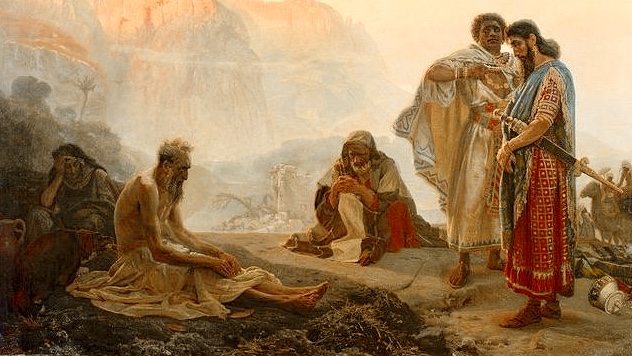
Our first reading this Sunday is taken from the Book of Job.  It’s not exactly the most uplifting story in the Bible.  You’ve got to love how it wraps up:
            …I shall not see happiness again.
            The Word of the Lord.  Thanks be to God.
Thanks be to God?  We’re supposed to be grateful for that unhappy ending?


The Book of Job is more than 40 chapters of “ugh.”  The poor guy can’t catch a break.  First, all his sheep are struck by lightening.  Then thieves steal all his camels.  Then all his children a killed during dinner when the house blows down in a windstorm.  And then Job’s covered with boils from head to toe.

This tale of woe is quite a downer, to say the least.  It can leave us asking, “Why?”  Why is this book even in the Bible?  It’s certainly not a feel-good story.

The Book of Job wrestles with a couple of perennial questions.  (1) Can human beings love God for his own sake (and not just to get something out of the relationship)? That’s certainly an idea worth exploring, but we’ll leave that one aside for another time.  (2) Why?  Why is there suffering in the world?  Why do bad things happen to good people?

Several “friends” (we’ll use the term loosely) come (so they say) to “comfort” Job in his anguish.  But their message is far from consoling: “Surely you must have done something to deserve this!  Why don’t you man up and accept responsibility?”  They believe that suffering is a matter of divine punishment.  Our reading today is part of Job’s response to one of these so-called friends.

Job himself wonders why all this has happened: “Maybe God is upset with me for some unknown reason.  Maybe the Lord’s fickle, or unreliable.”

In the end, God himself speaks up.  Why do bad things happen to good people?  In typical Jewish fashion, God answers a question with a question:  “Who are you to ask?  Who are you to question me?  My ways are not your ways.”

The mystery of suffering forces us to reckon with the fact that God’s will doesn’t bend to mine; I, rather, must bend to the will of God.

Why?  Why is there suffering in the world?  Why do bad things happen to good people?  We don’t know!  The Lord’s message to Job and to us is essentially:  “You’re just going to have to trust me.”

That’s where the Old Testament leaves us.  But things are rather different after Jesus.  That’s because, in Jesus, God himself comes to suffer.  In effect, he’s saying, “Let me show you, once and for all, that suffering will not defeat me.”  The New Testament may not answer our repeated question, “Why?” but when it comes to suffering, Jesus does show us how.

In the gospel last Sunday, we found Jesus driving out an evil spirit.  Today, he’s curing the sick.  In a few short chapters, he’ll calm a calm storm at sea.  Since the original sin of Adam and Eve, our world’s been a mess.  This is no longer paradise!  But how does Jesus respond to this mess—to the demons, the disease, the disasters he encounters?  He rebukes them all, and they obey.  Christ has come to heal this broken world.  Even now, at the very start of his ministry, we see that for sickness and sorrow, for the devil and death, it’s the beginning of the end.

Two Sundays back, we heard how Jesus called four fishermen—Simon and Andrew, James and John—to be his first disciples.  This Sunday’s passage comes just a few verses later.  And where do we already find Jesus?  Already at the bedside of Simon’s mother-in-law!  Jesus clearly takes a keen and immediate interest in the personal lives of those who follow him.  “So tell me about your family.  Would you mind if I came over to the house?  What’s that about your wife’s mother?”  Jesus gets right into the nitty-gritty of their lives.


Does Jesus cure everyone who is sick?  No.  There were still sick people in Galilee.  There are still sick people today.  His mission wasn’t one of medical miracles.  Physical healing wasn’t the reason he came.  But when he does cure the sick, and the manner in which he does it, makes something crucial very clear.  As the French writer and thinker Paul Claudel put it about one hundred years ago, “Jesus did not come to explain away suffering, or to remove it.  He came to fill it with his presence.”  God is right there with us when we’re hurting.  We do not face any of our trials alone.

Jesus has had a particularly busy day.  He begins by preaching in the synagogue.  Then he drives out the unclean spirit.  Next he heals Simon’s mother-in-law.  After she prepares a quick bite for him, it’s back to work: more sick people, more possessed people, until after the sun goes down.  And this was all on the Sabbath—supposedly a day of rest!

What does Jesus do early on Sunday morning?  He goes off to a deserted place.  It’s not hard to imagine why: he’s got to be tired.  It’s hardly a stretch to think he needed a little time and space for himself.  But his disciples find him, and what do they say?  “Everybody’s looking for you.  The people—they need you!”

Isn’t that always the way?  You’ve had a tough day, or maybe a tough week, and all you want is a few minutes to yourself, to sit down in your comfy chair, to put your feet up…and the phone rings.  Or there’s a knock at the door.  Or someone’s calling for you from upstairs.  Someone needs our help.

How do we respond?

(Sigh!)  Sadly, all too often, we moan and groan, don’t we?  We drag our feet, as if something’s being taken away form us.  Our response is an unwilling one.   Whether we’re dealing with a minor inconvenience or a major crisis, we view it as one more thing to be endured; like Job’s sleepless night, we’re just waiting restlessly for it to be over.

Or, we can do like Jesus did.  We can get up and go.  We can say, “Yes,” to those who need us.  We can willingly submit to our troubles.  We can give of ourselves.

St. Paul gives us an example of this.  In his first letter to the Corinthians, just before the section we hear this Sunday, he tells us about what he’s freely given up for the sake of gospel.  For one, he’s given up a salary.  He has every right to financial support as a preacher and teacher, but he has decided to forgo it, so as not to be a burden on anyone.  He’s also given up having a wife and family.  “The other apostles might have ’em,” Paul says, “but not me!” 

Now, he doesn’t write this to be all proud and macho.  (“See how tough I am?  See how holy I am?”)  Paul shares this because this is the way of Jesus: this is how Jesus lived; this is how Jesus died.  It’s the way of self-sacrifice: to willingly lay down my life and join my sufferings to those of Christ.  Sure, life is hard—sometimes really hard—no question about it.  But as God proved beyond all shadow of doubt on that first Easter morning: suffering does not have the final say.  That’s the very heart of the gospel! 

And so, no matter what may come, I can put all my trust, all my hope, in the Lord.  God’s got a plan, even if I can understand very little or nothing of it.

St. Bernadette was the young French girl who saw the Virgin Mary at Lourdes in February of 1858.  She was no stranger to suffering.  She grew up poor and sickly.  When she first spoke of the apparitions, she was harassed and ridiculed.  Later fleeing the curious crowds who wished to see and touch her, she became a cloistered nun and died in the convent after a long illness at the young age of 35.  But Bernadette didn’t waste her time asking, “Why?  Why?  Why?”  Instead, she turned to Jesus to better learn how.

In one of her notebooks, Bernadette wrote this heartfelt prayer:
            I beg you, O my God…
            not that you spare me from suffering,
            but that you do not abandon me in the midst of it;
            that you teach me to search for you in suffering
            as my only comforter;
            that you sustain my faith, strengthen my hope,
            and purify my love in suffering;
            that you give me the grace to recognize your hand in suffering
            and to desire no other comforter but you.

* * *
After Holy Communion:
On that Sabbath in Capernaum, Jesus came to Simon’s mother-in-law on her sickbed.  Today, in the Holy Eucharist, Jesus comes to us here.  He is present now, with all the same power and love as then.  Let us open our hearts to him.  Let us expose to him our wounds.  Let us give him our suffering and sorrows, our weakness and brokenness.  Jesus wants to heal us.