Sunday, April 21, 2013

Sing

When you live in the same house as the Vocations Director, you really have to do things up for the World Day of Prayer for Vocations...

   Fourth Sunday of Easter   C 

In the midst of all the other news—
so sad and distressing—
coming out of Boston these past several days,
I suspect many of you have seen some footage
of Wednesday night’s Bruins-Sabres game. 
It was the first major sporting event in that city
following last Monday’s bombing of the Boston Marathon. 
Before play got underway,
teams and fans both paused for a moment of silence
in tribute to the victims. 


And then Rene Rancourt 
stepped forward
to sing the Star Spangled Banner—
just as he has done 
whenever the Bruins
have taken the home ice 
since 1976. 
But only a couple of lines 
into the song,
Rancourt lowered his mic 
and let the crowd take over,
in one of the most beautiful 
and moving renditions
of our beloved national anthem
that anyone has ever heard.


It began with one voice—
strong, recognized, and reliable.
It was then picked up by just a few.
But soon, 17,000 people—
including, no doubt, 
many who would otherwise
claim that they can’t sing a note—
were belting out those lyrics 
penned in battle
not quite 200 years ago.

It was loud—very loud—
but the song echoed not only because of the volume.
The familiar text was clear,
but it conveyed a message far greater than it’s words.

On this Good Shepherd Sunday, Jesus says:
My sheep hear my voice;
I know them, and they follow me.

During this Year of Faith,
we’ve been encouraged to look back
at all the many examples of faithfulness who have preceded us.
As a whole, we look to the Saints.
But as individual believers,
we can look back to people much closer to home.
I’m sure we could all give names of men and women—
family members, friends, and neighbors;
priests, religious sisters, and lay teachers—
who built up the Church, often in the face of many hardships.
I—for example—think of my grandparents.
Like John in his vision, we see a great multitude,
of every nation, race, and tongue,
who have survived times of great distress,
trusting always that the Lamb will shepherd them.

But during this Year of Faith,
we are also encouraged to look ahead.
I think of my nieces and nephew.
I think of our young parishioners soon to be confirmed
or receive their first Holy Communion.
With so many voices in the world
contradicting or rejecting the Gospel of Christ—
much as it was when Paul and Barnabas preached in Antioch—
I wonder:
What will become of them?
What will become of their faith?
What will become of these parishes—of this Church?

There’s great comfort in knowing
that we stand on the strong shoulders
of those who have gone before us.
Yet there’s also great danger in growing complacent.
How do we make sure that the Good Shepherd’s voice
is heard—loud and clear—in our world today?

For 50 years, this 4th Sunday of Easter
has been designated as the World Day of Prayer for Vocations.
In particular, we are encouraged to pray
for vocations to the priesthood,
since without priests none of the other vocations can stand.
(Without the priesthood, there can be no Eucharist…
…and without the Eucharist, there can be no Church.)
In his message for this annual observance,
now-Pope Emeritus Benedict XVI
cited these striking words of Pope Paul VI from back in 1964:
The problem of having a sufficient number of priests
has an immediate impact on all of the faithful:
not simply because they depend on it
for the religious future of Christian society,
but also because this problem
is the precise and inescapable indicator
of the vitality of faith and love
of individual parish and diocesan communities,
and the evidence of the moral health of Christian families.
Wherever numerous vocations
to the priesthood and consecrated life are to be found,
that is where people are living the Gospel with generosity.

When I arrived as your pastor almost three years ago,
I was in for quite a culture shock:
I was leaving two relatively small parishes
in a rather quiet corner of the Adirondacks;
I was coming to now shepherd four parishes,
which together form the largest Catholic community
in the entire Diocese of Ogdensburg.
As I’ve described it, I went from basically being a one-man-band
to conducting a major symphony orchestra!


That musical metaphor 
continues to speak to me.
The Catholic priesthood—you see—
is not about being a soloist.
Yes, we priests are charged 
by Christ and the Church
with teaching the words 
and starting the song…
…but we’re never intended 
to be singing it by ourselves.


As the challenging words of two Popes make clear,
we must all join in the singing.
The vocation of each one
depends on the vocations of all the others—
whether to holy orders or marriage,
to religious or single life.
In the Church, there can be no casual bystanders.
Everybody’s got a part to play, and every part is essential.
Use the voice God gave you—
no exceptions, no excuses!

And we need to make sure
we’re all on tempo and in tune.
We all know what it’s like
when we’re singing or saying the various parts of the Mass,
and someone in the crowd’s a little fast or a little slow,
or slips back into the old translation of the Missal:
it quickly throws the whole thing off.
So, too, when we willingly stray from Church teaching.
To try and croon to our own beat
only serves to compromise the music
and draw attention to oneself.

But while we need to sing together,
we must also realize that
we can’t and we shouldn’t all sing the same way.
Some sing bass while others sing soprano,
and if there weren’t any diversity
then there wouldn’t be any harmony, either.
We’ve all been made and remade in God’s likeness,
yet we’re not all cut from the same mold.
And so we must listen closely to each other
if we hope to achieve the right blend.

On this Good Shepherd Sunday,
we must all recommit ourselves
to calling forth young men 
(and maybe a few older ones)
to conduct the music taught us by Jesus.
But we must also recall
that this isn’t really about a chosen few—
as if preaching to the choir.
We’re talking about a melody
which ought to resound 
beyond these sacred walls
and be heard in our daily living.

In the midst of a frightening 
and tragic week,
a single patriotic song 
sung at a single hockey arena
brought comfort and hope 
to many, far and wide.
Then just imagine what can happen
when we all—
with full heart and mind and voice—
join in that unending hymn
which alone has the power
 to save the world!

So sing—
that the Shepherd’s voice 
might be heard.
  

Sunday, April 14, 2013

Breakfast

...served all day, just like in the very best diners.

   Third Sunday of Easter   C 

A mother was making breakfast for her two young sons
when they began to argue over who would get the first pancake.
The mother saw an opportunity to teach them an important lesson.
“If Jesus were sitting in this kitchen,” she said, “he would say,
‘My brother can have the first pancake.  I can wait.’”
Which is when the older boy turned to the younger
and said, “Tommy, you be Jesus!”

With our busy and unpredictable schedules,
the one meal Fr. Tom, Fr. Stitt, and I
are most likely to eat together on any given day
is breakfast.
It’s generally a pretty simple event:
cereal or toast, milk and orange juice,
a warm, caffeinated beverage, 
the radio and morning newspapers.
About once a week, 
we try to “do it up” a bit more,
with bacon and eggs or pancakes.
But on very special occasions—
in particular, when we have company—
and there’s nothing too heavy on the morning’s agenda,
we like to have what we’ve taken to calling,
“High Pontifical Breakfast.”
High Pontifical Breakfast is eaten in the dining room
instead of in the kitchen.
I’ll make crepes, and serve them up on the nice plates.
We take the extra time to linger 
over a second cup of coffee.

There’s breakfast, and then there’s breakfast.


This Sunday, we hear Jesus say
some of the most ordinary, down-to-earth words
found on his lips anywhere in the gospels:
Come, have breakfast.
It was not a fancy affair.
No porcelain teacups. 
No linen napkins.
Just a little toast and some freshly grilled fish
shared among friends on the beach.

Anytime we find Jesus breaking bread in the Scriptures,
the Eucharist ought to come to mind—and rightly so.
This seaside picnic at sunrise,
like the multiplication of loaves for the thousands
or—of course—Jesus’ Last Supper with his Apostles,
has something to teach us about our regular appointment
for Sunday breakfast with the risen Lord.
He is here, really and truly, in his Body and Blood:
both the unseen Host who calls us together
and the abundant Feast that’s spread before us.

During these past several weeks,
we’ve had many celebrations centered on the Most Holy Eucharist
which have been marked by extra solemnity:
our liturgies of the Easter Triduum;
our devotions for Divine Mercy Sunday;
our Eucharistic procession marking the end of 40 Hours.
They’ve all been—to borrow the expression—
“High Pontifical Breakfasts” with Jesus.
With gleeming candlesticks and clouds of incense,
with ministers in flowing white robes and golden sashes,
with crowds of people singing out their praises
and kneeling in worship before the Lamb of God on his throne,
they’ve borne a strong—and purposeful—resemblance
to the visions of John in the Book of Revelation,
from which we hear during this Easter season.
One of you said to me that these rich and beautiful ceremonies
have been a “little taste of heaven.”
This is, of course, only “right and just!”
We ought to do our best for the One
who, in order to rescue us, gave his all.


But you can’t have High Pontifical Breakfast every day.

Which is why we mustn’t forget just how “ordinary”
is this third time when Jesus is revealed to his disciples
after being raised from the dead.
He’s come to see them at work.
Remember: these men were fishermen
before Christ called them to leave their nets and follow.
He’s come to visit with them over a simple meal.
It’s something which happened so regularly
during the years they’ve known him
that no one feels the need to ask, “Who are you?”
And Jesus has come to restore his relationship with them—
their leader, in particular—
at the moment when they’re feeling least worthy
to keep company with the Son of God.
Simon Peter doesn’t rush to cover his nakedness
because he’s suddenly feeling modest;
no, Peter, like Adam and Eve, covers himself
because he’s feeling ashamed:
ashamed, since the last time he saw Jesus,
he was publically denying three times over
that he even knew the man.  (cf. R. Barron)
As the Acts of the Apostles makes clear,
Peter will go on to prove beyond doubt the love he triply professes,
choosing to obey God rather than men
and willingly suffering dishonor for the sake of Jesus’ name.


We expect to encounter the risen Lord
in those exceptional ritual moments
which take place over the course of the Church’s calendar.
But Jesus also desires
to take part in the lives of his followers—then and now—
in ways not possible before his resurrection.
He’s constantly breaking through our locked doors.
He’s constantly appearing on life's beaches.
He wants to be with us, not only at Sunday Mass,
but in the middle of our daily lives—
in moments both great and small.  (cf. C. Jamison)
Allow Christ in, and the ordinary is transformed:
once empty nets are filled to the breaking point.

Let’s not be like those seven disciples on the Sea of Tiberius—
unable to recognize Jesus when he’s standing on our shores.
Instead, let’s live with eyes wide open,
fully expecting to see him here at church,
present in Sacrament upon our altars,
but also during breakfast at home,
sitting right across the kitchen table.
  

Wednesday, April 10, 2013

Old & New

As we went for our walk with the Lord through the park and the heart of downtown Malone last night, I was really struck by something.  In the Gospel, we heard about two disciples on the road who could see anything but Jesus (despite how very, very close he'd come) and because of this, they nearly lost their way.  As I carried the Blessed Sacrament in procession, I couldn't see anything but Jesus (with the monstrance only inches from my nose) and because of this, had to trust completely that he was the Way.  Isn't this what it's all about: letting Jesus be our only guide?

   Forty Hours: Votive Mass of the Most Holy Eucharist   

Readings - Rev 1:5-8 / Ps 34:2-11 / 1 Cor 10:16-17 / Lk 24:13-35 


40 Hours.
The first time I heard anything about it
I was a “tween,“ as they say these days.
It was in this little black prayer book,
which was my mother’s during her childhood before it was mine.
(I’m so glad my mother 
was able to join us tonight.)
“Devotion of the Forty Hours,” it says
at the head of a few pages of prayers.
But I had no idea 
what happened during those 40 hours—
or why 40.


The next time I heard something about 40 Hours
was during my time in the seminary and first years as a priest.
My elder brothers in the priesthood
would speak nostalgically of the good ol’ days
when many priests would come together from far and wide
to take part in 40 Hours.
But the stories they shared
often had very little to do with anything that happened in church,
and much more to do with the card playing and carousing
that took place over in the rectory.
I’m so pleased that a number of my brother priests—
some of them with faces very familiar to you—
have joined us here tonight.
Welcome!  You honor us with your presence.
You should know that we did enjoy
a nice meal together earlier this evening…
…but I can assure there wasn’t too much carousing!


But the one who finally gave me a fuller picture
of what 40 Hours is all about is our own Fr. Tom,
who experienced it annually while in the seminary in Philadelphia.
As we began to make plans for the Year of Faith,
it was at the top of his list to suggestions.
And so here we all are, 40 hours later.
We’re indebted to you, Fr. Tom,
for inspiring these days of prayerful renewal.

Reviving this venerable tradition—
which hasn’t taken place in Malone
or anywhere in the Diocese of Ogdensburg, 
as best we know,
for at least 30 or 40 years—
has meant dusting off and polishing up
a whole bunch of stuff 
pulled from our sacristies and attics.
The more careful observers among you 
will have noted that different monstrances 
were used over the last three days:
Sunday from St. Joseph’s, 
Monday from St. John Bosco,
and today from St. Helen’s.
The monstrance we will use for tonight’s Procession
is from here at Notre Dame;
we have photos from 60 to 70 years ago
showing that very same vessel 
(and the same candelabras, too,)
used for Benediction 
out on the front steps of this church.
And the embroidered ombrellino
which will be held over the Blessed Sacrament
during the first steps of the Procession
has been graciously loaned to us
by St. Patrick’s Church in Hogansburg—
the “mother church” of Malone 
and of Catholic parishes all the way 
from Massena to Churubusco.

Many more than 40 hours 
have gone into the preparations
for these grace-filled days,
on the part of our staff, choirs, servers, and others;
to any and all who played a part:
our deepest thanks.

40 Hours.

For 40 hours those two disciples on the road to Emmaus
had been keeping quiet vigil over the Body of the Lord—
much as we have been in this church for three days—
40 hours being the traditional period of time Christ lay in the tomb.
And they concluded those 40 hours
by walking with the Risen Lord along the way,
by inviting him to their wayside table —
much as we are about to do.

Those two disciples spent 40 hours looking back, 
conversing about all the things that had occurred.
It had the potential to stop them in their tracks,
leaving them downcast;
instead, they found their hope restored.
We have spent these 40 hours
paging through the old books, reminiscing about the ol’ days,
dusting off the relics of years gone by
not as a lesson in history,
but because they hold promise for the future.
You see, for the Church,
Tradition isn’t about being old fashioned;
it holds the mysterious power to keep things novel and fresh—
and that’s because it comes to us from God,
who is Alpha and Omega, the beginning and the end,
ever-ancient and ever-new.


Our 40 Hours are coming to an end,
but they are really only a beginning.
May we not be like those disciples on the way to Emmaus:
slow of heart to believe,
our eyes prevented from recognizing the Lord,
alive and present here in our midst.
Have we not felt our hearts burning within us?
Instead, let us set out at once and recount
to our families, our coworkers, our friends,
all that has taken place.
Jesus Christ is made known to us once more
in the breaking of bread!
  

Sunday, April 7, 2013

Have Mercy

If you're in the neighborhood, be sure to join us for 40 Hours!

   Second Sunday of Easter - Divine Mercy   C 

A politician—getting ready for his next campaign—
went to have his portrait taken.
After receiving the proofs,
he stormed back into the photographer’s studio screaming:
“These pictures don’t do me justice!”
To which the photographer replied:
“Sir, with a face like yours, what you need isn’t justice, but mercy.”

Most of the time, finding something empty
isn’t cause for very much celebration.
An empty refrigerator, or empty gas tank, or empty wallet
bring us down, not lift us up.
But the paradoxically good news of Easter
is news of an empty tomb.


Most historians—and not just those who are believers—
will concede that a tomb was indeed found empty
on that first Easter morning.
But nobody ever claimed to have seen
exactly what happened before dawn
on that first day of the week:
nobody took a picture with their iPhone;
nobody wrote a story for the Jerusalem Times.
And so, over the centuries,
a number of theories have developed
which explain that empty tomb,
but which also deny that it had anything to do
with resurrection.
There’s the conspiracy theory
(and don’t we all just love one of those!),
which claims that some of Jesus’ disciples hid his body
and concocted the accounts of seeing him alive again.
There’s the theory that the women got confused
and mistakenly went to the wrong tomb.
There’s the theory that Jesus
wasn’t actually dead when he was buried,
but just appeared to have died.
There’s the theory that the whole thing
was nothing more than wishful thinking:
a massive shared hallucination.  (cf. W. L. Crag, America, 4/1/13)

Now, none of these theories
are anywhere near as convincing as the gospel account:
that Jesus’ tomb was empty
because he had been raised from the dead.
Based on what evidence? 
On the changed lives of Jesus’ disciples.
The men and women
who had followed Jesus before his crucifixion
are positively transformed after his tomb goes empty.
Those who had been hiding behind locked doors
are now found preaching and healing openly among the crowds.

They will go on to travel 
to the four corners of the earth.
(Thomas himself, 
infamous for his initial doubts,
is believed to have taken the gospel 
all the way to India.)
Of the eleven remaining Apostles,
ten of them would later 
willingly die as martyrs.
People won’t generally go to such extremes
for a fake, or a mistake, 
or a figment of their imaginations!

The best evidence, then, 
of why Jesus’ tomb is empty
is that men and women 
who had experienced Divine Mercy
then went out as witnesses and agents
of the same Divine Mercy for others.
Those who had—by-and-large—
abandoned Jesus on his way to the Cross,
clearly experienced something
which causes them to believe that Jesus
will never abandon them.
For their infidelity,
they knew that justice 
demanded punishment;
instead, Jesus—raised up from the grave—
returns to give them peace.
The wounds of his Passion—
in Christ’s hands, feet, and side—
which could have been used 
as proof against them,
have become, rather, the sign 
of the greatest love
this world has ever known.

When Luis Montesano—
once a lawyer and a professor of law—
entered the seminary four years ago 
in Buenos Aires,
Cardinal Jorge Bergoglio was his Archbishop.
(He’s now better known, of course, 
as Pope Francis.)
Luis recalls taking part in 
the “Night of Charity,”
during which Catholic parishes 
of the Archdiocese
go out one night each week
to bring food to those who live on the streets.
Cardinal Bergoglio was always perfectly clear
on how the nights should unfold:
first, there would be Eucharistic Adoration,
and only then going out to the poor—
giving them something to eat
and engaging in conversation with them.
The Archbishop informed his people:
“Don’t be hasty.  This isn’t fast food.
The order is, Christ first, then Christ, 
and Christ last of all.”
First, meet Christ in the Eucharist;
then seek Christ in the poor;
and finally bring Christ to the poor.  

Is that not the pattern we see
among the Apostles and first disciples?
To first experience, to receive, the Divine Mercy,
and then to go and put it into practice?
And is that not what’s expected
of disciples still today—of you and me?

Today, on this Divine Mercy Sunday,
we begin our 40 Hours Eucharistic devotions.
For 40 hours over the course of three days
we are called to come and sit at the feet of him
who once was dead, but is now alive forever:
to plead and adore before the risen Christ,
really and truly present in the Most Holy Eucharist.
(You can find the full schedule of liturgies and devotions—
and a beautiful note of personal encouragement from Bishop LaValley—
inserted in the bulletin.)

But we cannot—we must not—stop there!
Which is why the 40 Hours will conclude
with a procession through the streets of Malone.
Having experienced mercy ourselves,
we will go out as its witnesses and agents
in our own spiritual “night of charity.”

Both you and I are all-too-aware
of the many people here in the North Country who are materially poor.
And we do well to make every effort to meet their bodily needs
through the Corporal Works of Mercy:
feeding the hungry, giving drink to the thirsty,
clothing the naked, sheltering the homeless,
visiting the sick and the imprisoned, and burying the dead.
I’m moved by the generosity with which parishioners
strive regularly to accomplish these charitable works.
But there are even more folks across our region
who are spiritually poor—destitute, in fact.
And what are we doing for them?
During this Year of Faith in particular,
we are being challenged by the Church
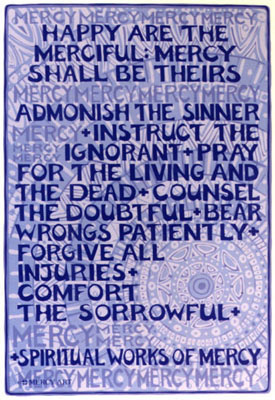
to recommit ourselves to the Spiritual Works of Mercy—
to meeting the deep needs of the soul:
by admonishing the sinner, by instructing the ignorant,
by counseling the doubtful, by comforting the afflicted,
by bearing wrongs patiently, by forgiving offences willingly,
and by praying for the living and the dead.


My friends,
in the way we worship, 
in the way we live each day,
in the way we reach out to needy neighbors,
we ought to be saying before the world, “We have seen the Lord!”
We must be the convincing evidence today
that Jesus is in fact risen from the dead;
that Jesus has entrusted to his Church and her priests the power to forgive sins;
that Jesus remains very much alive and present among us in the Sacrament of his Body and Blood;
that Divine Mercy is flowing freely and desires to fill every soul.

But if we aren’t willing to be those witnesses,
if we aren’t able to give that testimony,
then more than Christ’s tomb will remain empty.

So come—come to 40 Hours!
And then, go—go to announce the good news.