Sunday, August 19, 2012

Chew on This

   Twentieth Sunday in Ordinary Time   B 

Have you ever watched 
a dog chewing on a bone?
It’s a slow, 
drawn out process,
as if there’s nothing else 
going on in the world.

Have you ever watched
 a teenage boy eat supper?
(I mean no offense—
I used to be one!)
The food goes down so fast 
you’d think he’d inhaled it.
It’s simply a matter 
of refueling the machine.

Jesus has talked a lot about eating lately.
Following the multiplication of loaves and fishes,
this is the third Sunday in a row
that we hear from his sermon on the bread of life.

In the original Greek of this Sunday’s passage
from Saint John’s Gospel,
we find two different words for eating.
Four times, Jesus uses the verb phagein,
which indicates the way humans eat:
chewing with your mouth closed.
Whoever “eats” this bread will live forever.
But four other times, Jesus uses the verb trogein,
which indicates the way animals eat:
gnawing on something…taking us back to that dog with a bone.
Whoever “gnaws on” my flesh and drinks my blood
remains in me and I in him.

No wonder Jesus provoked
such a strong reaction among his Jewish listeners!
On the surface, his language is—quite frankly—pretty disturbing.

This little lesson in New Testament Greek
prompts an important reflection:
How do we approach the Eucharist—
as fast food…or slow?
The best way for me
to guarantee a compliment on my homily
is to keep it short.
And that also goes for the whole Mass.
A few times this summer,
when the temperature rose above 90 degrees,
I was right there with you!
No one comes more overdressed to this dinner party than me.
But—in general—what’s the big hurry?
Why this rush to eat and run?

I think some of it has to do
with our Catholic sense of obligation.
We Catholics are obligated to attend Mass
on all Sundays and certain holy days.
That’s how we interpret the third commandment.
It’s the Church’s longstanding teaching
that for us to intentionally skip Sunday Mass
without a serious reason is gravely sinful. (cf. Catechism 2177, 2180-2183)

For centuries, this precept has helped to fill the pews.
But—if not properly understood—
it can mess up our thinking quite a bit.
We’re not obliged to come to church
in the same way we’re obliged to show up for work
if we expect to receive our paycheck.
If we’ve come to think of the Mass as something
we need to check off our religious to do list,
a way to punch our spiritual timecards and so avoid the fires of hell,
then it’s little wonder we’d just want to get it over with
as quickly as possible.
There…I’ve fulfilled my obligation!

It’s getting pretty rare these days,
but occasionally I’ve run into families
who’ve maintained a custom of eating a big Sunday dinner.
Mom—maybe Dad—goes all out in cooking the weekly feast,
and everybody comes together
to share a long, leisurely meal.
The good food is a big part of it.
But even more:
it’s chance for the whole family to come together
to talk about the week; to talk about old times;
to talk about the future and their dreams for it.
It isn’t written as a law,
but there is clearly an obligation to come and eat Sunday dinner.
One has a duty to the family…
…but it isn’t fulfilled merely to stay out of trouble.
It’s about love.
It’s about belonging.
It’s about—pardon the expression—eating like that dog:
slowly, intentionally,
as if there’s nothing else going on in the world.

That—my friends—is our obligation to the Mass!

The Lord has built his house for company
and set his table for feasting.
He sends out messengers with the invitation:
Come, eat of my food and drink of my wine!
Leave behind foolishness; progress in wisdom;
here learn the secret to life!
If you want to fill yourselves,
let it not be on the worldly bread
which generations have eaten and still died.
Fill up on me.
Draw your sustenance from me.
The food I give has the power to make you live forever.
And if you want to drink up,
don’t get drunk on wine.
Instead, become intoxicated with my Spirit,
for I have the ability to not merely lift your feelings,
but to raise you up on the last day.

In the Eucharist,
God is giving you something to chew on.
Even during the dog days of summer,
be sure to take your time.

Wednesday, August 15, 2012

The Assumption of the Blessed Virgin Mary


I fondly recall my father singing this song (well, the refrain, anyway) when I was a child, with both great affection and great gusto.  Little did I know that I was in such good company: it seems that St. Thérèse of Lisieux used to sing it along with her friends, having learned it from her mother.  The story behind this beautiful French hymn to Our Lady is a rather touching one, and its text seems most appropriate to me on this great solemnity.

The Mother of God's high destiny is ours, as well: to be raised in the full integrity of our humanity--body and soul--to heaven.  Where Mary has gone--now dwelling in complete, eternal union with her divine Son--we long one day to follow.

We sang this (although not nearly as well as Patty Griffin does, who first heard it as a lullaby sung by her French Canadian grandmother) at the end of the holy day Mass here at Notre Dame...


J'irai la voir un jour
Au ciel, dans la patrie!
Oui, j'irai voir Marie,
Ma joie et mon amour.

               Au ciel, au ciel, au ciel,
               J'irai la voir un jour!

J'irai la voir un jour!
C'est le cri d'espérance
Qui calme ma souffrance
Au terrestre séjour.

J'irai la voir un jour!
J'irai m’unir aux anges,
Pour chanter ses louanges
Et pour former sa cour.

J'irai la voir un jour,

Cette Vierge si belle!

Bientôt j'irai près d'elle

Lui dire mon amour.

J'irai la voir un jour!

J'irai près de sa trône

Recevoir ma couronne

Dans l'éternel séjour.

J'irai la voir un jour!
J'irai, loin de la terre,
Sur le coeur de ma Mère
Reposer sans retour.
I will go to see her one day,
In heaven, in my homeland!
Yes, I will go to see Mary,
My joy and my love.

               To heaven, to heaven, to heaven,
               I will go to see her one day!

I will go to see her one day!
It is the cry of hope
That calms my suffering
During my earthly stay.

I will go to see her one day!
I will join myself to the angels
In order to sing her praises
And to form her court.

I will go to see her one day,
This Virgin so beautiful!
Soon I will go to be near her
And tell her of my love.

I will go to see her one day!
I will go near her throne
To receive my crown
In eternal rest.

I will go to see her one day!
I’ll go, far from the earth,
To rest without return
On my Mother's heart.

Fr. Pierre Janin (1853)


Sunday, August 12, 2012

Make a Stink

I can almost smell you from here...

   Nineteenth Sunday in Ordinary Time   B 

There was a couple at the 4:00pm Mass yesterday—
they were there last Saturday, too—
that I only see at this time of year.
(They belong to another nearby parish.)
Even if I didn’t already know them personally,
even if they weren’t wearing
their bright red “Eat at Joe-Joe’s” T-shirts,
I would still have known that they were at Mass
while on break from working at a food stand
down at the Franklin County Fair.
How would I have known?
Because I could smell it!
The distinct aroma of fair food—
from sausage to cotton candy to fried dough—
just tends to cling to you.

Saint Paul writes to the Ephesians:
Christ loved us and handed himself over for us
as a sacrificial offering to God for a fragrant aroma.

Part of the great beauty of Catholic worship—
the divine wisdom of the Church’s sacramental system—
is that it takes into account the whole person.
The liturgy is not merely an intellectual pursuit:
a matter of absorbing words and concepts,
and then turning them over in our minds.
No, as we sang in the psalm:
we’re here to “taste and see” the Lord’s goodness—
to partake of a feast for all the senses.
Oh, our communion with God is spiritual, to be sure,
but it comes to us in the form of bodily food:
the taste of wheat as we eat the Bread of Life.
Sight comes into play as we see
the flicker of candles, the color and fold of vestments,
images in statue and stained glass.
We also hear words and music and silence.
We touch the hands of our neighbors in peace,
and even daringly reach out to touch the very Body of Christ.
But smell?  That’s a sense we don’t often take into account…
…and yet even our noses come into play liturgically.


When Saint Paul writes
of the “fragrant aroma” of Christ’s sacrifice,
he’s probably calling to mind 
the huge amounts of incense
used in the Jerusalem temple.
(In the temple, 
the priests burned incense by the shovelful;
I get complaints when I use just a teaspoon!)
Christ’s self-offering in love 
to God on our behalf
should be understood to rise to the Father
like a billowing cloud 
of sweet-smelling smoke.
We aren’t simply to keep burning incense;
we are to imitate 
the pure and pleasing sacrifice it signifies.


The liturgy also gets smelly when we use Sacred Chrism—
one of the Church’s three holy oils,
consecrated by the Bishop and perfumed with balsam.
The Church uses Chrism
in some of its most sacred ceremonies
when someone or something is permanently set aside
to be an image of Christ:
at Baptism; at Confirmation;
in the dedication of a Church or an altar;
twelve years ago today,
my hands were anointed with Sacred Chrism
as I was ordained a priest.

Did you ever have a great aunt who wore too much perfume?
You knew she’d been around, even if you didn’t see her,
simply by sniffing the air.
Or if she gave you a hug, 
the scent would cling to you for hours.
That’s how Chrism is supposed to work!
We Christians—called to be other Christs—
should have an “odor of sanctity” about us:
should be so holy that others can—well—smell it.
That doesn’t mean we are to make a big show
of living our faith in the world.
But if we do as Saint Paul encourages us—
if we remove bitterness, anger, and malice from our midst;
if we are kind, compassionate, and mutually forgiving—
then others will sense—will smell
that there’s something different about us.
And God will smell it, too,
rising up to heaven as a fragrant aroma.

As a priest—as your priest—
my hands have been set aside in a particular way
to carry on the ministry of Christ:
to make of his people, with his people, and for his people
a living sacrifice pleasing to the Father.
Please pray for me that all I lift up in offering with these hands
will be acceptable in the sight of God.


While fair food has a distinct and alluring aroma,
most folks will say that the smell of fresh-baked bread
is one of the most irresistible of all.
It was bread delivered by angels
which strengthened Elijah to overcome his discouragement
and continue on his journey.
It is Jesus—the living bread come down from heaven—
that fortifies us not only to cross the deserts of this passing life,
but to attain to that life which lasts forever.
The Father draws us here—draws us to his Son—
by the smell of this heaven-sent bread.
May the holy aroma of the Eucharist cling to each of us
in a way that stimulates the senses of those around us—
above all, in a way that pleases the very heart of God.


Wednesday, August 8, 2012

Fair Day

A visit from my sister, niece, and nephew yesterday had Fr. Tom and I taking in the joys of a gorgeous afternoon at the Franklin County Fair.  A few highlights...


Sunday, August 5, 2012

Hungry?

   Eighteenth Sunday in Ordinary Time   B 

A rich man came across a poor, hungry beggar.
The rich man asked, “Do you smoke?
I could give you some cigarettes.”
But the beggar replied, “No, I don't smoke.
I’m just want food.”
Then the rich man asked, “Well, do you drink?
I have a bottle of good whiskey 
I could give you.”
But the beggar responded, “No, I don't drink.
I’m just looking for something to eat.”
Finally the rich man asked, “Do you gamble?
I could give you some good tips 
on the races this weekend.”
The beggar again replied, “No.
I’m just hungry and need some food.”
So the rich man said,
“In that case, I’d better take you to my home.”
He loaded the beggar into his fancy car,
drove him to his swanky house,
and there introduced him to his wife.
She immediately asked,
“What are you planning to do with this man?
Are you going to invite him to live with us,
to eat our food and wear our clothes?”
“Heavens, no!” the rich man replied.
“I just wanted to show you what becomes of a man
who doesn’t smoke, drink, or gamble.”

Rich or poor,
on the seashore or in the desert,
we all get hungry.
We have physical appetites for food and drink, for sure.
But we also have longings and desires
for affection and intimacy, for security and belonging,
to understand and to possess.

We all know what happens
when you don’t respond to bodily hungers
with a regular, balanced diet:
you settle for the junk food most quickly and easily available.
Your health suffers for it…
…and—no matter how much of it you eat—
you still can’t seem to shake the hunger.
So, too, with the appetites of mind and soul.
How often we settle for junk!
And we all know, my friends,
that smoking, drinking, and gambling
are just the tip of the iceberg.

St. John Vianney—whose feast was celebrated yesterday—
once put it this way:
Without the Holy Eucharist
there would be no happiness in this world;
life would be insupportable. 
When we receive Holy Communion,
we receive our joy and our happiness. 
The good God,
wishing to give himself to us in the sacrament of his love,
gave us a vast and great desire,
which he alone can satisfy.

Where do you go when you’re hungry—really hungry?
Is there junk food you’ve settled for?
Do you truly recognize the one and only place
where your deepest appetites can be fed?
Are you ready and willing—if necessary—to change your diet?


As Jesus instructed the crowds
miraculously filled by five loaves and two fish,
“Do not work for food that perishes,
but for the food that endures to eternal life.”

May our partaking in the true Bread from heaven
only serve to deepen our hunger
for him alone who can satisfy it.
   

Sunday, July 29, 2012

Winning Isn't Everything


   Seventeenth Sunday in Ordinary Time   B 


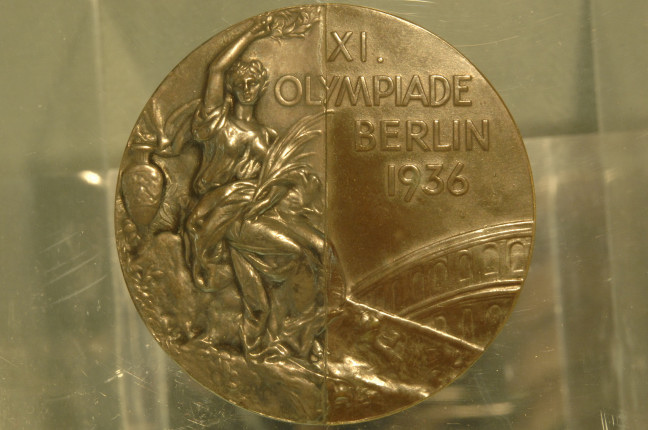
The 1936 Summer Olympics in Berlin
are generally remembered for their controversy.
Hosted by Hitler’s Nazi party,
the original intention was that no Jews or blacks
be allowed to participate in the Games;
at the threat of international boycott,
the organizers relented.

But there’s a little known piece of 1936 Olympic trivia
which has recently caught my attention.
It seems that two Japanese athletes—
Shuhei Nishida and Sueo Oe—
tied for second place in the men’s pole vault.
Rather than continue 
to compete against each other in a jump-off,
the two drew lots for the silver medal.
Nishida won, and Oe took the bronze.
But when the pair got back to Japan,
they had their medals cut in two and then joined together
so that each had a medal which was half silver and half bronze.


For the next few weeks,
the eyes of the world will be fixed on London
and the Olympic Games now underway there.
The Olympics would not be the Olympics, of course,
without competition…but—as stories like that
of the Japanese pole-vaulters remind us—
competition is not their ultimate purpose.
The purpose of the Olympics is not the awarding of medals—
though it is right for us to celebrate excellence and achievement;
no, the purpose of the Olympics
is to bring the world closer together:
first by uniting athletes across competitive borders,
and then by better uniting their nations
in mutual understanding and respect.

If strict competition isn’t the ruling principle
even of the Olympic Games,
then maybe there are some of the other areas of life and society
where we need to reexamine our purpose and priorities.
I think of global economics,
where the gap keeps growing between rich and poor;
where nearly a billion people go to bed hungry each night
while there’s more than sufficient food to feed the world.
I think of national politics,
where the focus has shifted from what’s best for the country
to who wins and who loses—no matter the cost.
I even think of the Church,
where conflicts escalate on so many issues
ranging from liturgy to lifestyles.
But for all the struggle to come out on top,
why does it seem we’re not getting ahead—
in fact, that we’re loosing ground?
Is this what it means to take first place?

Consider how that little boy
brought forward by Andrew on the mountainside
could have easily looked at his little lunch and said:
That’s mine!  I earned it.  I brought it.  Get your own!
But instead, he placed his few loaves and fish in Jesus’ hands
and watched a miracle unfold:
not only that there was more than enough food to go around,
but that, by sharing this simple meal,
a ragtag crowd come from all over
had been changed into a community
reclining on the grass to picnic together in this out of the way place.

“I urge you,” Saint Paul writes to the Ephesians,
“to live in a manner worthy of the call you have received.”
He’s encouraging us to be the very best!
But Paul here doesn’t advocate a fiercely competitive spirit
where triumph comes at great expense to others;
rather, he’s summoning us to a humble striving
that preserves unity and strengthens the bonds of peace.  

Just imagine how different our times would be
if we each did our very best every day—
not for our own glory, but for God’s!


In 1936, a world on the brink of war
desperately needed the example of two Japanese pole-vaulters,
telling it that there’s something much more important than winning.
In 2012, when so many things still divide us,
the world very much stands in need of the same message.
May this message come not only from the Olympic Games,
but even more from those of us who are disciples of Jesus Christ:
who have in common one Lord, one faith, one baptism.
Continually brought closer together in one body by the Eucharist,
may our increasing unity give living witness
to the one God and Father of all.
Yes, we may need to lay aside some of our competitiveness…
…but let’s not neglect to go for the gold!
     

Thursday, July 26, 2012

St. Ann

As I mentioned last year, St. Ann has a pretty special place in my heart...so this afternoon, Fr. Tom and I make a quick pilgrimage to her shrine in Isle LaMotte, Vermont.  It wasn't the prettiest day to enjoy the view there on the eastern shore of Lake Champlain (the overcast skies were bringing us just a little bit of much needed rain), but it was well worth the drive, nonetheless...


Good Saint Ann,
pray for us!