Sunday, August 12, 2012

Make a Stink

I can almost smell you from here...

   Nineteenth Sunday in Ordinary Time   B 

There was a couple at the 4:00pm Mass yesterday—
they were there last Saturday, too—
that I only see at this time of year.
(They belong to another nearby parish.)
Even if I didn’t already know them personally,
even if they weren’t wearing
their bright red “Eat at Joe-Joe’s” T-shirts,
I would still have known that they were at Mass
while on break from working at a food stand
down at the Franklin County Fair.
How would I have known?
Because I could smell it!
The distinct aroma of fair food—
from sausage to cotton candy to fried dough—
just tends to cling to you.

Saint Paul writes to the Ephesians:
Christ loved us and handed himself over for us
as a sacrificial offering to God for a fragrant aroma.

Part of the great beauty of Catholic worship—
the divine wisdom of the Church’s sacramental system—
is that it takes into account the whole person.
The liturgy is not merely an intellectual pursuit:
a matter of absorbing words and concepts,
and then turning them over in our minds.
No, as we sang in the psalm:
we’re here to “taste and see” the Lord’s goodness—
to partake of a feast for all the senses.
Oh, our communion with God is spiritual, to be sure,
but it comes to us in the form of bodily food:
the taste of wheat as we eat the Bread of Life.
Sight comes into play as we see
the flicker of candles, the color and fold of vestments,
images in statue and stained glass.
We also hear words and music and silence.
We touch the hands of our neighbors in peace,
and even daringly reach out to touch the very Body of Christ.
But smell?  That’s a sense we don’t often take into account…
…and yet even our noses come into play liturgically.


When Saint Paul writes
of the “fragrant aroma” of Christ’s sacrifice,
he’s probably calling to mind 
the huge amounts of incense
used in the Jerusalem temple.
(In the temple, 
the priests burned incense by the shovelful;
I get complaints when I use just a teaspoon!)
Christ’s self-offering in love 
to God on our behalf
should be understood to rise to the Father
like a billowing cloud 
of sweet-smelling smoke.
We aren’t simply to keep burning incense;
we are to imitate 
the pure and pleasing sacrifice it signifies.


The liturgy also gets smelly when we use Sacred Chrism—
one of the Church’s three holy oils,
consecrated by the Bishop and perfumed with balsam.
The Church uses Chrism
in some of its most sacred ceremonies
when someone or something is permanently set aside
to be an image of Christ:
at Baptism; at Confirmation;
in the dedication of a Church or an altar;
twelve years ago today,
my hands were anointed with Sacred Chrism
as I was ordained a priest.

Did you ever have a great aunt who wore too much perfume?
You knew she’d been around, even if you didn’t see her,
simply by sniffing the air.
Or if she gave you a hug, 
the scent would cling to you for hours.
That’s how Chrism is supposed to work!
We Christians—called to be other Christs—
should have an “odor of sanctity” about us:
should be so holy that others can—well—smell it.
That doesn’t mean we are to make a big show
of living our faith in the world.
But if we do as Saint Paul encourages us—
if we remove bitterness, anger, and malice from our midst;
if we are kind, compassionate, and mutually forgiving—
then others will sense—will smell—
that there’s something different about us.
And God will smell it, too,
rising up to heaven as a fragrant aroma.

As a priest—as your priest—
my hands have been set aside in a particular way
to carry on the ministry of Christ:
to make of his people, with his people, and for his people
a living sacrifice pleasing to the Father.
Please pray for me that all I lift up in offering with these hands
will be acceptable in the sight of God.


While fair food has a distinct and alluring aroma,
most folks will say that the smell of fresh-baked bread
is one of the most irresistible of all.
It was bread delivered by angels
which strengthened Elijah to overcome his discouragement
and continue on his journey.
It is Jesus—the living bread come down from heaven—
that fortifies us not only to cross the deserts of this passing life,
but to attain to that life which lasts forever.
The Father draws us here—draws us to his Son—
by the smell of this heaven-sent bread.
May the holy aroma of the Eucharist cling to each of us
in a way that stimulates the senses of those around us—
above all, in a way that pleases the very heart of God.


Wednesday, August 8, 2012

Fair Day

A visit from my sister, niece, and nephew yesterday had Fr. Tom and I taking in the joys of a gorgeous afternoon at the Franklin County Fair.  A few highlights...


Sunday, August 5, 2012

Hungry?

   Eighteenth Sunday in Ordinary Time   B 

A rich man came across a poor, hungry beggar.
The rich man asked, “Do you smoke?
I could give you some cigarettes.”
But the beggar replied, “No, I don't smoke.
I’m just want food.”
Then the rich man asked, “Well, do you drink?
I have a bottle of good whiskey 
I could give you.”
But the beggar responded, “No, I don't drink.
I’m just looking for something to eat.”
Finally the rich man asked, “Do you gamble?
I could give you some good tips 
on the races this weekend.”
The beggar again replied, “No.
I’m just hungry and need some food.”
So the rich man said,
“In that case, I’d better take you to my home.”
He loaded the beggar into his fancy car,
drove him to his swanky house,
and there introduced him to his wife.
She immediately asked,
“What are you planning to do with this man?
Are you going to invite him to live with us,
to eat our food and wear our clothes?”
“Heavens, no!” the rich man replied.
“I just wanted to show you what becomes of a man
who doesn’t smoke, drink, or gamble.”

Rich or poor,
on the seashore or in the desert,
we all get hungry.
We have physical appetites for food and drink, for sure.
But we also have longings and desires
for affection and intimacy, for security and belonging,
to understand and to possess.

We all know what happens
when you don’t respond to bodily hungers
with a regular, balanced diet:
you settle for the junk food most quickly and easily available.
Your health suffers for it…
…and—no matter how much of it you eat—
you still can’t seem to shake the hunger.
So, too, with the appetites of mind and soul.
How often we settle for junk!
And we all know, my friends,
that smoking, drinking, and gambling
are just the tip of the iceberg.

St. John Vianney—whose feast was celebrated yesterday—
once put it this way:
Without the Holy Eucharist
there would be no happiness in this world;
life would be insupportable. 
When we receive Holy Communion,
we receive our joy and our happiness. 
The good God,
wishing to give himself to us in the sacrament of his love,
gave us a vast and great desire,
which he alone can satisfy.

Where do you go when you’re hungry—really hungry?
Is there junk food you’ve settled for?
Do you truly recognize the one and only place
where your deepest appetites can be fed?
Are you ready and willing—if necessary—to change your diet?


As Jesus instructed the crowds
miraculously filled by five loaves and two fish,
“Do not work for food that perishes,
but for the food that endures to eternal life.”

May our partaking in the true Bread from heaven
only serve to deepen our hunger
for him alone who can satisfy it.
   

Sunday, July 29, 2012

Winning Isn't Everything


   Seventeenth Sunday in Ordinary Time   B 


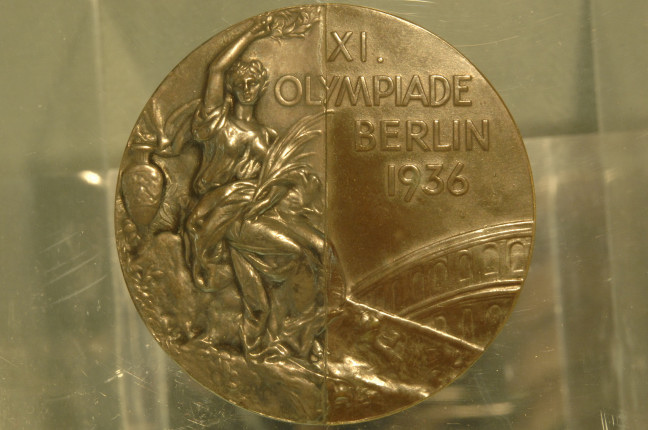
The 1936 Summer Olympics in Berlin
are generally remembered for their controversy.
Hosted by Hitler’s Nazi party,
the original intention was that no Jews or blacks
be allowed to participate in the Games;
at the threat of international boycott,
the organizers relented.

But there’s a little known piece of 1936 Olympic trivia
which has recently caught my attention.
It seems that two Japanese athletes—
Shuhei Nishida and Sueo Oe—
tied for second place in the men’s pole vault.
Rather than continue 
to compete against each other in a jump-off,
the two drew lots for the silver medal.
Nishida won, and Oe took the bronze.
But when the pair got back to Japan,
they had their medals cut in two and then joined together
so that each had a medal which was half silver and half bronze.


For the next few weeks,
the eyes of the world will be fixed on London
and the Olympic Games now underway there.
The Olympics would not be the Olympics, of course,
without competition…but—as stories like that
of the Japanese pole-vaulters remind us—
competition is not their ultimate purpose.
The purpose of the Olympics is not the awarding of medals—
though it is right for us to celebrate excellence and achievement;
no, the purpose of the Olympics
is to bring the world closer together:
first by uniting athletes across competitive borders,
and then by better uniting their nations
in mutual understanding and respect.

If strict competition isn’t the ruling principle
even of the Olympic Games,
then maybe there are some of the other areas of life and society
where we need to reexamine our purpose and priorities.
I think of global economics,
where the gap keeps growing between rich and poor;
where nearly a billion people go to bed hungry each night
while there’s more than sufficient food to feed the world.
I think of national politics,
where the focus has shifted from what’s best for the country
to who wins and who loses—no matter the cost.
I even think of the Church,
where conflicts escalate on so many issues
ranging from liturgy to lifestyles.
But for all the struggle to come out on top,
why does it seem we’re not getting ahead—
in fact, that we’re loosing ground?
Is this what it means to take first place?

Consider how that little boy
brought forward by Andrew on the mountainside
could have easily looked at his little lunch and said:
That’s mine!  I earned it.  I brought it.  Get your own!
But instead, he placed his few loaves and fish in Jesus’ hands
and watched a miracle unfold:
not only that there was more than enough food to go around,
but that, by sharing this simple meal,
a ragtag crowd come from all over
had been changed into a community
reclining on the grass to picnic together in this out of the way place.

“I urge you,” Saint Paul writes to the Ephesians,
“to live in a manner worthy of the call you have received.”
He’s encouraging us to be the very best!
But Paul here doesn’t advocate a fiercely competitive spirit
where triumph comes at great expense to others;
rather, he’s summoning us to a humble striving
that preserves unity and strengthens the bonds of peace.  

Just imagine how different our times would be
if we each did our very best every day—
not for our own glory, but for God’s!


In 1936, a world on the brink of war
desperately needed the example of two Japanese pole-vaulters,
telling it that there’s something much more important than winning.
In 2012, when so many things still divide us,
the world very much stands in need of the same message.
May this message come not only from the Olympic Games,
but even more from those of us who are disciples of Jesus Christ:
who have in common one Lord, one faith, one baptism.
Continually brought closer together in one body by the Eucharist,
may our increasing unity give living witness
to the one God and Father of all.
Yes, we may need to lay aside some of our competitiveness…
…but let’s not neglect to go for the gold!
     

Thursday, July 26, 2012

St. Ann

As I mentioned last year, St. Ann has a pretty special place in my heart...so this afternoon, Fr. Tom and I make a quick pilgrimage to her shrine in Isle LaMotte, Vermont.  It wasn't the prettiest day to enjoy the view there on the eastern shore of Lake Champlain (the overcast skies were bringing us just a little bit of much needed rain), but it was well worth the drive, nonetheless...


Good Saint Ann,
pray for us!

Sunday, July 22, 2012

Relax

Hope you can enjoy a day of rest...

   Sixteenth Sunday in Ordinary Time   B 


Sherlock Holmes and Dr. Watson 
went on a camping trip.
As they lay down for the night, Holmes said:
“Watson, look up into the sky 
and tell me what you see.”

Watson replied, “I see millions and millions of stars.”

"And what does that tell you, Watson?"

“Astronomically, 
it tells me that there are millions of galaxies

and potentially billions of planets.
Theologically, 
it tells me that God is great
and that we are small and insignificant.
Meteorologically, 
it tells me that we will have 
a beautiful day tomorrow.
What does it tell you, Holmes?”
“It tells me, my dear Watson, 
that somebody has stolen our tent.”


I spent this past week 
“camping,” after a fashion,
serving as the chaplain to 70 teenaged campers
and the staff at Camp Guggenheim.
It wasn’t exactly vacation:
I offered daily Mass, heard confessions,
led prayer, helped with workshops,
and took part in all the many 
summer camp activities
which kept me up well past my usual bedtime.
But it was a refreshing change of pace, nonetheless,
that gave me the opportunity
to climb a mountain, get out in my kayak,
eat a few more ice cream cones 
than I probably should,
and even stop to look up 
and marvel at the stars.

Coming back from these days—paradoxically—
both a little more sleepy and a little more relaxed than usual,
I smiled widely to come across the following reflection yesterday morning:

Modern life is lived at high tension;
its pace is intense and nerves get frayed.  
Whatever it costs,
we must learn how to stop, when we need to,
and draw a quiet breath.…
[W]e must still learn how to relax…

In order to acquire this art,
we must learn particularly how to take advantage
of the little opportunities life has to offer
and become children at heart again.
We must not live at such an intensive, hustling pace
that we no longer have time to…have time.
To be relaxed makes one accessible to others.…

We must learn, or re-learn, to have time.
Our Lord himself did not want his apostles
to live in a state of perpetual tension.
He urged them to “come away into a quiet place”:
“rest a little”, he said to them
on days after they had finished their apostolic missions.  
In the wilderness and in solitude,
he revealed to them the best of himself and his message.…

We stand in need of rest;
rest in the ordinary sense of the word,
and also rest in God.  
We must find a place for him in the bustle of the day;
a place for private prayer, for slow and meditative reading.
We need this “oxygen.”
No luxury this; it is one of our vital necessities.…
In the midst of work,
we must keep our hearts open to God.
It helps so much to keep things in their proper proportion
if we keep a window open to heaven.…

We need to get our breath back.
That is why the Church is so insistent
on Sunday being kept as a holy day;
a day for public worship, certainly,
but also a day of rest.…
We must stop,
like the [mountain] climber who has reached a high peak,
to take breath for a moment, admire the view,
fill our lungs with fresh air and go on to the next peak.…
Do not let us neglect to fix our gaze on the sky
until we can see the stars there.
We make much better headway here on earth
when we have a sense of direction
and move forward with a firm step on solid ground.
Looking at the heavens is the form of relaxation
we can least dispense with
if we want to keep things in their perspective
and make the world a better place to live.  (Christian Life Day by Day)*


Those words are so apropos today!
Incredibly, they were written by 
Leon Joseph Cardinal Suenens of Belgium
all the way back in 1961—
a time to which we very well 
might look back now 
as a far simpler one…


During these last several days,
our hearts—like Christ’s—have been moved with pity
at news of fatal car accidents and damaging storms
here in the North Country,
and the senseless shooting in Colorado that tore apart
what should have been an enjoyable evening at the movies.
Things can seem completely run amok—
people running about like sheep without a shepherd.
How crucial for us to remember
that Christ Jesus came preaching peace—
peace to those both far and near!
We need to stay in touch with that peace.
We need to re-learn how to relax—
not just because we want to be rested when we get back to work,
but because “to be relaxed makes one accessible to others,”
and accessible to God above all else.


On these clear summer nights,
let’s all take some time to step out and look up at the stars,
catching our breath and—even for just a moment—
resting in the God who made them.

*The entire book is available online here;  
these passages are excerpted from chapter 27, "Learning to Relax," which begins on page 95.